Most wig cap net complaints do not start in the factory. They start in a quotation that never defined the mesh. A buyer approves a sample that stretches comfortably over a 56 cm block, places 20,000 pieces, and receives a lot that weighs 22% less per piece and splits at the hem after two wearings. Nothing on the paperwork was violated, because the paperwork only said “black wig net, 40D”.
The word invisible has the same problem. One supplier means a 3 mm diamond mesh in black; another means a 2 mm matte nude net with a bonded edge. Both are honest, and both disappoint a buyer who expected the other. This guide covers the four specifications that decide whether a net cap works — denier, mesh, stretch and recovery, pack density — plus the price bands and arrival checks. Figures are typical commercial ranges from production in Xuchang, Henan, China, not guarantees for one order.
What buyers actually mean by a wig cap net
Three different products travel under the same name, and each is specified differently.
A net cap is the open-mesh item most people picture: a fishnet dome with a diamond opening, an elastic or folded hem, and a flat circumference of roughly 44–48 cm that stretches to 58–64 cm. Salons use it to compress and hold a client’s natural hair under a wig. Wig brands use it as a breathable base layer or as a disposable hygiene cap in try-on rooms.
A dome cap is knitted far denser, often 40–60 stitches per 10 cm, and reads as near-opaque. It is a wig foundation, judged on seam placement and colour match rather than mesh openness. A mesh liner is stitched inside a finished wig to the weft rows, usually as cut panels, and its denier is chosen for seam strength, not appearance.
Before any price discussion, ask for flat circumference, stretched circumference at break, mesh opening in millimetres, and weight per piece. A supplier who cannot answer those four numbers in writing is quoting a look, not a product. The same discipline applies when you compare MOQ, lead times and pricing structures across a category.
Denier: the single number that sets sheer, strength and price
Denier is the weight in grams of 9,000 metres of yarn. It is a linear density rather than a diameter, but in nylon netting the two track closely: 20D yarn measures about 0.05 mm, 40D about 0.07 mm, 70D about 0.09 mm. Thin yarn disappears against skin; thick yarn survives handling. You cannot have both in one cap.
| Yarn | Where it fits | Weak point | Relative price |
|---|---|---|---|
| 20D | Bridal and editorial try-on caps; nude tones | Snags on nails and comb teeth; 8–12% packing loss | Highest |
| 30D | Retail two-packs, salon disposables | Hem pulls if the elastic is under-cured | Mid-high |
| 40D | Wholesale default: wig bases, salon bulk | Visible on very dark hair if mesh is coarse | Baseline |
| 70D | Reusable caps, laundry-tested school supply | Reads as thick netting; kills an invisible claim | Lowest |
The quality risk sits between 30D and 40D, because the two feel almost identical in the hand. A 40D lot switched to 30D loses roughly 20–25% of its weight per piece and about the same share of tensile strength, while the piece price falls by only USD 0.01–0.02. That reads as a saving on the invoice and becomes a claims problem in the salon, where the net splits at the crown during a fitting.
The cheap test is a kitchen scale and a ruler. Weigh ten pieces: a 40D net in 3 mm mesh typically lands at 6.0–7.5 g, a 30D at 4.5–5.8 g. Then stretch one cap to 60 cm and hold for 30 seconds. If the yarn whitens at the intersections, the lot is finer than stated or was over-stretched during finishing.
Mesh size and hole shape: 2 mm, 3 mm and 4 mm
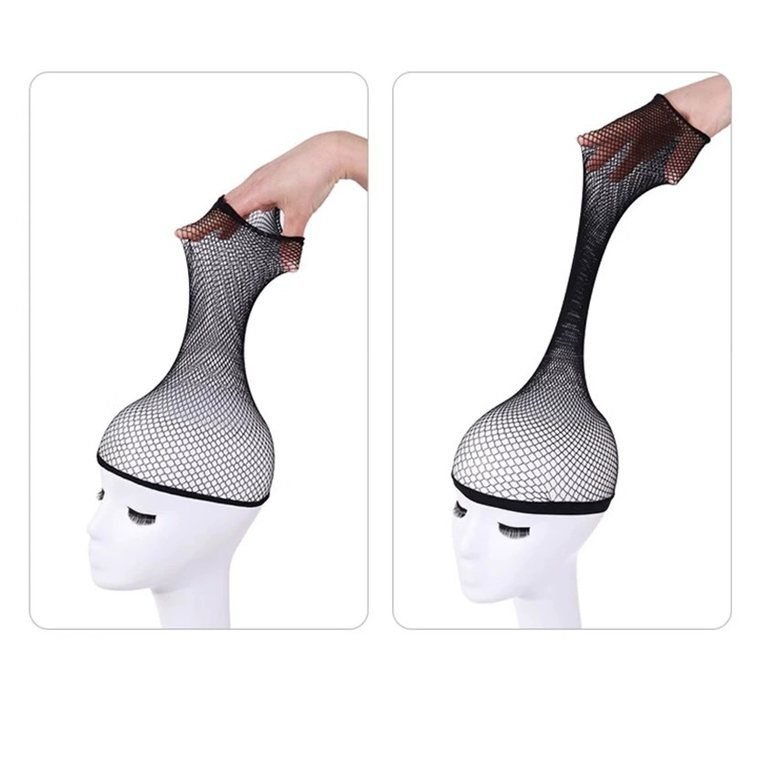
Mesh opening is measured between yarn centres, not between the visible gaps, and the difference matters when two suppliers both quote “3 mm”. Ask for the method in writing: flat, or at 50% extension. The same net measures 4 mm flat and 2.8 mm stretched.
4 mm diamond. The most breathable option and the cheapest to knit. Air moves freely, which suits stage, cosplay and dance work where a cap sits under a wig for two hours. The trade-off: fine human hair pushes through the openings, and the cap reads as fishnet rather than foundation if worn alone.
3 mm diamond. The wholesale standard for wig bases. It holds blunt-cut hair without poking through, sits flat under a lace front, and knits at a commercially sensible speed. Most 40D black nets on the market sit here.
2 mm diamond or hex. The only mesh that supports an honest invisible claim, because the openings are small enough to break up the pattern at reading distance. It costs more for two reasons: knitting speed drops by roughly a third, and the tighter structure needs a finer yarn to avoid a stiff, board-like hand.
Match yarn to mesh. A 20D yarn in a 4 mm opening slides at the knots and produces run-prone holes; a 70D yarn in a 2 mm opening cannot knit without crowding. Workable pairings are 20–30D with 2 mm, 30–40D with 3 mm, and 40–70D with 4 mm. Anything outside that needs a sample before a purchase order.
Stretch, recovery and the elastic hem
A net cap is a stretch article, so flat dimensions alone tell you very little. Specify four numbers: flat circumference, stretched circumference before yarn break, recovery after three cycles, and hem construction.
Commercial caps run 44–48 cm flat and 58–64 cm at break. Recovery should hold at 90% or better, measured by extending to 1.5× flat, holding 30 seconds, releasing for 60 seconds, then re-measuring. A cap that returns at 85% feels loose after a month of salon use and will not stay on a 52 cm head.
The hem is where most failures start. Three constructions are common: a 6–8 mm elastic band folded and stitched, a folded hem with spandex thread laid in, and a bonded edge. The elastic band is the most durable and easiest to inspect; the bonded edge is flattest and most prone to delamination in a hot container.
Ask what cure or heat-set step the hem receives. Under-cured elastic is the most common cause of “it went slack after five washes” complaints, and it is invisible at sample stage because a fresh cap always recovers well. A three-cycle wash test on three pieces before shipment costs almost nothing and catches it.
Thread choice matters too. Monofilament nylon gives a crisp, low seam but can scratch a scalp; textured nylon is softer and bulkier, and tends to lower complaint rates in salon use.
Colour, dye lot and what “invisible” can honestly mean
Black is the hardest colour to keep consistent, not the easiest. Different dye baths produce shifts that are visible at ΔE 1.5–3, and a net is thin enough that the shift reads as a grey or brown cast against dark hair. Nude ranges are worse in a different way: there is no industry standard for “light beige”, so six suppliers ship six colours under the same name.
Two controls fix it. Approve colour against a physical standard rather than a screen — a Pantone chip plus a signed production sample, held by both sides. Then write a tolerance into the purchase order: ΔE ≤ 1.5 on a spectrophotometer, or 4–5 on the grey scale for visual checks under D65 light. Without a number, “close to the sample” is unenforceable.
Be equally precise in your own marketing. What the product can support is a combination: mesh at 2 mm or finer, a matte yarn that does not catch light at the edge, a hem that sits flat rather than rolled, and a colour within two shades of the wearer’s scalp. What it cannot support is “completely undetectable”. Buyers who write the second claim inherit every return.
Retain three pieces per lot, sealed, labelled with the lot number and signed by both parties, for 12 months. When a dispute arrives in month four, the retained sample settles it in ten minutes instead of a month of photographs.
Weight per piece and why it moves your freight bill
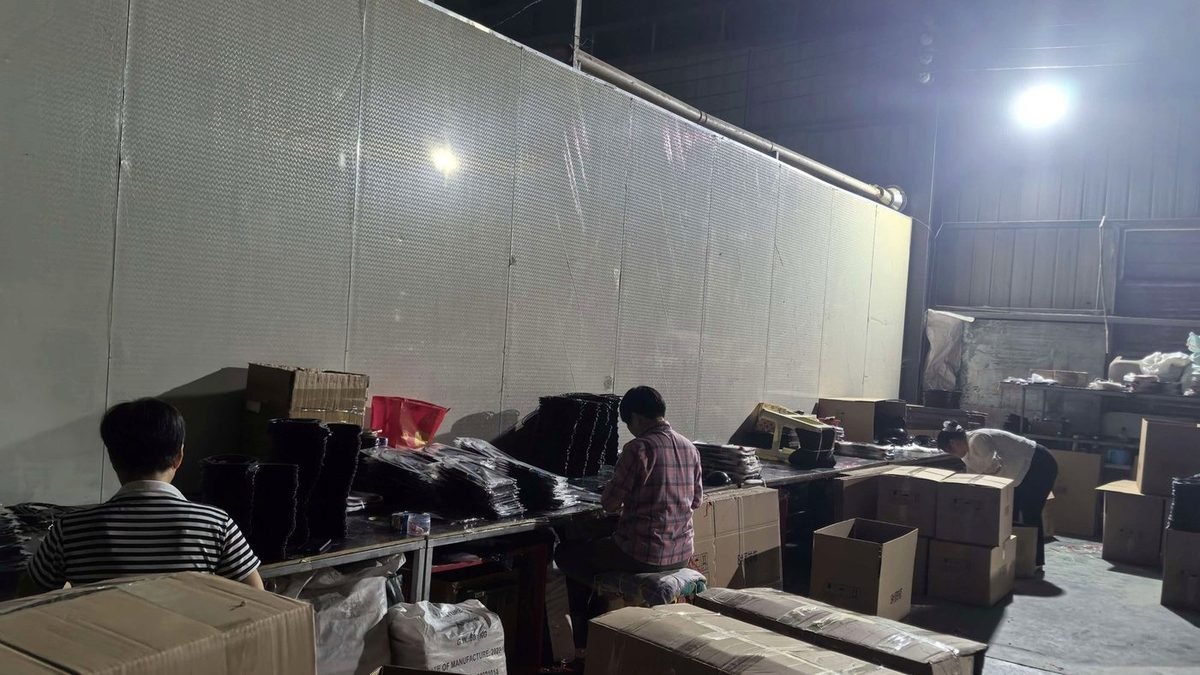
A net cap weighs 4–9 g. A thousand pieces weigh under 9 kg, which means ocean freight is never calculated on weight for this product. It is calculated on volume, and volume is set by how the caps are packed.
The standard bulk pack is 100 pieces per OPP bag, 10 bags per carton, giving 1,000 pieces in a carton of roughly 55 × 38 × 32 cm, or 0.067 CBM. A 40HQ of about 68 CBM therefore holds roughly 1,000 cartons on paper; plan on 60–70% of theoretical because cartons do not stack perfectly and pallets waste height.
Retail packaging changes the arithmetic fast. Hanging cards at 12 pieces per card, with a euro slot and printed backing, typically triple the packed volume per piece. The caps weigh the same, but freight per piece can rise from about USD 0.004 to USD 0.012 on a 40HQ at USD 2,800 — real money on a product selling at USD 0.10.
| Pack format | Pcs / carton | CBM / carton | Board grade |
|---|---|---|---|
| 100 pcs / OPP bag, bulk | 1,000 | 0.067 | ECT-32 single wall |
| 12 pcs / hanging card | 288 | 0.085 | ECT-32 single wall |
| Compressed, flat-packed | 2,000 | 0.058 | ECT-44 double wall |
Compression is worth the conversation. Nets laid flat and stacked rather than bulked loosely can double carton density, but the hem takes a set and the cap needs a few minutes to recover before it fits properly. Acceptable for salon disposables, not for retail.
Unit price bands and what sits behind them
FOB prices for net caps land in three bands. Basic black 40D in 3 mm mesh, bulk packed, runs about USD 0.06–0.12 per piece at 1,000–5,000 pieces. Matte nude 20–30D in 2 mm mesh with a bonded hem and colour control runs USD 0.15–0.30. Retail-ready versions on a printed hanging card add roughly USD 0.03–0.06 in material and labour.
Custom dyeing adds USD 0.01–0.02 per piece but only clears at 3,000 pieces per colour, because a dye bath has a minimum load. That is the number that kills most “eight colours in our first order” plans: eight colours at 3,000 pieces each is 24,000 pieces, not 3,000.
Compare landed cost, not piece price. A 1,000-piece trial at USD 0.09 is USD 90 of goods; air freight on 0.07 CBM often costs USD 60–90, which doubles the landed unit cost. Sea freight on the same volume is USD 15–25 but adds 30–40 days. For a first order the honest comparison is total cost of getting sellable stock onto a shelf, divided by pieces that survive handling. Our shipping and export page sets out how both options are quoted.
The spec sheet that stops a bad lot
Eight lines on a purchase order prevent most of what goes wrong in this category. Anything unwritten is treated as supplier’s discretion in a dispute.
- Fibre: nylon 6 or nylon 66, stated explicitly. They dye differently and do not mix in one lot.
- Denier with tolerance: 40D ±10%, not “40D”.
- Mesh: opening in mm, hole shape, and the extension at which it is measured.
- Dimensions: flat circumference and stretched circumference at break.
- Weight per piece: 6.0–7.5 g, with a stated sample size for the check.
- Colour: reference to an approved physical standard plus ΔE tolerance.
- Pack: pieces per bag, bags per carton, carton dimensions, board grade, label content.
- Inspection: AQL 2.5 for major defects, with a named list of what counts as major.
Two clauses are worth adding beyond the specification. First, a pre-production sample signed by both parties, with the production lot held against it. Second, a defect definition: a hole over 3 mm, a broken hem stitch run over 10 mm and a colour shift above ΔE 1.5 are major; a loose thread under 5 mm is minor. Defined terms turn an argument into a count.
If the order also includes stands, combs or bottles, consolidate the specification into one document per SKU. Our OEM and ODM process uses the same eight-line structure across categories, which makes reorders predictable.
Four checks on arrival that catch most defects
Incoming inspection for net caps takes about twenty minutes per lot and needs no laboratory.
Weigh ten pieces. Average them against the specified range. A 15% shortfall is a denier or yield problem, and it surfaces as tearing within weeks of sale.
Stretch three pieces to the specified limit and hold 30 seconds. Watch the knots. Whitening at the intersections means the yarn is over-stressed; a run opening beyond 5 mm means the mesh was knitted too loose for that yarn.
Fit one cap on a block two centimetres larger than your target head size. It should sit flat at the hairline without rolling, and the hem should not lift when the wearer turns their head.
Check colour against the retained sample in daylight, not office lighting. Fluorescent tubes push black toward blue and make nude tones look warmer than they are, which is how a rejectable lot gets accepted.
Photograph each check with the lot number visible and keep the images with the retained samples. Claims filed within 14 days, with that evidence, are usually settled at credit or replacement; claims filed in month three are argued. Apply the same discipline to wig stands, where carton damage is the usual issue.
Two things are worth doing before the next enquiry. First, rewrite the specification using the eight lines above and send it with the enquiry, not after the quotation. Suppliers quote what they are asked for, and a specification with tolerances returns comparable prices instead of three quotes for three different products.
Second, run a 1,000-piece trial in the pack format you intend to sell. Bulk pricing on a product that ships on hanging cards hides the freight difference until the container is booked. If you are still choosing, send us the target channel and head size range and we will quote both against 0.067 CBM and 0.085 CBM.
Leave a Reply