Author: admin

  • Men’s Styling Combs for Wholesale: Tooth Pitch, Material and Pocket Format Specs

    Men’s Styling Combs for Wholesale: Tooth Pitch, Material and Pocket Format Specs

    A photo of a black comb on a white background is not a specification. Buyers send us that photo every week, we quote from it, and four times out of five the sample comes back with the wrong tooth pitch, a spine that flexes too much in the hand, or flash along every tooth edge. It looks identical in the photo, sells badly, and somebody eats the air freight on a re-run.

    The cause is that “men’s comb” covers four different products with different dimensions, and the variables that decide whether a comb feels expensive — pitch, tooth taper, root radius, spine thickness, resin shrinkage, edge finishing — are invisible in a picture. What follows are the numbers we work to at our moulding plant in Xuchang, Henan, China, so you can write a spec sheet instead of sending a photo, and cost a men’s comb programme before you commit to tooling.

    Four shapes that all get ordered as “a men’s comb”

    The first split is not material or colour, it is format. A pocket comb, a barber taper comb, a fork or rake comb and a beard comb are moulded on different tools, packed in different cartons and sold off different shelves. Mixing them up in one purchase order is the most common cause of a sample rejection nobody can explain.

    Format Length Weight Teeth Where it sells
    Pocket comb 100–130 mm 12–18 g 18–26 per side Gift sets, grooming, hotel amenity
    Barber taper comb 178–203 mm 20–28 g 22–28, two pitches Salon supply, clipper kits
    Fork / rake comb 185–210 mm 22–32 g 14–20 wide + 4–6 tines Barber retail, styling kits
    Beard comb 90–110 mm 10–14 g 12–18, coarse Beard oil bundles, subscription boxes

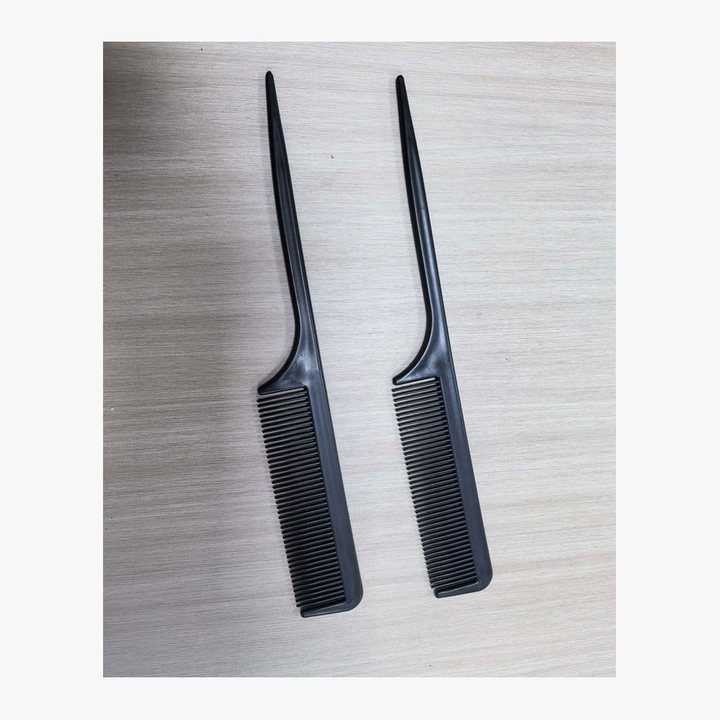
    The fork or rake comb is the one that trips buyers up: a wide-tooth face for lifting and separating, a tined face for raking product through, and on some designs a three-prong tail that doubles as a part picker. It is not a scaled-up pocket comb, and it cannot be produced from a pocket-comb mould by swapping an insert.
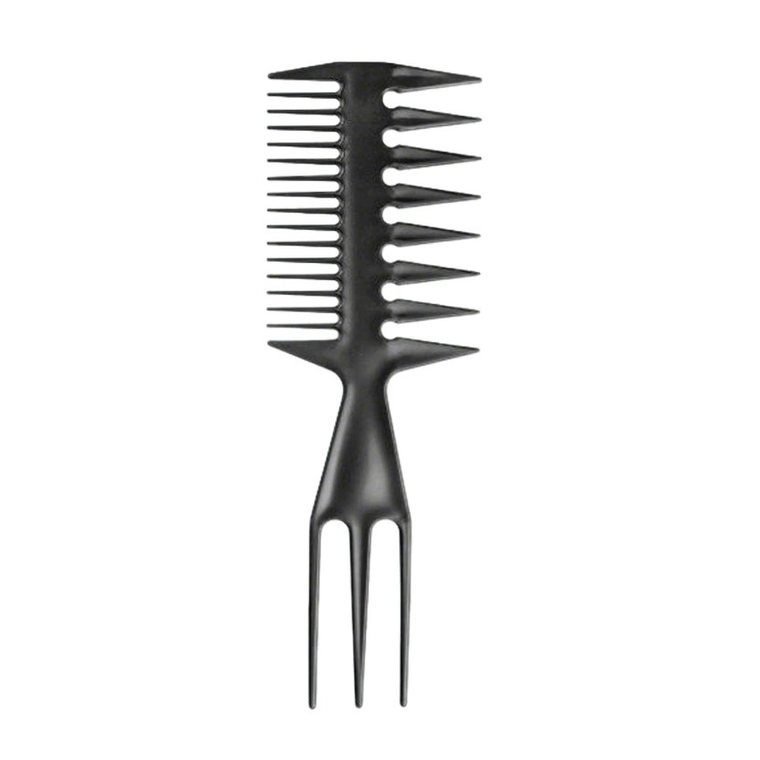
    Black double-sided fork and rake men's styling comb GP-ST05 with wide teeth and three-prong tail, moulded by Globaplas
    Fork and rake comb GP-ST05: wide-tooth face one side, five tines the other, three-prong tail. Two slides, one tool.

    Tooth pitch: the number that decides how a comb feels

    Pitch is the centre-to-centre distance between two teeth. It sits between 1.2 mm and 3.0 mm on men’s combs, roughly 8 to 21 teeth per inch. Below 1.2 mm you have a fine-hair comb, and in PP the teeth deflect permanently after a few months of pocket carry. Above 3.0 mm the comb stops gripping and slides through the hair without doing anything.

    Three dimensions move with pitch and are almost never written on a purchase order.

    Tooth tip thickness — 0.8 mm to 1.2 mm at the point. A 1.2 mm tip on a 1.6 mm pitch leaves 0.4 mm of gap, which is the difference between a comb that glides and one that drags. Tips under 0.7 mm feel sharp and will fail a hand-feel check in a salon.

    Tooth depth — 12 mm to 22 mm from tip to spine on a barber comb, 8 mm to 12 mm on a pocket comb. Deeper teeth flex more. When a buyer says a comb “bends too much”, the fix is usually depth and spine, not a different resin.

    Root radius — the fillet where tooth meets spine. Keep it at 0.25 mm minimum. A sharp internal corner is a stress riser: the tooth cracks at the root on the first drop and the crack runs along the spine. It is a tooling detail, cut into the cavity, and it costs nothing to specify.

    We hold pitch to ±0.15 mm across cavities on a 12-cavity tool, and we check it with a go/no-go pitch gauge at the machine rather than a caliper on the first part of the shift. Ask for both the tolerance and the method.

    Material: PP, ABS, glass-filled PP or acetate

    Resin sets shrinkage, and shrinkage sets whether the pitch you drew is the pitch you ship. PP shrinks 1.2–1.8%, ABS 0.4–0.7%, 30% glass-filled PP 0.2–0.5%. On a 1.8 mm pitch, a 1.5% difference across a long spine shows up as a bow, and a bowed comb will not sit flat in a blister.

    Resin Density Shrink Hand feel FOB band, USD/pc
    PP homopolymer 0.90–0.91 1.2–1.8% Light, flexible, matte 0.14–0.30
    ABS 1.04–1.06 0.4–0.7% Rigid, dense, gloss 0.20–0.42
    30% glass-filled PP 1.05–1.15 0.2–0.5% Stiff, dry, heat-stable 0.45–0.85
    Cellulose acetate 1.28–1.32 0.4–0.8% Warm, heavy, saw-cut teeth 0.90–2.20

    Acetate combs are not moulded: the sheet is cast or extruded, the profile cut, the teeth sawed and polished — which is why one acetate comb can cost more than five PP ones. A buyer who sends an acetate reference and asks for 0.35 will be quoted a PP substitute, and the substitution shows in the hand.

    Heat deflection sits around 90–105°C for PP, 80–95°C for ABS and 70–80°C for acetate, so an acetate comb left on a dashboard bends and stays bent. On glass-filled PP, budget for an antistatic masterbatch: plain GF-PP at 10^12 ohm surface resistivity still pulls lint in a dry retail environment, and a dusty comb does not sell.

    For the flex and drop tests behind those figures, see our comb material comparison.
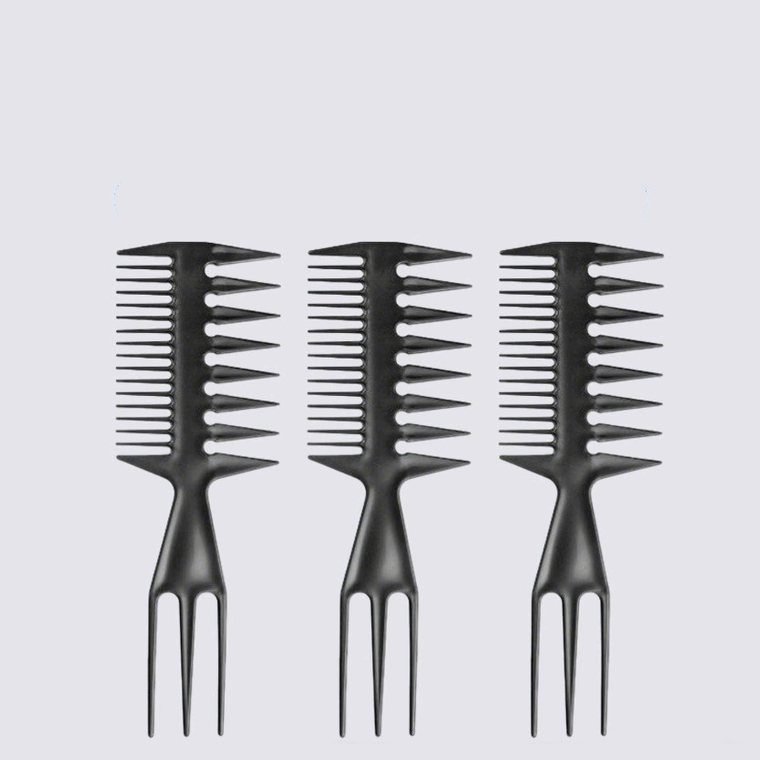
    Three black GP-ST05 men's styling combs side by side showing consistent tooth pitch and matching spine thickness across cavities
    Three combs from one 12-cavity run, checked side by side: identical pitch, no bow along the spine.

    The fork profile is a mould problem before it is a design problem

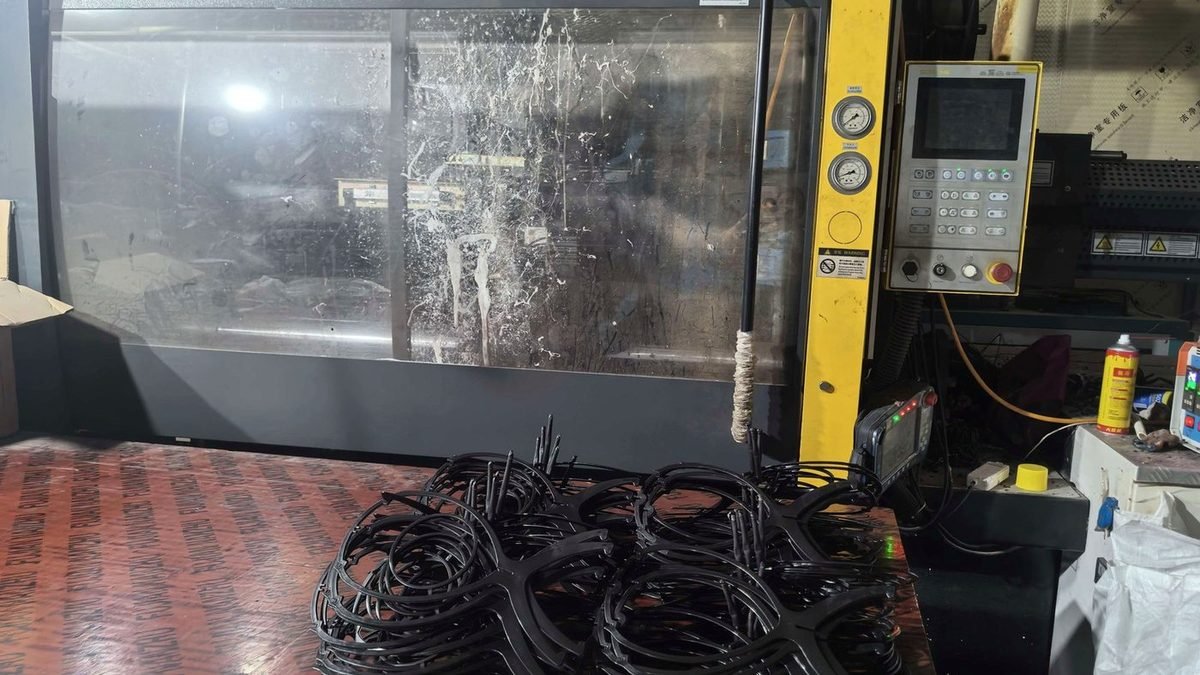
    A pocket comb is a two-plate tool. A fork comb is not. The tines stand away from the spine at an angle, and a tine running perpendicular to the parting line needs a slide or a lifter to release, otherwise it drags and scuffs on ejection. The GP-ST05 tool runs two slides, a gate at the tail end, and ejector pins on the spine rather than between teeth.

    Gate position matters more than buyers expect. Gating at the tail fills the spine first, then the teeth from the root outward, which keeps the weld line in the thick section where it is invisible. Gate into the middle of the tooth row and the flow front meets itself halfway along the spine, leaving a cold weld that fails in flex.

    Typical figures for a men’s comb tool: 8 to 16 cavities, a 25 to 45 second cycle depending on wall thickness and hot-runner setup, 20 to 30 days from drawing release, and USD 3,000–9,000 for a 12-cavity mould with one slide. Tooling is one-time and belongs to whoever paid for it — the mechanics are in our tooling cost article.

    Spine, thickness and weight: what a buyer feels in the hand

    Spine thickness runs 5–8 mm on a men’s comb. Under 5 mm the comb twists under thumb pressure on the wide-tooth face; over 8 mm it reads as a hotel comb whatever the resin. Web thickness is 2.2–4.0 mm on the tined face and 1.4–2.2 mm on the fine face, and that web is where sink marks appear when the rib behind it is too thin.

    Finished weight is a useful honesty check on a sample. A 178 mm barber comb in PP should land at 20–28 g. A sample at 14 g means either the spine is thinner than the drawing or the moulder ran a lower-density grade to save resin — both show up in the breakage rate within three months. We weigh ten parts from the first shot; ±0.5 g across a 12-cavity tool is the target, and a wider band points at a cooling problem on one cavity.

    Where the comb will be dropped on a hard floor — barber shops, which is most of the volume — add a 0.3 mm chamfer on the outer edges. Cost: nothing. Effect on breakage: worth measuring over your first 500 pieces.

    Edge finishing: the gap between a USD 0.18 comb and a USD 0.28 comb

    Two combs can come off the same tool and feel like different products. What happens after ejection decides it, and we run three levels.

    Deflash only. A blade or trimming fixture removes the gate stub and any flash at the parting line. Fastest and cheapest, and the tooth edges still carry a micro-burr you can feel with a thumbnail.

    Ceramic tumbling. Parts run 20–40 minutes in a vibratory bowl with ceramic media and a light compound. This breaks the burr, softens every tooth tip and gives the matte finish most private-label programmes want. It adds roughly USD 0.01–0.02 per piece at volume and pays for itself in fewer complaints about sharp teeth.

    Flame or hot-air polishing. A brief pass melts the surface skin on the tooth edges and spine, producing a gloss PP cannot reach from the mould. It is a manual station, it adds USD 0.03–0.06, and it is the only way to a gloss black pocket comb without moving to ABS or a coating. The trade-off: over-polishing rounds the tips and changes the pitch feel, so it needs a fixed pass speed and a standard sample at the line.

    Packaging: four formats and what each adds per unit

    On a product with a 0.18–0.30 unit cost, packaging is not a detail; it can double the landed cost. Four formats we run most often, with typical add-on cost per piece at 1,000–5,000 units:

    OPP bag, unprinted — USD 0.008–0.015. Right for salon bulk packs and clipper-kit inserts, where the comb is a component rather than a retail item.

    Printed backing card with euro slot — USD 0.03–0.06, 300–350 gsm board, four-colour both sides. The default for beauty-supply and pharmacy chains. Card art needs 3 mm bleed, and the slot must be punched on the vertical centre line or the comb hangs crooked on the peg.

    Blister on printed card — USD 0.08–0.14 including PVC or PETG forming. Better theft resistance, more freight because the pack is thicker, and the format most likely to fail a drop test when the seal is under-run.

    Tin or gift box — USD 0.35–0.60. Only sensible inside a multi-piece grooming set where the box carries the price.

    The carton matters as much as the pack. A 500-piece carton of pocket combs runs 0.035–0.05 CBM, so 1,000 pieces is roughly 0.07–0.10 CBM — under a tenth of a pallet, which is why small comb orders ship LCL or consolidated rather than in a container. Use 32 ECT board for sea freight and stack no more than eight cartons high: combs are light, but the cartons crush and the cards inside take a permanent set.

    Finished men's styling combs packed into export cartons at the Globaplas factory in Xuchang, Henan, China
    Export cartons before consolidation — 500 pocket combs per carton, 0.035–0.05 CBM each.

    For Amazon the prep rules change the pack again: poly bag with a suffocation warning, no loose pieces in the master carton, and an FNSKU label that does not cover the card art. We keep a separate FBA prep checklist for that route.

    Price bands, MOQ and carton maths

    FOB China bands for a men’s comb at 1,000–5,000 pieces, one colour, OPP bag: PP pocket 0.14–0.30, ABS pocket or barber 0.20–0.42, glass-filled PP barber 0.45–0.85, acetate 0.90–2.20. Add 0.03–0.06 for a printed card, 0.01–0.02 for tumbling, and 0.10–0.25 where a design needs a two-shot look rather than pad printing.

    Our standard MOQ is 1,000 pieces per colour. Below that, buyers normally take from stock rather than a dedicated run, because a 12-cavity tool still has to be set up, purged and colour-changed for 300 pieces. If you are testing a shape before committing, ask what is in stock in black — black covers most of the menswear channel and it is the colour we hold deepest.

    Lead time on a repeat colour is 20–30 days from deposit, plus 7–10 days for a pre-production sample when the tool is new or the colour is a Pantone match. Add three weeks for LCL to a US or EU port in the four weeks before Chinese New Year, when every consolidator in Ningbo and Shenzhen is overbooked. Our shipping and export page lists the documents issued with each shipment, and the lead-time calendar explains why a November order is not a June order.

    Custom colour is where quotes diverge most. Pantone matching to ΔE ≤ 1.5 is achievable in PP and ABS, but masterbatch has a 25 kg minimum, which is 2,000–5,000 combs depending on part weight. On a 1,000-piece run, expect either a colour surcharge or the closest stock colour. The tolerance side is in our Pantone guide.

    A five-point approval sheet before you release the PO

    Most men’s comb disputes are settled by five measurements that take under ten minutes on a sample. Put them on the approval sheet and sign a physical golden sample; photographs will not settle an argument about feel.

    1. Pitch and tip. Measure ten consecutive teeth with a pitch gauge. Record the average and the spread. Beyond ±0.15 mm goes back to the moulder.

    2. Weight. Weigh five pieces from the same bag. A ±0.5 g band is normal; a 2 g spread means mixed cavities or mixed resin.

    3. Flex. Hold the comb at both ends and press the middle against a table edge until the spine deflects about 10 mm. It should return flat within a second. A permanent set means the spine is too thin or the resin too soft.

    4. Burr. The stocking drag test, both faces, three points along the tooth row.

    5. Colour. Compare against the approved masterbatch chip under D65 light, not office lighting. ΔE ≤ 1.5 on a solid colour, and check a second carton from a later production day, because batch drift is what customers notice three months after delivery.

    Two actions are worth taking this week. Put pitch tolerance, spine thickness and finish level in your next RFQ instead of a photo — every supplier then quotes the same object, and the cheapest quote stops looking cheapest by accident. And if you are building a grooming range, treat the fork comb and the beard comb as a pair: they share a shelf and a customer, and running both in one colour on one setup splits the changeover cost. What is already tooled sits on our product pages, OEM services covers colour, print and packaging work, and a drawing or reference sample can go through the contact form for a spec review before any tooling decision.
  • When to Order Hair Accessories: Peak Season, Chinese New Year and Lead Time Math

    When to Order Hair Accessories: Peak Season, Chinese New Year and Lead Time Math

    Two dates decide whether a hair accessories programme makes money: the day you place the purchase order, and the day the cartons land in your warehouse. Buyers who treat lead time as a fixed number — thirty days, always — get caught in the same two months every year. A 1,000-piece wig stand order that runs through the moulding shop in 22 working days in March takes 34 in October, then waits eleven days for a vessel, and arrives a fortnight after the shelf date it was planned for.

    What follows is the calendar our own production planners work from: a factory in Xuchang, Henan, China, moulding on its own tooling and shipping to the US, UK, EU, Turkey, the Gulf and West Africa. Every figure is a typical range, not a quotation, and your own PO history should override it after three shipments. It runs from the lead-time stack to the freight peak, and ends with a calendar you can lift into a planning sheet.

    Build the order date backwards from the shelf, not forwards from today

    Most late shipments are arithmetic failures, not production failures. A buyer takes the 25-day production time from a quotation, adds 30 days of transit, and books a date that ignores sampling, packaging approval, port congestion and the pre-holiday queue. Start at the shelf date instead, and subtract every stage at its realistic long end rather than its best case.

    Stage Typical range What pushes it to the long end
    Artwork and dieline approval 5–14 days Barcode or legal text mismatch, second revision round
    Pantone lab dip 3–7 days Metallics, translucent tints, matching to a fabric swatch
    Pre-production sample 7–10 days New tool, first-shot sink marks or short fills
    Bulk production, existing tool 20–30 days Peak queue, four or more colour changes, hand assembly
    Bulk production, new tool 45–60 days Tool build 18–30 days, then trials before a full run
    Port-to-port, ocean 14–18 days USWC; 30–36 days North Europe Rollover to a later sailing, transhipment, congestion
    Port to your door 7–14 days Customs examination, chassis shortage, DC appointment slots
    Repeat SKU to a US warehouse 45–60 days Existing tool, existing carton, no new colour
    New SKU with new tool to the EU 95–125 days Tool plus sample plus retail packaging plus longer transit

    Run it once with real dates. You want stock on the shelf on 15 September. Reordering a foldable stand you already sell, subtract 60 days: the PO needs to be with us by mid-July. The same stand in a new Pantone colour and printed box, subtract 95 days: early June. A new shape needing a mould, the date moves to May, and the mould is signed off before the packaging artwork is even finalised. That gap between 60 and 95 days is where the money sits, and running artwork and tooling in parallel rather than in sequence recovers three to four weeks of it.

    What actually happens on the factory floor in the fourth quarter

    Injection moulding is a queue business. A tool with eight cavities on a 30-second cycle produces roughly 900 to 1,000 pieces an hour, so a 1,000-piece order consumes about one hour of machine time. That hour is never the constraint. The constraint is the slot: which machine, which day, after which colour purge, with which material already dried.

    Three things consume the calendar in October and November. Mould changes: swapping a tool on a 250-tonne machine and stabilising the first shots takes two to four hours, and a colour change adds one to two hours of purging before the first sellable part. Tooling availability: if your SKU shares a tool family with other buyers’ orders, batching is what holds the unit price down, and batching means waiting for the batch to fill. Labour: carding, bagging and packing are hand operations, and 1,000 pieces with a euro-slot card and a polybag consume two to three people for a day and a half.

    So your order date matters less than your position in the colour sequence. Black, white and two pastels may run as four separate batches; black and white only clears in one run and ships a week earlier. If the range can survive on three colours instead of six for the first season, say so at quotation stage, not at artwork stage.

    Virgin PP and ABS resin sacks in the Globaplas material store before a peak-season run
    Resin is staged and dried before the run; a shortage here delays the whole colour sequence.

    The Chinese New Year wall resets everything in February

    Chinese New Year is the largest fixed event in any sourcing calendar, and it does not cost you a week. In 2027 the holiday falls in the first week of February. Factories begin winding down 10 to 15 days before it as material deliveries stop and finishing lines clear; much of the workforce travels home 7 to 20 days ahead, because rail and bus tickets are booked months in advance; production restarts 7 to 10 days after, but staffing only returns to normal around day 18 to 25, as workers trickle back and new hires are trained.

    Net effect: a four to six week dead zone in production, plus a freight squeeze on both sides of it. Orders placed in January are not late because anyone is careless. They are late because the factory is empty and the port is jammed with everyone else’s pre-holiday rush.

    Three habits remove most of that risk. Place the post-holiday order in November, not January, and ask for a written slot with a week number rather than a lead time in days. Buy your top three SKUs six to eight weeks deep in November and December, while the factory is still running and vessel space is bookable. Start any new tool in October: a mould built in December is not trialled until March. Resin closes on a similar schedule — we hold a 30-day buffer on standard PP and ABS, but a special masterbatch ordered in January is a February problem.

    Ocean freight peaks on a different clock

    Production and shipping do not squeeze at the same moment, which is why single-cause explanations for late deliveries are usually wrong. Rates and space tighten twice: late August to mid-October, as US and European retailers pull holiday inventory forward, and mid-December to early February, before the New Year shutdown. Trans-Pacific spot rates move 1.6 to 2.5 times between the June trough and the September peak, and space allocations are typically cut 10 to 14 days before a sailing — exactly when a buyer running two weeks late tries to book.

    Typical port-to-port transit, excluding the door leg: 14 to 18 days from Ningbo or Qingdao to Los Angeles; 28 to 33 to New York; 30 to 36 to Rotterdam and Hamburg; 25 to 32 to Istanbul; 30 to 40 to Lagos; 28 to 34 to Durban. Add 7 to 14 days for clearance, drayage and a warehouse appointment, and another 5 to 10 if the container is selected for examination.

    LCL is priced per CBM with a one-CBM minimum, typically 45 to 95 USD per CBM from Ningbo to a European base port, plus destination CFS and documentation charges of 60 to 120 USD per shipment. Below roughly 12 to 15 CBM, LCL usually wins once those fixed charges are counted; above it, a 20ft at 1,600 to 3,200 USD off-peak is cheaper and faster to release. Run that break-even before deciding a first order is too small to containerise — the method is in our container loading guide.

    Four windows that actually shape the year

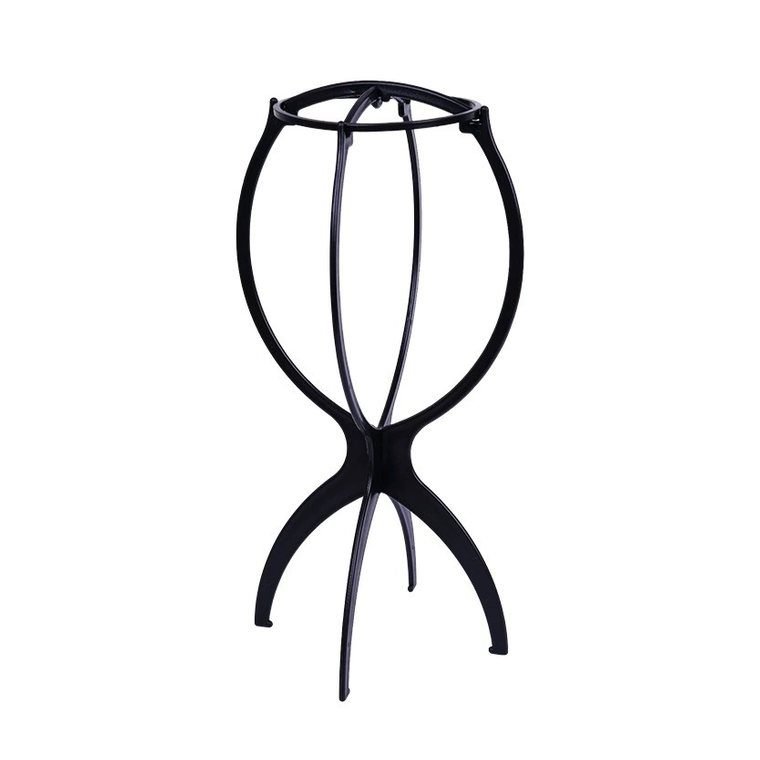
    Salon Foldable Wig Stand GP-WS06 folded flat for carton packing
    Folded flat, the carton is about 0.045 CBM, which is what makes air freight viable on a top-up.

    Most trade customers do not buy evenly across twelve months. They buy against four or five retail and salon events, each with a ship-by date set by the shelf set rather than by the factory.

    Window Ship from China by Why that date
    Halloween and cosplay, US and UK 10–20 August Costume retail sets in early September; late stock becomes discounted stock
    Black Friday and holiday gifting 20 September–5 October Marketplace and DC receiving cut-offs fall 4–6 weeks before the event
    Back to school, US and EU 15–31 May Salon and beauty-supply resets run through July and August
    Ramadan and Eid, Gulf, Turkey, North Africa 4–6 months ahead Moves about 11 days earlier each year; in 2027 it lands in February–March, against the New Year shutdown
    January salon reset 15–30 November Has to clear the factory before February, so it sails before the rush

    The Ramadan row is the one buyers most often get wrong, because the date moves. Between 2026 and 2028 the start of Ramadan shifts roughly 22 days earlier in the Gregorian calendar, so a Gulf distributor who ordered in October for a March arrival will be six weeks late the next year if they reuse the same calendar. Re-derive Islamic calendar events every season instead of copying last year’s purchase order.

    For salon and barber chains the pattern is sharper: September to November carries the largest share of the year’s comb and stand volume, because chains restock before the pre-holiday service peak and again before January price increases. Their production slot for that window is decided in July.

    Where the order date actually slips

    Across a few hundred purchase orders a year, the delay almost never comes from the moulding machine. It comes from approvals, and the costs are predictable.

    • Packaging artwork and dieline, 5 to 14 days. The dieline has to exist before artwork can be laid out, and barcodes, warnings and importer addresses are often supplied late by the brand owner. This is the longest external dependency in the chain.
    • Pantone approval, 3 to 7 days per round. A lab dip is a physical plaque we mould and send; approving it on a monitor costs a round trip.
    • Sample sign-off, 7 to 10 days. The factory side is fine; the delay is usually the buyer’s internal review, which eats a week nobody budgeted.
    • Deposit and payment instruction, 3 to 5 days. Slots are held against a received deposit, not a received PO.

    Two fixes recover most of those days. Lock packaging first, because it is the only item here that depends on a third party outside the factory, then run colour approval in parallel with the tooling check. Nominate one person with authority to approve artwork and colour within 48 hours — the most common cause of a missed sailing we see is a five-day silence on a colour plaque.

    Splitting the order beats expediting it

    Finished wig stands packed into export cartons on the night shift at the Globaplas packing floor
    Splitting into two shipments costs less than expediting one late shipment, if cartons are marked per shipment.

    When a shipment will be three weeks late, the instinct is to pay for speed on the whole order. That is usually the wrong trade. Air freight is charged on volumetric weight with a divisor of 6,000 — one cubic metre is about 167 chargeable kilos. A carton of 60 × 40 × 25 cm is 0.06 CBM, so 10 chargeable kilos whether it holds six kilos of product or twelve. At 5.50 to 7.50 USD per kilo, three such cartons cost 165 to 225 USD to fly.

    The same volume moves by sea for around 15 USD at 80 USD per CBM. Air costs roughly ten times as much per piece but buys back 25 to 30 days, so the rational move is a split: fly 10 to 20 per cent of the order — the fastest-moving SKU, or the one a key account has already committed to — and let the balance sail. Two hundred pieces of a folding stand occupy 0.18 CBM and reach a European warehouse in five to seven days.

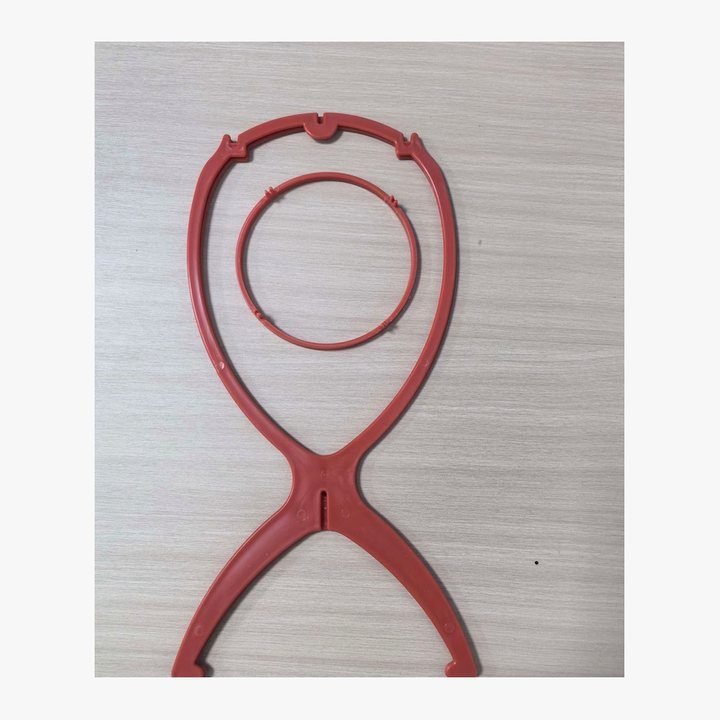
    The products that tolerate air are the flat, dense ones: tail combs and rat-tails, sectioning clips, tape rolls, hair nets, teasing combs. The products that do not are the hollow ones: ventilated and tripod stands cube out long before they weigh out, so you pay for air on empty space. If air is genuinely necessary on a stand order, ship the foldable version, which packs at roughly 0.045 CBM per dozen against 0.06 for the rigid classic model — about 25 per cent less chargeable weight. Our foldable wig stand was designed around that constraint.

    A two-lot production run is the other split worth planning: 60 per cent first, 40 per cent four weeks later. It costs a second set-up and booking, typically 150 to 300 USD on an LCL-sized balance, but it puts stock on shelf a month earlier and leaves a natural point to fix a colour before the full quantity is committed.

    A calendar you can copy

    This is the working version, built for a buyer whose fiscal year starts in January and whose main markets are the US, UK, EU and Gulf. Shift it two to four weeks if your retail calendar differs.

    Month What to have done
    January Production restarting; confirm the slot booked in November and reserve February–March sailings
    February New Year dead zone; use it for artwork and dielines for the second half, not for production promises
    March–April Back-to-school production; the cheapest ocean rates of the year, so move anything heavy now
    May Back-to-school ships; place Halloween orders and start tooling if the season needs a new shape
    June–July Halloween production; Black Friday POs placed, packaging approved, colours signed off
    August Halloween ships by mid-month; Black Friday production running; space tightens from here
    September Black Friday ships by early October; January-restock PO placed so it clears the factory before February
    October Peak freight; new tooling approved now, never in December; no new colours unless unavoidable
    November January restock ships; post-New-Year PO placed with a written slot; six to eight weeks of buffer on top sellers
    December Pre-holiday rush; space scarce and rates high; nothing new, only confirmed repeat production

    Two actions are worth taking this week. Take your three highest-velocity SKUs, find the shelf date you actually need, and subtract the numbers in the first table — not the round number in an old quotation. Then put that order-by date next to the Chinese New Year date in the same planning sheet, because the collision between the two is what turns a delay into a missed season.

    If you want a slot checked against a real shelf date, send the SKU list, the quantity and the month you need stock, and we will confirm which week the tool is free. The factory page shows the moulding and assembly floors, shipping and export covers consolidation, and the contact page reaches the planning desk. Order quantity changes both price and queue position — our MOQ and lead time breakdown covers that side, and OEM services explains what a custom colour or carton adds at each stage.

  • Hair Rollers Wholesale: Diameter, Curl Size and Reorder Cycles

    Hair Rollers Wholesale: Diameter, Curl Size and Reorder Cycles

    A salon chain orders “hair rollers, assorted” and gets a carton of 25 mm rollers. Every stylist on the floor wanted 40 mm for body, so the carton sits in the stockroom for eight months. A distributor orders 20,000 pieces at a good unit price, then discovers the carton cube is three times what he assumed and the freight per roller is larger than the roller itself. Neither buyer did anything careless. Both orders simply left the diameter, the wall section and the pack format undefined.

    This guide is written for the person who signs the purchase order: the importer, the beauty-supply distributor, the salon group buyer, the Amazon or TikTok Shop seller. It covers the seven numbers a roller specification actually needs — diameter, length, wall thickness, unit weight, pieces per carton, carton cube and clip force — plus the reorder maths that decides whether a first order is 1,000 or 30,000 pieces. Figures below are typical ranges from our own tooling and moulding lines in Xuchang, Henan, China, not quotations; your cavity count, colour and packing will move them.

    What a purchase order for hair rollers is really buying

    Four constructions dominate the wholesale market, and they are not interchangeable. Vented snap-on rollers — the type we mould — are a single hinged cylinder in PP, with a grid of ribs that lets air through and a clip moulded into the shell. Self-grip rollers use a hook-and-loop skin on a plastic core and need no clip, but the skin attracts lint and loses grip after roughly 40–60 uses. Magnetic rollers carry a steel insert and a coated surface and cost three to five times more. Foam and sponge rollers are the cheapest per piece and the least durable.

    Most B2B enquiries we receive are for the vented snap-on type, in a 6, 8 or 12-piece set, packed for retail or for back-bar use. If you are still mapping your range, the roller sits alongside our wig stands, combs, spray bottles and clips and usually ships in the same container as them, which matters later when we get to carton maths.

    Diameter sets the curl, and the finished curl is 10–20% smaller

    Buyers routinely quote a roller diameter and expect the same figure on the head. Hair springs back. Wound under tension on a 32 mm roller, damp hair dries to a curl of about 24–28 mm; the reduction depends on hair length, texture and how many turns the section takes. Thin, straight hair holds closer to the roller; coarse or layered hair releases 15–20%.

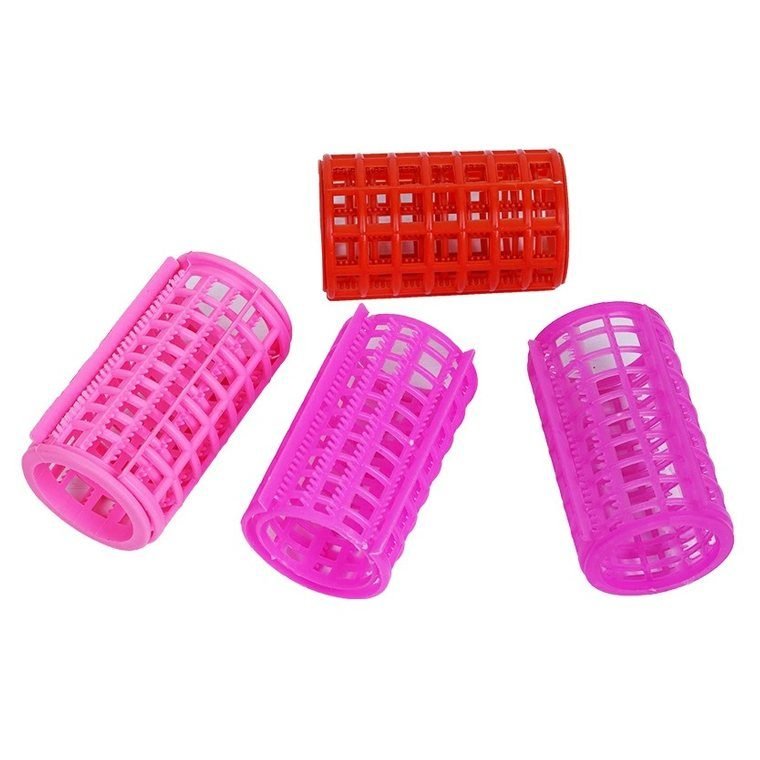
    Vented plastic hair rollers in four diameters, magenta and orange, on white background
    Four diameters from one mould family: the shell geometry stays constant, only the barrel and rib pitch change.
    Roller Ø (mm) Finished curl (mm) Where it sells Unit weight (g)
    20 15–18 Root lift, short cuts, barber sets 4–6
    25 19–22 Fringes, root volume, men’s styling 5–7
    32 24–28 Body on shoulder-length hair 7–9
    40 30–35 Blow-dry volume, mid-length 9–12
    48 36–42 Long hair, bridal and event sets 12–15
    55 42–48 Crown volume, thick or coarse hair 15–19

    Two practical consequences. First, sell the curl, not the diameter: put the finished curl range on the header card and returns drop. Second, length matters as much as diameter and is the number buyers forget. A 60–70 mm barrel is standard; jumbo 55 mm rollers run 70–80 mm because a short barrel on a wide diameter cannot hold a full section, and the clip pops open mid-set.

    Wall thickness, rib grid and the hinge that fails first

    Almost every roller complaint we see traces to the living hinge, not the barrel. The hinge is a thin web of PP moulded in the same shot as the shell; it survives because the polymer chains orient across the fold. Below about 0.30 mm the web tears within a few dozen cycles. Above 0.50 mm it resists folding, the clip springs back and the roller will not close flat on a thin section. Our tooling runs a 0.35–0.45 mm web, and we cycle-test five pieces per lot to 500 open-close movements before shipping.

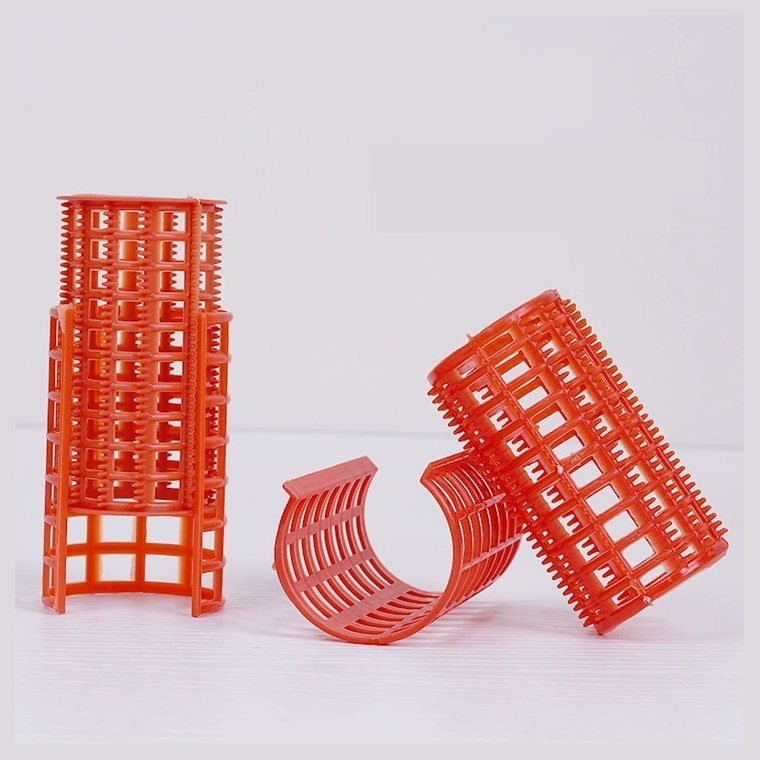
    Open hinged vented hair roller in orange showing rib grid, clip and living hinge detail
    The hinge web and rib pitch are cut into the same tool: change one and the clip force changes with it.

    Barrel wall is the second variable. At 1.2 mm a 48 mm roller flexes visibly when a section is wound tight, and the ribs — 2.0–3.0 mm wide, with 6×8 mm to 10×12 mm openings — start to splay. At 1.6–1.8 mm the roller holds shape but uses 25–30% more material, which is money you can measure per 1,000 pieces. Copolymer PP is the right grade here; homopolymer is stiffer and cheaper but stress-whitens at the hinge after roughly 100–150 cycles. Our comparison of PP, ABS and glass-filled PP covers the same trade-off on combs, where stiffness matters more than fold life.

    Clip force should land between 3 and 6 newtons. Under 3 N the roller opens in a full head of hair; over 8 N stylists break nails and stop buying. This is a tooling dimension, not a QC fix, so if a sample feels wrong, say so before the mould is cut.

    How many diameters belong in one salon set

    A 12-piece set built from three diameters sells better than twelve rollers of one size, because a set is bought to do a whole head. The composition that moves most in our orders is four 20 mm, four 32 mm and four 40 mm; the second most common is a 6-piece root-lift set of 20 mm and 25 mm only.

    Colour is a merchandising decision with a real cost. Running each diameter in its own colour lets a stylist grab the right size without reading a label, and it costs nothing extra at the moulding stage as long as you accept a 1,000-piece minimum per colour for a custom Pantone. If you want to start smaller, take stock colours and print the diameter on the header card instead. The set-composition logic is the same one behind bulk buying for salons and barber shops, where back-bar and retail packs are costed separately.

    Weight, carton fill and what freight does to landed cost

    Rollers are hollow, so they cube out long before they weigh out. A 40HQ takes about 65 usable cubic metres; a roller carton at 60×40×40 cm is 0.096 m³, so roughly 660 cartons fit before you touch the weight limit. At a freight rate of USD 2,200–3,600 per 40HQ — a normal band from China to the US East Coast — that is about USD 43 per cubic metre, or USD 4 of freight per 1,000 small rollers and USD 17 per 1,000 at 55 mm.

    That gap is why a 55 mm roller that costs 4 cents more to mould can cost 9 cents more landed. Pack density is the lever: nest the barrels mouth-to-mouth where the clip allows, keep the polybag slack out of the carton, and do not let a supplier “fill” a carton with air to hit a round piece count. Ask for the packed carton dimensions and the gross weight on the sample invoice, then check them yourself. Our shipping and export page lists the carton data we quote against, and the container loading guide works through mixed SKUs in one 20ft or 40ft box.

    Export cartons stacked and strapped in the packing area before container loading
    Packed carton dimensions decide the freight per roller more than the unit price does.

    Price bands at 1,000, 10,000 and 50,000 pieces

    Injection moulding is a volume business and the price curve is steep at the bottom. Typical FOB bands for vented snap-on rollers in stock colour, polybagged without a header card:

    • 20–25 mm: USD 0.035–0.06 at 1,000 pieces, USD 0.028–0.045 at 10,000, USD 0.022–0.035 at 50,000.
    • 32–40 mm: USD 0.05–0.09 at 1,000, USD 0.04–0.07 at 10,000, USD 0.032–0.055 at 50,000.
    • 48–55 mm: USD 0.08–0.14 at 1,000, USD 0.065–0.11 at 10,000, USD 0.05–0.09 at 50,000.

    Three things move a quote inside those bands: colour, which needs a masterbatch run and 1,000 pieces per shade; packing labour, because a 12-piece set handled by hand costs more than loose pieces; and cavity count. A 16-cavity tool produces roughly four times a 4-cavity tool per hour on the same machine, which is why a supplier with a large tool is cheaper at 50,000 and not necessarily cheaper at 1,000. Our mould shop cuts and maintains tools on site, so a diameter change is a tooling decision rather than an outsourced project — OEM and ODM services covers how colour, logo and packaging are handled.

    Packaging formats and their cost per set

    Four formats cover almost every order we ship. A polybag with a printed header card is USD 0.015–0.03 per set and is the default for distributors who sell from a bin. A colour box with a window runs USD 0.05–0.10 per set and suits pharmacy and beauty-supply chains. A blister on a printed euro-slot card is USD 0.04–0.08 and hangs on a pegboard without a shelf. A barcoded hang tag alone is USD 0.005–0.01 and is enough for Amazon FBA, where the outer carton does the branding.

    Print quality, not format, generates complaints. Type under 6 pt on a header card fills in on a flexo press, and a 1 mm registration shift on a two-colour card reads as a defect at retail. Send vector artwork, specify the card Pantones separately from the roller colour, and approve a printed dummy before the run. On a 12-piece set the packaging is often 15–25% of landed cost, so it earns one extra approval round.

    Reorder cycles: sizing a first order for salons and distributors

    An eight-chair salon doing 15 clients a day will use rollers on roughly a third of them. A set of 12 survives 30–40 services before clips fatigue and barrels cloud, so a busy salon replaces 15–25% of its stock a year — a few hundred pieces, not a few thousand. That is why salons buy from distributors and distributors buy from factories.

    For a distributor, a workable starting point is 8–12 weeks of cover on the two fastest diameters and 12–16 weeks on the tail sizes. On a 30,000-piece annual run that is a first order around 6,000–9,000 pieces across three diameters, with 60% in 32 mm and 40 mm. A first order of 1,000 pieces per diameter is enough to test a market and stays inside our standard MOQ; a mixed container with wig stands, combs and spray bottles then spreads freight across SKUs that are heavier and worth more per cubic metre.

    Seasonality is narrower than most buyers assume. Retail demand lifts from late August through November, and production in Xuchang is tightest in September and October. Place a repeat order 45–60 days before you need stock: 15–25 days production, 3–5 days for colour matching on a new shade, and 25–35 days on the water to the US or Europe.

    What to check before the container leaves Xuchang

    Five checks catch nearly every defect we have seen come back. Measure the outside diameter at three points with a caliper — tolerance ±0.5 mm. Weigh ten pieces against the approved sample — ±5%. Cycle five rollers 500 times and look for whitening at the hinge. Drop a packed set from 1.2 m onto concrete, six faces, then open the carton. Compare a production piece with the signed master under D65 light and accept no more than ΔE 1.5.

    Run these at AQL 2.5 for major and 4.0 for minor defects, and put the numbers in the purchase order rather than in an email. A roller that measures 31.2 mm is not a 32 mm roller once it sits in a set with the size printed on the card.

    Two things to do before your next order. Write the specification as seven lines — diameter, barrel length, wall thickness, unit weight, clip force, pieces per carton, carton cube — and send it with the enquiry, not after the sample is approved. Then ask for packed carton dimensions on the quotation, because at large diameters freight is the second-largest line item after moulding cost.

    If you want a starting point, we will send a dimensioned drawing and a packed-carton sheet for the diameters you are considering. Send the sizes and the target market and we will come back with a specification and a sample plan rather than a price list.

  • Wig Cap Nets: Denier, Mesh Size, Stretch and Pack Density for Wholesale Buyers

    Wig Cap Nets: Denier, Mesh Size, Stretch and Pack Density for Wholesale Buyers

    Most wig cap net complaints do not start in the factory. They start in a quotation that never defined the mesh. A buyer approves a sample that stretches comfortably over a 56 cm block, places 20,000 pieces, and receives a lot that weighs 22% less per piece and splits at the hem after two wearings. Nothing on the paperwork was violated, because the paperwork only said “black wig net, 40D”.

    The word invisible has the same problem. One supplier means a 3 mm diamond mesh in black; another means a 2 mm matte nude net with a bonded edge. Both are honest, and both disappoint a buyer who expected the other. This guide covers the four specifications that decide whether a net cap works — denier, mesh, stretch and recovery, pack density — plus the price bands and arrival checks. Figures are typical commercial ranges from production in Xuchang, Henan, China, not guarantees for one order.

    What buyers actually mean by a wig cap net

    Three different products travel under the same name, and each is specified differently.

    A net cap is the open-mesh item most people picture: a fishnet dome with a diamond opening, an elastic or folded hem, and a flat circumference of roughly 44–48 cm that stretches to 58–64 cm. Salons use it to compress and hold a client’s natural hair under a wig. Wig brands use it as a breathable base layer or as a disposable hygiene cap in try-on rooms.

    A dome cap is knitted far denser, often 40–60 stitches per 10 cm, and reads as near-opaque. It is a wig foundation, judged on seam placement and colour match rather than mesh openness. A mesh liner is stitched inside a finished wig to the weft rows, usually as cut panels, and its denier is chosen for seam strength, not appearance.

    Before any price discussion, ask for flat circumference, stretched circumference at break, mesh opening in millimetres, and weight per piece. A supplier who cannot answer those four numbers in writing is quoting a look, not a product. The same discipline applies when you compare MOQ, lead times and pricing structures across a category.

    Denier: the single number that sets sheer, strength and price

    Denier is the weight in grams of 9,000 metres of yarn. It is a linear density rather than a diameter, but in nylon netting the two track closely: 20D yarn measures about 0.05 mm, 40D about 0.07 mm, 70D about 0.09 mm. Thin yarn disappears against skin; thick yarn survives handling. You cannot have both in one cap.

    Yarn Where it fits Weak point Relative price
    20D Bridal and editorial try-on caps; nude tones Snags on nails and comb teeth; 8–12% packing loss Highest
    30D Retail two-packs, salon disposables Hem pulls if the elastic is under-cured Mid-high
    40D Wholesale default: wig bases, salon bulk Visible on very dark hair if mesh is coarse Baseline
    70D Reusable caps, laundry-tested school supply Reads as thick netting; kills an invisible claim Lowest

    The quality risk sits between 30D and 40D, because the two feel almost identical in the hand. A 40D lot switched to 30D loses roughly 20–25% of its weight per piece and about the same share of tensile strength, while the piece price falls by only USD 0.01–0.02. That reads as a saving on the invoice and becomes a claims problem in the salon, where the net splits at the crown during a fitting.

    The cheap test is a kitchen scale and a ruler. Weigh ten pieces: a 40D net in 3 mm mesh typically lands at 6.0–7.5 g, a 30D at 4.5–5.8 g. Then stretch one cap to 60 cm and hold for 30 seconds. If the yarn whitens at the intersections, the lot is finer than stated or was over-stretched during finishing.

    Mesh size and hole shape: 2 mm, 3 mm and 4 mm

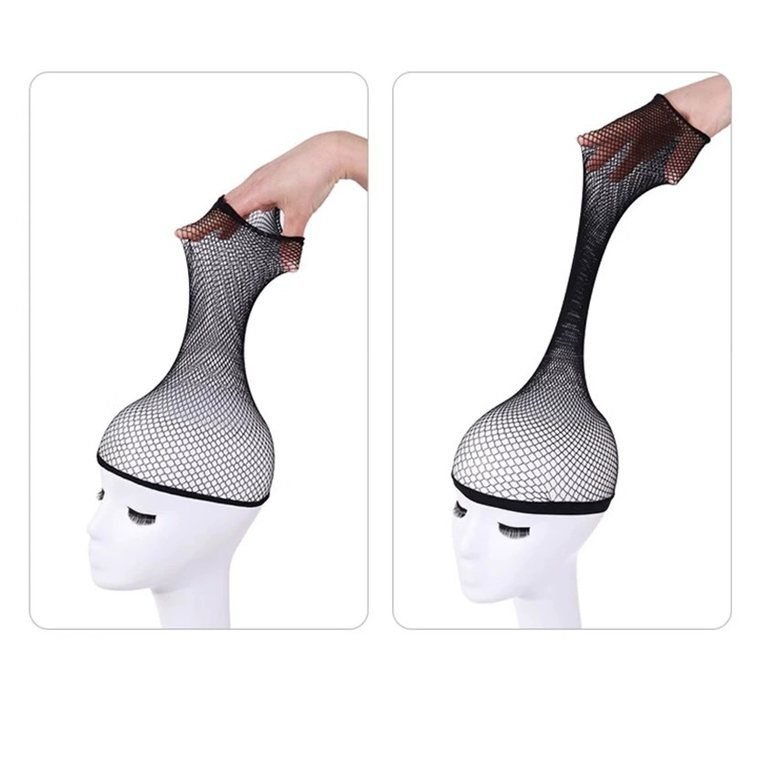
    Black invisible hair net GP-HN01 stretched over a block to show diamond mesh openings and elastic hem
    GP-HN01 under stretch: the diamond opening closes to about half its flat size, which is why mesh should always be specified at a stated extension.

    Mesh opening is measured between yarn centres, not between the visible gaps, and the difference matters when two suppliers both quote “3 mm”. Ask for the method in writing: flat, or at 50% extension. The same net measures 4 mm flat and 2.8 mm stretched.

    4 mm diamond. The most breathable option and the cheapest to knit. Air moves freely, which suits stage, cosplay and dance work where a cap sits under a wig for two hours. The trade-off: fine human hair pushes through the openings, and the cap reads as fishnet rather than foundation if worn alone.

    3 mm diamond. The wholesale standard for wig bases. It holds blunt-cut hair without poking through, sits flat under a lace front, and knits at a commercially sensible speed. Most 40D black nets on the market sit here.

    2 mm diamond or hex. The only mesh that supports an honest invisible claim, because the openings are small enough to break up the pattern at reading distance. It costs more for two reasons: knitting speed drops by roughly a third, and the tighter structure needs a finer yarn to avoid a stiff, board-like hand.

    Match yarn to mesh. A 20D yarn in a 4 mm opening slides at the knots and produces run-prone holes; a 70D yarn in a 2 mm opening cannot knit without crowding. Workable pairings are 20–30D with 2 mm, 30–40D with 3 mm, and 40–70D with 4 mm. Anything outside that needs a sample before a purchase order.

    Stretch, recovery and the elastic hem

    A net cap is a stretch article, so flat dimensions alone tell you very little. Specify four numbers: flat circumference, stretched circumference before yarn break, recovery after three cycles, and hem construction.

    Commercial caps run 44–48 cm flat and 58–64 cm at break. Recovery should hold at 90% or better, measured by extending to 1.5× flat, holding 30 seconds, releasing for 60 seconds, then re-measuring. A cap that returns at 85% feels loose after a month of salon use and will not stay on a 52 cm head.

    The hem is where most failures start. Three constructions are common: a 6–8 mm elastic band folded and stitched, a folded hem with spandex thread laid in, and a bonded edge. The elastic band is the most durable and easiest to inspect; the bonded edge is flattest and most prone to delamination in a hot container.

    Ask what cure or heat-set step the hem receives. Under-cured elastic is the most common cause of “it went slack after five washes” complaints, and it is invisible at sample stage because a fresh cap always recovers well. A three-cycle wash test on three pieces before shipment costs almost nothing and catches it.

    Thread choice matters too. Monofilament nylon gives a crisp, low seam but can scratch a scalp; textured nylon is softer and bulkier, and tends to lower complaint rates in salon use.

    Colour, dye lot and what “invisible” can honestly mean

    Black is the hardest colour to keep consistent, not the easiest. Different dye baths produce shifts that are visible at ΔE 1.5–3, and a net is thin enough that the shift reads as a grey or brown cast against dark hair. Nude ranges are worse in a different way: there is no industry standard for “light beige”, so six suppliers ship six colours under the same name.

    Two controls fix it. Approve colour against a physical standard rather than a screen — a Pantone chip plus a signed production sample, held by both sides. Then write a tolerance into the purchase order: ΔE ≤ 1.5 on a spectrophotometer, or 4–5 on the grey scale for visual checks under D65 light. Without a number, “close to the sample” is unenforceable.

    Be equally precise in your own marketing. What the product can support is a combination: mesh at 2 mm or finer, a matte yarn that does not catch light at the edge, a hem that sits flat rather than rolled, and a colour within two shades of the wearer’s scalp. What it cannot support is “completely undetectable”. Buyers who write the second claim inherit every return.

    Retain three pieces per lot, sealed, labelled with the lot number and signed by both parties, for 12 months. When a dispute arrives in month four, the retained sample settles it in ten minutes instead of a month of photographs.

    Weight per piece and why it moves your freight bill

    Export cartons of finished hair accessories closed, taped and labelled at the Globaplas factory
    Packed cartons at the end of the line. Net caps are light but bulky, so carton dimensions move landed cost far more than piece weight does.

    A net cap weighs 4–9 g. A thousand pieces weigh under 9 kg, which means ocean freight is never calculated on weight for this product. It is calculated on volume, and volume is set by how the caps are packed.

    The standard bulk pack is 100 pieces per OPP bag, 10 bags per carton, giving 1,000 pieces in a carton of roughly 55 × 38 × 32 cm, or 0.067 CBM. A 40HQ of about 68 CBM therefore holds roughly 1,000 cartons on paper; plan on 60–70% of theoretical because cartons do not stack perfectly and pallets waste height.

    Retail packaging changes the arithmetic fast. Hanging cards at 12 pieces per card, with a euro slot and printed backing, typically triple the packed volume per piece. The caps weigh the same, but freight per piece can rise from about USD 0.004 to USD 0.012 on a 40HQ at USD 2,800 — real money on a product selling at USD 0.10.

    Pack format Pcs / carton CBM / carton Board grade
    100 pcs / OPP bag, bulk 1,000 0.067 ECT-32 single wall
    12 pcs / hanging card 288 0.085 ECT-32 single wall
    Compressed, flat-packed 2,000 0.058 ECT-44 double wall

    Compression is worth the conversation. Nets laid flat and stacked rather than bulked loosely can double carton density, but the hem takes a set and the cap needs a few minutes to recover before it fits properly. Acceptable for salon disposables, not for retail.

    Unit price bands and what sits behind them

    FOB prices for net caps land in three bands. Basic black 40D in 3 mm mesh, bulk packed, runs about USD 0.06–0.12 per piece at 1,000–5,000 pieces. Matte nude 20–30D in 2 mm mesh with a bonded hem and colour control runs USD 0.15–0.30. Retail-ready versions on a printed hanging card add roughly USD 0.03–0.06 in material and labour.

    Custom dyeing adds USD 0.01–0.02 per piece but only clears at 3,000 pieces per colour, because a dye bath has a minimum load. That is the number that kills most “eight colours in our first order” plans: eight colours at 3,000 pieces each is 24,000 pieces, not 3,000.

    Compare landed cost, not piece price. A 1,000-piece trial at USD 0.09 is USD 90 of goods; air freight on 0.07 CBM often costs USD 60–90, which doubles the landed unit cost. Sea freight on the same volume is USD 15–25 but adds 30–40 days. For a first order the honest comparison is total cost of getting sellable stock onto a shelf, divided by pieces that survive handling. Our shipping and export page sets out how both options are quoted.

    The spec sheet that stops a bad lot

    Eight lines on a purchase order prevent most of what goes wrong in this category. Anything unwritten is treated as supplier’s discretion in a dispute.

    • Fibre: nylon 6 or nylon 66, stated explicitly. They dye differently and do not mix in one lot.
    • Denier with tolerance: 40D ±10%, not “40D”.
    • Mesh: opening in mm, hole shape, and the extension at which it is measured.
    • Dimensions: flat circumference and stretched circumference at break.
    • Weight per piece: 6.0–7.5 g, with a stated sample size for the check.
    • Colour: reference to an approved physical standard plus ΔE tolerance.
    • Pack: pieces per bag, bags per carton, carton dimensions, board grade, label content.
    • Inspection: AQL 2.5 for major defects, with a named list of what counts as major.

    Two clauses are worth adding beyond the specification. First, a pre-production sample signed by both parties, with the production lot held against it. Second, a defect definition: a hole over 3 mm, a broken hem stitch run over 10 mm and a colour shift above ΔE 1.5 are major; a loose thread under 5 mm is minor. Defined terms turn an argument into a count.

    If the order also includes stands, combs or bottles, consolidate the specification into one document per SKU. Our OEM and ODM process uses the same eight-line structure across categories, which makes reorders predictable.

    Four checks on arrival that catch most defects

    Incoming inspection for net caps takes about twenty minutes per lot and needs no laboratory.

    Weigh ten pieces. Average them against the specified range. A 15% shortfall is a denier or yield problem, and it surfaces as tearing within weeks of sale.

    Stretch three pieces to the specified limit and hold 30 seconds. Watch the knots. Whitening at the intersections means the yarn is over-stressed; a run opening beyond 5 mm means the mesh was knitted too loose for that yarn.

    Fit one cap on a block two centimetres larger than your target head size. It should sit flat at the hairline without rolling, and the hem should not lift when the wearer turns their head.

    Check colour against the retained sample in daylight, not office lighting. Fluorescent tubes push black toward blue and make nude tones look warmer than they are, which is how a rejectable lot gets accepted.

    Photograph each check with the lot number visible and keep the images with the retained samples. Claims filed within 14 days, with that evidence, are usually settled at credit or replacement; claims filed in month three are argued. Apply the same discipline to wig stands, where carton damage is the usual issue.

    Two things are worth doing before the next enquiry. First, rewrite the specification using the eight lines above and send it with the enquiry, not after the quotation. Suppliers quote what they are asked for, and a specification with tolerances returns comparable prices instead of three quotes for three different products.

    Second, run a 1,000-piece trial in the pack format you intend to sell. Bulk pricing on a product that ships on hanging cards hides the freight difference until the container is booked. If you are still choosing, send us the target channel and head size range and we will quote both against 0.067 CBM and 0.085 CBM.

  • EXW vs FOB vs CIF vs DDP: How to Read a Hair Accessories Quotation

    EXW vs FOB vs CIF vs DDP: How to Read a Hair Accessories Quotation

    A buyer sends the same specification to three factories and gets back $1.28, $1.35 and $2.05 per piece. The first number looks like the best deal. It usually is not. The $1.28 quote is EXW from an inland factory, the $1.35 is FOB Ningbo, and the $2.05 is DDP to a warehouse in New Jersey. Add export declaration, trucking, ocean freight, duty, destination charges and inland delivery, and the $1.28 piece commonly lands at $2.18 while the $2.05 piece lands at $2.07. The cheapest-looking quote is frequently 5 to 15 per cent more expensive in the wrong direction, and the buyer only discovers it after the goods have shipped.

    This guide does not repeat what drives a unit price — that is covered in our MOQ, lead time and pricing breakdown. It deals with the wrapper around the price: what EXW, FOB, CIF and DDP each oblige, where risk passes, how the cost stack behaves at 2 CBM versus 28 CBM, and which invoice lines appear three weeks after you thought the deal was closed. Everything below uses plastic hair accessories — wig stands, combs, spray bottles — because their value-to-volume ratio makes the terms matter more than they do for dense goods.

    The number on the quotation is not the number you pay

    A foldable wig stand at 1,000 pieces costs somewhere between USD 0.95 and 1.60 FOB China depending on wall thickness, colour and packaging. That range is roughly 40 per cent wide, which is why buyers fixate on it. But the product cost is only the first of six lines that end up in your landed cost per unit, and at low volumes the other five can add 40 to 60 per cent on top.

    The lines are: the goods themselves, export clearance and origin handling, main carriage, insurance, import duty and taxes, and destination handling plus inland delivery. An Incoterm is simply a contract about which of those six you pay and at which physical point the goods stop being the seller’s problem. It is not a discount, a service level, or a statement about quality — and under Incoterms 2020 it does not even cover payment terms or the transfer of ownership, which sit in the sales contract instead.

    What each term actually obliges

    Six terms cover almost every quotation a hair accessories buyer will see. The differences that cost money are in the last two columns: who pays the import charges, and where risk passes.

    Term Export clearance Main carriage Cargo insurance Duty and import VAT Risk passes to buyer
    EXW Buyer Buyer Buyer Buyer At the factory door, not loaded
    FCA Seller Buyer Buyer Buyer On handover to the buyer’s carrier
    FOB Seller Buyer Buyer Buyer When goods are on board at origin port
    CIF Seller Seller Seller, minimum cover Buyer Still on board at origin port
    DAP Seller Seller Seller, optional Buyer At the named place, not unloaded
    DDP Seller Seller Seller, optional Seller At the named place, not unloaded

    EXW looks cheapest and is usually the wrong term for a first order

    Under EXW the buyer is responsible for export clearance in China. That is a customs procedure a US or EU company cannot easily perform, so in practice your forwarder performs it and bills you a pickup fee plus an export declaration, typically USD 120 to 220 per shipment on top of the EXW price. Vendors in Yiwu and Guangzhou quote EXW because it is the smallest number on the page, not because it saves you money. If you are collecting from a factory with your own forwarder, ask for FCA instead: the seller handles export clearance, the price moves up slightly, and the paperwork becomes straightforward.

    FOB is the working default for container buyers

    FOB names a Chinese port. Our shipments normally load through Qingdao or Shanghai, roughly two days by truck from Xuchang, and the FOB price includes that inland leg, the export declaration and terminal handling at origin. FOB is the right choice when you already have a freight forwarder, when you are consolidating several suppliers, or when you want control of the carrier and the insurance claim. Ask for the quote as “FOB Qingdao” or “FOB Shanghai” rather than plain “FOB”, because the port changes the inland trucking cost by USD 200 to 500 per 40ft container.

    CIF gets you to a port, not to your warehouse

    CIF includes ocean freight and a minimum insurance cover to a named destination port. Two things surprise buyers. First, the risk transfers at the origin port, the moment the container is on board — not when it arrives. If the vessel is damaged you claim against the insurer, not against the factory. Second, CIF leaves destination terminal handling, documentation, customs brokerage, delivery order fees and inland trucking with you; on a 40ft container into a US or EU port those lines commonly total USD 350 to 700. CIF is convenient for a first trial container and rarely the cheapest option at volume.

    DDP is a price, not a service level

    DDP means the seller clears import and pays duty and import taxes. The trap is what “import taxes” is taken to mean. A quote described as DDP into the EU that excludes VAT is not DDP; it is DAP with a friendly label, and the VAT bill lands on you. Into the US, DDP requires the seller to act through a US importer of record or a foreign entity with a bond, which some factories arrange through a broker and some simply do not. Also check exclusions: demurrage and storage after the free days, remote-area delivery surcharges, and unloading at destination are usually outside any DDP quote.

    Export cartons stacked at the Globaplas packing area in Xuchang, Henan before container loading
    Cartons staged for loading: the FOB price covers everything up to the vessel, and nothing after it

    Where the money actually goes between FOB and DDP

    The clearest way to see the terms at work is to price the same order at three shipment sizes. The product is a foldable wig stand at USD 1.35 FOB, 50 pieces per carton, carton 62 × 42 × 38 cm, 0.099 CBM, 10.4 kg gross. One thousand pieces is 20 cartons, 1.98 CBM and 208 kg.

    Cost line, USD per piece 1,000 pcs, LCL 14,100 pcs, 20ft 34,300 pcs, 40HQ
    Product, FOB China 1.35 1.35 1.35
    Ocean or LCL freight 0.22 0.16 0.08
    Origin handling and documents 0.10 0.03 0.02
    Destination handling and delivery 0.21 0.04 0.02
    Duty and fees, about 8% 0.13 0.12 0.12
    Inland haul to your warehouse 0.09 0.01 0.01
    Landed cost per piece 2.10 1.71 1.60

    The same product, from the same machine, lands 31 per cent cheaper per piece on a full 40HQ than on a 2 CBM LCL shipment. None of that difference is in the factory price. It is entirely in how freight and fixed charges are divided, which is why comparing FOB prices at different volumes is meaningless and why a “cheap” supplier can produce an expensive shipment.

    Light plastic cubes out long before it weighs out

    A 40HQ has about 76 CBM of nominal space and 68 CBM usable after pallets and stacking losses; a 20ft has 33 nominal and roughly 28 usable. At 0.099 CBM per carton and 10.4 kg gross, the 40HQ fills with 686 cartons, 34,300 pieces, at 7.1 tonnes. The container’s payload limit is around 26 tonnes. You run out of space at a quarter of the weight, which is normal for wig stands, spray bottles and hair rollers, and it means every decision about carton size and nesting is really a freight decision.

    Air freight punishes the same ratio. Chargeable weight is the greater of actual weight and volume multiplied by 167 kg per CBM, so 1.98 CBM of wig stands becomes 331 kg chargeable against 208 kg actual. At USD 4.20 to 6.50 per kg, moving 1,000 stands by air costs USD 1,390 to 2,150 — USD 1.39 to 2.15 per piece, more than the product itself. Air is defensible for a sample carton, a restock of a best-selling colour, or a launch deadline. It is not a shipping strategy for plastic accessories.

    Worker packing pink wig stands into export cartons on the Globaplas assembly line in Xuchang
    Packing is where CBM is decided: carton dimensions, nesting and fill rate set the freight bill months before the vessel sails

    Risk transfer is not the same thing as cost transfer

    Under CIF you pay freight to your destination port, which makes the term feel like the seller is responsible until arrival. Legally the opposite is true: risk passes when the goods are on board at the origin port, exactly as under FOB. If a container is lost or damaged mid-voyage, the seller’s obligation is fulfilled and your remedy is an insurance claim, which is why the insurance clause matters more than the freight line.

    CIF requires only minimum cover, usually Institute Cargo Clauses (C), at 110 per cent of contract value. ICC (C) is a named-perils cover: it pays for total loss, sinking, fire and collision, but not for water damage, theft from a container or handling damage, which are the realistic risks for cartons of plastic. Ask for ICC (A) instead, or arrange your own policy. Marine cargo premiums for plastic accessories typically run 0.25 to 0.55 per cent of insured value, so USD 25 to 55 on a USD 10,000 shipment — a small number against a claim you cannot make.

    Comparing two quotes without doing the arithmetic

    Take a real decision pattern. Supplier A quotes USD 1.35 FOB for 1,000 foldable stands; supplier B quotes USD 2.15 DDP to a New Jersey warehouse. Supplier A looks 37 per cent cheaper. Normalise both to landed cost: supplier A reaches USD 2.10 per piece on a 2 CBM LCL shipment, plus a broker fee of USD 120 to 150 and your own time on the entry. Supplier B is USD 2.15 all in, with no broker, no entry and no duty exposure. On that volume the two are within 2 per cent, and B carries less operational risk.

    Run the same comparison at 34,300 pieces and the answer inverts. Supplier A lands at USD 1.60; supplier B’s DDP price would need to be below USD 1.75 to compete, and DDP quotes at that volume usually carry a margin of 8 to 12 per cent for the freight and duty risk the seller is taking. The rule of thumb: under about 5 CBM, DDP is often the better buy even at a higher unit price; above 15 CBM, FOB plus your own forwarder typically wins.

    Black foldable wig stand GP-WS06 used in the landed-cost example, 50 pieces per export carton
    The GP-WS06 foldable stand used in the examples: 0.099 CBM and 10.4 kg per carton of 50, which is what makes freight per piece so sensitive to volume

    The invoice lines that appear after you have agreed the price

    Most disputes about quotations are not about the unit price; they are about charges that were never in it. Watch for these, and ask whether each is included before you compare anything:

    • Origin terminal handling and documentation — USD 120 to 220 per container, sometimes split as THC, doc fee and seal fee.
    • Security filings — US AMS and ISF at USD 30 to 60 per shipment, filed by the forwarder, not the factory.
    • Destination THC, delivery order and customs brokerage — USD 250 to 450 per container into a US port, often more in the EU.
    • Demurrage and detention — free time is commonly 5 to 7 days at destination; after that USD 75 to 150 per container per day, charged to whoever holds the bill of lading.
    • Import VAT and duty deferment — separate from DDP unless the quote says otherwise, and in the EU tied to your EORI number.
    • Compliance costs at destination — EU packaging EPR registration and GPSR responsible-person details are importer obligations, not shipping lines, and are covered in our EU compliance walkthrough.

    What to put in the RFQ so the quotes are comparable

    Comparability is a specification problem, not a negotiation problem. Send every supplier the same request and the numbers line up:

    • The Incoterm with the named place: “FOB Qingdao”, “CIF Hamburg”, “DDP 07001”. A term without a place is not a quote.
    • Quantity, colours and packaging, down to polybag thickness and carton marking.
    • Carton dimensions, pieces per carton, gross weight and CBM per 1,000 pieces — without these you cannot compute freight per unit.
    • HS code and country of origin, so your broker can price duty before you compare. A tail comb usually clears under 9615.11; a plastic wig stand more often under 3924.90 or 9615.19, and the two lines do not carry the same rate.
    • Quote validity, typically 15 to 30 days given resin and freight volatility, and the currency.
    • Payment terms, usually 30 per cent deposit with the balance against the bill of lading copy, and the quantity tolerance, commonly plus or minus 5 per cent.

    If you are still at the stage of choosing between suppliers rather than terms, the factory verification checklist covers what to check before price becomes the deciding factor. For our own terms, the shipping and export page lists the ports we load from and the documents we issue with each shipment.

    Two things to do before the next quote arrives

    First, build the landed-cost line into your comparison sheet now: product, freight per unit, origin charges, duty percentage, destination charges, inland delivery. Six rows, one formula, and the cheapest-looking quote stops winning arguments it should not win. Our container loading guide gives the carton and CBM figures you need for the freight row if the supplier has not provided them.

    Second, ask for the quote in the term you can actually execute. If you have a forwarder, ask FOB and ignore EXW and DDP. If you are testing a market with 1,000 pieces and no import infrastructure, ask DDP with the VAT position stated in writing. Either way, get the named place and the exclusions in the same email. A quotation with no term is a price, not an offer, and the difference usually shows up as an invoice line — or as a request for your import details two days before the vessel closes.

    We quote FOB Qingdao or Shanghai as standard on the full accessory range, including foldable wig stands, and can quote DDP through a forwarding partner for trial volumes. Custom colours, printed cartons and private label under our OEM service change the packing dimensions, so ask for CBM per 1,000 pieces with the quotation rather than after the order. Send the spec through the contact form and you will get it back with the term and place named.

    Related reading

  • Custom Colour Hair Accessories: Pantone Matching, ΔE Tolerance and Batch Consistency

    Custom Colour Hair Accessories: Pantone Matching, ΔE Tolerance and Batch Consistency

    A buyer approves a Pantone chip on a Tuesday, places 3,000 pieces, and six weeks later opens a carton of red foldable wig stands that read like tomato soup next to the chip still taped to their desk drawer. Nothing is broken. Nothing is out of dimension. The parts were moulded on the same tool that produced the sample. And yet the argument that follows lasts three weeks, because the purchase order said “red, as approved” and nothing else — no tolerance, no light source, no measured value.

    Colour is the most common reason a first production run gets argued about, and almost every one of those arguments traces back to the same gap: the buyer wrote a colour name, the factory matched a chip, and neither side defined what “match” means in numbers. This article covers what happens between a Pantone number and a moulded part — masterbatch, let-down ratio, resin base — then gives you the clauses, tolerances and approval steps to write into a PO. All figures are typical ranges from commodity injection moulding, not guarantees for a specific part.

    Red foldable wig stand GP-WS01R moulded in-house on Globaplas own tooling
    GP-WS01R in red. The same tool also runs white, black and pink, which is exactly why the colour target has to be written down rather than remembered.

    Why colour fails before dimensions do

    Dimensional faults are self-evident. A stand that will not seat on a table, a comb whose teeth snap at 12 mm — these fail on contact, in front of the buyer, and the factory cannot argue. Colour is structurally fragile in three ways.

    It is judged against a reference in a different material. A Pantone chip is ink on coated paper. Your part is pigmented thermoplastic. The two will never be identical, and the gap is physics, not a defect. If the PO treats the chip as an absolute target with zero tolerance, every shipment is technically non-conforming.

    It is judged under whatever light happens to be on. The same part that matches under a north-facing window at 10 a.m. can look two ΔE units off under a warm LED in a beauty supply aisle. Buyers and factories routinely measure this and then argue about it without comparing notes on the light source.

    It drifts in ways nobody records. Resin lot, masterbatch lot, regrind percentage, melt temperature, mould temperature, cycle time — each shifts the final colour a little. Over 10,000 pieces you get several batches. If nobody keeps a retained sample per batch, you have no evidence either way.

    The fix is a written colour specification with a number in it, plus an approval chain that produces physical evidence at three points.

    What “Pantone matched” actually means in injection moulding

    There is no Pantone mixing vat at the moulding machine. Colour arrives one of three ways, and which one you get determines both accuracy and minimum order.

    Pre-compounded resin

    The compounder pellets the base resin with pigment already dispersed, and the moulder buys finished colour in bags. Accuracy is the best of the three routes and lot-to-lot consistency is tight, because the compounder controls dispersion. The cost is compounder minimums — commonly 300–500 kg per custom shade. For a foldable wig stand in the 55–70 g range, 300 kg is roughly 4,300–5,400 pieces. That is why a genuinely custom colour often implies a larger quantity than the 1,000-piece MOQ.

    Masterbatch at let-down

    The moulder buys natural resin plus concentrated masterbatch and doses it at the throat, typically 2–4% by weight for solid colours and 1–2% for tints. This is how most hair accessory production runs: one 25 kg sack at 3% let-down covers about 830 kg of resin — enough for well over 10,000 stands — and the same sack serves several products in one colour family.

    The trade-off is dosing error. A gravimetric feeder holds dose to roughly ±1%. A volumetric feeder on a short run can wander 5%, and a five percent swing in pigment load shows on light shades long before it shows on black.

    Dry colour powder

    Pigment powder tumbled with natural pellets. Cheapest and fastest, least consistent — streaking, plate-out on the mould, colour that shifts with tumbling time. Fine for a short promotional run in a dark colour, poor beside a printed colour card on a shelf.

    When a supplier says “Pantone matched”, ask which of the three routes they will run. On our own line it depends on volume and shade depth, and it is written into the quotation rather than decided at the machine. Resin choice also shifts colour before pigment is added: natural PP is translucent and slightly yellow, natural ABS is cream, and identical masterbatch dosing produces visibly different results. We cover that in the PP vs ABS vs glass-filled PP comparison.

    Write the colour target into the PO: ΔE, light source, geometry

    A colour clause that survives a dispute has four parts. Missing any one hands the argument to whoever is louder.

    1. The tolerance, as a number. Use ΔE00 (CIEDE2000), not ΔE*ab — the older formula overweights differences in saturated blues and reds and lets a visibly wrong red pass. Typical acceptance bands in consumer plastics:

    ΔE00 target Where it fits What it means in practice
    ≤ 1.0 Tight, brand-critical Trained eye cannot separate the parts side by side. Expect a matching fee and a pre-production plaque.
    1.0 – 2.0 Normal retail standard Slight shift, visible only with parts held together. Sensible default for hair accessories.
    2.0 – 3.0 Utility, bulk, giveaway Same colour family, clearly not the same shade. Acceptable only if written into the order.

    2. The light source. Specify CIE D65 (6500 K daylight) as primary and add a second source for a metamerism check — CIE A (2856 K incandescent) or F11 (triphosphor fluorescent, close to retail lighting). Metamerism is where two samples match under D65 and split under shop light. It is common when one side is a paper chip and the other pigmented plastic, and it cannot be fixed after moulding.

    3. The instrument geometry. A 45/0 or integrating-sphere d/8 spectrophotometer, and — the clause most buyers omit — whether the reading includes specular reflection (SCI) or excludes it (SCE). The two modes differ by several ΔE units on a glossy part. Pick one and require the same mode from both sides.

    4. The physical standard. A moulded plaque in the actual resin at the actual texture, signed and dated by both parties, cut into three: one for the factory, one to the buyer, one sealed in the file. Not a paper chip. A paper chip is a starting point; the plaque is the contract.

    Natural plastic raw material sacks in the Globaplas raw material store before pigment is added
    Base resin before pigment. Natural PP and natural ABS start from different colours, so the same masterbatch dose lands in two different places.

    Where batch-to-batch variation actually comes from

    Resin lot

    Natural PP from different lots carries slightly different haze and yellowness index. On a white or pastel part this shows as a half-unit ΔE drift with no process change at all. Factories that run light colours seriously hold one resin lot for the whole order rather than topping up mid-run.

    Masterbatch lot and dose

    Masterbatch itself varies by lot, typically less than resin but not zero. Dose error compounds it: at 3% nominal, a feeder running 2.85% shifts a mid-tone by roughly one ΔE. Gravimetric dosing matters more on pastels than on black.

    Regrind

    Runners and rejects get ground and fed back. Regrind carries heat history, so it darkens and dulls, and the effect is non-linear — the first 10% costs almost nothing visually, 30% is obvious. Cap regrind at 15–20%, same colour and same resin; mixed-colour regrind muddies a clean pastel fastest.

    Melt temperature, mould temperature, cycle

    Higher melt temperature improves dispersion and can deepen a shade. Mould temperature changes surface gloss on PP, and a gloss change reads as a colour change to the eye even when the spectrophotometer disagrees. A 10 °C drift on a textured part is enough to make two batches look different in a photo. Quicker cycles also leave PP less crystalline and slightly more translucent, which is a real effect on thin-walled parts like comb spines.

    None of these can be eliminated. All of them can be bounded and documented per batch, which is what turns a complaint into a measured conversation.

    The approval workflow that prevents disputes

    Three physical checkpoints, each producing something you keep. Skip one and you are relying on memory.

    Stage 1 — colour plaque, before the tool runs

    The factory moulds flat plaques, typically 75 × 100 mm at 2 mm nominal wall, in the specified resin and masterbatch. Three to five pieces. You approve against D65 and sign. Cost is usually absorbed or charged as a matching fee in the USD 80–150 range; timing is 5–10 working days including masterbatch delivery. Do this before mass production — a plaque that fails costs a fee, a production run that fails costs a run.

    Stage 2 — first-off samples from the production tool

    Plaques and moulded parts are not the same surface. Tool texture, draft and wall thickness all change how light leaves the part. First-off samples — 5–10 pieces pulled from the first hour, before packing — are the real approval point. Measure them, photograph them beside the signed plaque under the same lamp, and keep both.

    Stage 3 — per-batch retention

    For any order spanning more than one production batch, retain two pieces per batch, labelled with date, machine, resin lot and masterbatch lot, held for at least 24 months. This is the cheapest insurance in the whole process. When a buyer reorders in month 14 and says “this is not the same red”, the retained samples answer in ten minutes instead of ten emails.

    Ask for the batch record alongside the inspection report. If a supplier cannot say which resin lot went into which carton, they cannot control colour — they can only hope.

    Gloss, texture and the light the product will live under

    Two parts can measure identically and look different, because gloss and texture change how much light returns to the eye. A high-gloss red reads deeper and more saturated; the same colour at SPI B-2 or a matte texture reads lighter and flatter. If your plaque is glossy and your production part is textured, you approved the wrong reference.

    This matters for hair accessories because the product ships into three contexts at once: a printed colour card, a marketplace photograph, and a shelf under store lighting. A shade that matches the card under D65 but shifts under F11 looks wrong on the shelf while passing every measurement. Approve the plaque at production texture, under both lamps — five minutes, no cost.

    What custom colour costs, and the real minimum

    Colour is rarely a large line item, but the cost is front-loaded and it is not where buyers expect it. Typical structure for a 1,000–5,000 piece run:

    Cost item Typical range Notes
    Colour matching fee USD 80–150 one-off Often waived on a repeat order; ask rather than assume
    Masterbatch, 25 kg sack USD 6–15 per kg Driven by pigment chemistry, not by part size
    Per-piece colour premium USD 0.01–0.04 At 1,000–5,000 pcs; falls sharply above 10,000
    Machine purge between colours 30–60 min, 5–15 kg resin Why four colours in one run costs more than sequential runs
    White specifically +USD 0.01–0.03 vs mid-tones Opacity needs 4–8% TiO₂ and hides nothing — the hardest shade to hold

    The 1,000-piece MOQ applies to the part, not the colour. A custom shade on 1,000 pieces is workable when the masterbatch minimum can be spread across future orders or shared with another product in the same colour family — a red stand, a red storage box and a red sectioning clip can draw from one sack. If a shade is single-use and low volume, the honest answer is either raise the quantity or pick from a running colour range. On standard colours we hold stock, which is what makes sub-1,000 trial orders realistic; on a bespoke shade the trade-off is 7–12 extra days for masterbatch.

    Globaplas in-house moulds and tooling maintained for hair accessory production
    Tooling in our own workshop. Texture and draft on the tool decide how a colour reads on the finished part, so plaque and production surface must match.

    Colour continuity across repeat orders

    Second orders are where colour quietly breaks. The masterbatch sack is finished, the compounder’s lot has changed, a different machine runs the job, and nobody compares the new parts to the old ones because both look red.

    Three cheap habits prevent it. Keep the signed plaque as a permanent standard, not a one-off approval — pull it out at the start of every repeat run. Record the masterbatch supplier, code and let-down ratio on the batch card, so a repeat order reorders the same input instead of rematching. And when retained sample and new batch disagree, measure before concluding: a ΔE reading separates a supplier problem from a lighting problem.

    Where a shade is tied to brand identity — a salon chain’s signature colour, a private label line sold beside printed packaging — fix the masterbatch code in writing on the specification sheet. That one line converts colour from a verbal understanding into a controlled input. The wider sequence, including how colour sits alongside card, blister and barcode decisions, is in our private label walkthrough.

    What to send us, and what to check before you sign

    Sourcing custom colour on wig stands, combs, spray bottles or clips comes down to a Pantone number plus four facts: resin (PP or ABS), surface finish (gloss, matte, textured), the light source you will judge under, and quantity per colour. Send those and the colour question is answerable in a day. Our OEM and ODM service runs Pantone matching, masterbatch sourcing and plaque approval as a standard step, not an extra, and the factory page shows the moulding and tooling setup the colour runs on.

    Before you sign the PO, check five lines are present:

    • A ΔE00 tolerance with a number in it, plus the instrument mode (SCI or SCE).
    • A named light source for approval, and a second source for a metamerism check.
    • A physical plaque standard in the production resin at the production texture, signed and dated.
    • A regrind cap, stated as a percentage.
    • A per-batch retention requirement, with the retention period in months.

    Five lines, roughly forty words. They will not make colour perfect — nothing does — but they turn the conversation from “this looks wrong” into “this measures 2.4, the limit was 2.0, here are the retained samples”. That is a conversation with an ending. Start with the foldable wig stand range to see how colourways are quoted in practice, or browse the full product catalogue for the parts most often ordered in custom shades.

    Related reading

  • PP vs ABS vs Glass-Filled PP: Choosing a Comb Material for Wholesale

    PP vs ABS vs Glass-Filled PP: Choosing a Comb Material for Wholesale

    Most comb complaints do not arrive as material complaints. They arrive as “the teeth bent after two weeks in the salon”, “the black came off on the towel”, or “this one feels cheap next to the brand we used before”. By then the container has cleared customs, the cartons sit in a distributor warehouse, and the only lever left is a credit note.

    The root cause is usually one line near the bottom of the quotation: material: plastic. Four resins sit behind that phrase, and the gap between the cheapest and the dearest is roughly 70% per kilogram before density, cycle time, tool wear and surface finish are counted. This guide sets out what each resin does to a comb in service, where the difference lands per 1,000 pieces, and how to write a specification a factory cannot quietly substitute.

    The four resins that turn up in comb quotations

    Ask a supplier what the comb is made of and most answer “PP” or “ABS”. Push one level further and ask for the grade and the melt flow index. A PP comb moulded from an 8 MFI extrusion grade and one moulded from a 30 MFI injection grade can differ by 0.3–0.4 percentage points of shrinkage — enough to change tooth pitch at the ends of a 40-tooth row.

    Polypropylene (PP)

    Homopolymer PP sits at 0.90–0.91 g/cm³, the lowest density of the four, so you get more parts per kilogram as well as a lower price per kilogram. Typical injection grades for combs run a flexural modulus of 1.2–1.7 GPa, a heat deflection temperature of 95–110 °C at 0.45 MPa, and mould shrinkage of 1.2–2.0%. It resists alcohol, acetone, peroxide and alkaline perm lotion. The trade-offs are a waxy hand feel, scratches that show on gloss, and low stiffness: a 1.0 mm PP tooth flexes visibly under thumb pressure. The same resin family is what lets the living hinge on our foldable wig stand survive thousands of cycles.

    ABS

    ABS is amorphous, 1.04–1.07 g/cm³, with a flexural modulus of 2.0–2.4 GPa, a heat deflection temperature of 85–95 °C, and shrinkage of only 0.4–0.7%. It takes high gloss off a polished tool, feels dense, and prints cleanly — which is why most premium men’s styling combs and counter display pieces are ABS. The cost is real: 50–70% more per kilogram plus 15% more weight per identical part, so material cost per piece typically doubles against PP. ABS is also soluble in acetone.

    HIPS and GPPS

    High-impact and general-purpose polystyrene are the budget rigid options: 1.04–1.05 g/cm³, shrinkage 0.4–0.7%, good gloss, price close to PP. They are also brittle. A HIPS tooth that takes a 30° bend often snaps rather than springing back, and the break leaves a sharp edge. These grades belong in promotional combs, hotel amenities and giveaways that sit in a drawer rather than a stylist’s hand.

    Glass-filled PP

    Adding 10–30% chopped glass fibre lifts the flexural modulus to 3.5–5.0 GPa and the heat deflection temperature to 140–155 °C, while pulling shrinkage down to 0.3–0.6%. Teeth stay straight in a hot car. Two penalties follow: glass is abrasive, so cavities need hardened S136 or nitriding and realistic tool life falls from 500,000+ cycles to roughly 200,000–300,000; and the fibres read through the surface, so a true high gloss is not achievable.

    Property PP ABS HIPS GF-PP 20–30%
    Density (g/cm³) 0.90–0.91 1.04–1.07 1.04–1.05 1.02–1.12
    Flexural modulus (GPa) 1.2–1.7 2.0–2.4 1.6–2.0 3.5–5.0
    HDT at 0.45 MPa (°C) 95–110 85–95 70–85 140–155
    Mould shrinkage (%) 1.2–2.0 0.4–0.7 0.4–0.7 0.3–0.6
    Tooth bent 30° Returns, no mark Returns, may craze Whitens, snaps Stiff, chips
    Acetone contact No effect Etches in seconds Etches, crazes No effect
    FOB 1,000 pcs (USD) 0.18–0.42 0.24–0.58 0.16–0.36 0.28–0.62

    These are typical production-quotation ranges for 12–30 g combs, not test data from one grade. Two suppliers quoting the same resin can still land 15% apart, because cycle time and cavity count move cost more than resin does.

    One-piece moulded black tail comb GP-ST01B, no glued joint at the spine
    One-piece moulded tail comb: spine, teeth and handle come out of a single cavity, so there is no joint to fail.

    Stiffness and tooth memory under load

    Tooth geometry decides most of the perceived quality. On a tail comb the root runs 0.9–1.6 mm and the tip 0.5–0.9 mm, with a pitch of 1.6–2.0 mm. At those dimensions a single tooth under a 2 N side load deflects roughly 2–4 mm depending on resin, and what happens next is what the customer remembers.

    PP deflects furthest and returns cleanly: bend a 1.0 mm PP tooth 30° twenty times and it comes back straight with no visible mark. HIPS shows a white stress line at the root by cycle eight to twelve and snaps by cycle twenty. ABS returns well for the first twenty to thirty cycles, then crazes at the root — the part still works, but a hairlike crack holds dirt and dye.

    There is a commercial layer: density is felt as weight, and buyers read weight as quality. A 26 g PP wide-tooth comb and a 28 g ABS comb of the same shape feel different in the hand. For salon distributors handing the product to stylists that 2 g is worth USD 0.05–0.08 per piece; for a supermarket multipack it is not.

    Shrinkage and tooth spacing

    This is where substitute grades cause the most expensive failures. A 40-tooth row at 1.8 mm pitch spans 72 mm; at 1.5% shrinkage the part comes out 1.08 mm shorter than the cavity. Fine if the tool was cut for that shrinkage, a disaster if the tool was cut for ABS at 0.5% and then run in PP to save cost — the accumulated error pushes the end teeth out of pitch, the row looks uneven and the tips splay.

    Shrinkage is directional too. PP shrinks 0.2–0.4 points more across the flow direction than along it, which is why a long thin spine bows into a shallow banana rather than simply shortening. Cooling in the tool runs 8–14 seconds for a 12–30 g comb, and shortening that to hit a cycle target is the most common way a good tool starts producing a bad part. Specify the grade, not the family.

    Heat: dryers, hot tools and the 90 °C line

    Combs meet heat in four places: hood dryers at 50–60 °C for 20–40 minutes, hot tools at 180–230 °C in brief contact, UV cabinets at 40–50 °C, and the disinfectant bucket that some markets fill with steaming water.

    A simple in-house check separates the resins: clamp the comb, hang 500 g from the last tooth, immerse in water at 80 °C for 30 minutes, then measure bow along the spine after cooling. PP typically returns with under 1 mm of permanent bow. ABS at 3 mm spine thickness commonly shows 2–4 mm, because its deflection temperature of 85–95 °C already sits inside the test window. HIPS deforms earlier; glass-filled PP only moves near 140 °C.

    Hot-water disinfection means PP or GF-PP; a retail comb that lives in a bathroom cabinet and never sees 80 °C is safe in ABS, which looks better on the shelf.

    Chemical resistance: acetone is the test that matters

    Salon chemicals are a short list with long consequences: 70–75% alcohol, acetone in nail polish remover, peroxide dye at 6–9%, alkaline perm lotion at pH 8–9.5, and adhesive removers used to lift wig tape residue.

    PP and glass-filled PP shrug off all of them. ABS does not survive acetone: a single drop etches a dull ring in 10–20 seconds, and a soaked cloth held against a spine for a minute can craze through the wall. HIPS behaves worse. The failure is undramatic — the comb keeps working but carries a chalky scar, and in a salon that scar is what the stylist shows the distributor when asking for a replacement.

    Two ways out: mould in PP and accept the softer feel, or keep ABS and print a care line on the sleeve — avoid acetone and solvent cleaners. For a private label selling into salons, the first is usually cheaper than the returns.

    Static, drag and the feel through wet hair

    Polyolefins are good insulators, which is exactly the problem. Untreated PP sits at a surface resistivity of roughly 1014–1016 Ω, so a wide-tooth detangling comb run through dry hair in low humidity lifts the hair and leaves it standing. An antistatic masterbatch at 1–3% loading pulls resistivity to about 1010–1011 Ω and adds roughly USD 0.03–0.06 per kilogram — under a cent per comb, the cheapest quality upgrade in the category.

    Surface finish changes drag as much as resin does. A cavity polished to SPI A-2 (Ra 0.05–0.1 µm) slides through wet hair; a matte etch at VDI 24–30 grips. Neither is better in the abstract: a teasing comb wants grip at the spine and slip at the tip.

    Steel-tooth wig comb GP-CB05, metal pins set into a moulded pink body
    Metal pins change the drag profile but add a compliance question: skin-contact nickel release is capped under REACH, so ask for the alloy and a test report, not an assurance.

    Mixed-material products add a second specification. Metal pins set into a plastic cushion give lower friction and better heat tolerance at the tip, but the metal is now a skin-contact component. Under EU REACH, nickel release from items in prolonged skin contact is limited to 0.5 µg/cm²/week, and that is a test your supplier should document. The wider picture — GPSR responsible person, packaging EPR, REACH declarations — is in our EU import compliance guide.

    Production mould on the bench before a run at the Globaplas plant in Xuchang, Henan
    Cavity count sets both cycle time and how tooling cost amortises: four cavities at 30 seconds gives 480 parts an hour, eight cavities on the same cycle gives 960 from one machine hour.

    What the resin delta costs per 1,000 pieces

    Resin price is one of three inputs; the others are part weight and moulding cost per piece.

    Typical spot ranges for injection grades in China have run roughly USD 1.05–1.30/kg for PP homopolymer, 1.25–1.55 for HIPS, 1.45–1.85 for 20–30% glass-filled PP, and 1.60–2.10 for general-purpose ABS over the past two years; nylon sits higher at 2.60–3.40. These move with oil and feedstock duty, so treat them as an order of magnitude, not a quote.

    Moulding cost behaves differently. A machine hour on a 100–180 tonne press costs roughly USD 18–35 including labour and overhead in our region. Four cavities on a 30-second cycle gives 480 pieces an hour, so machine time lands at USD 0.04–0.07 per piece; eight cavities halves it. This is why the gap between two suppliers quoting “PP” is often a tooling gap, not a resin gap — the arithmetic is in our mould cost and tooling ownership guide.

    Comb Resin USD/kg Material/pc (USD) FOB 1,000 (USD) What you buy
    Wide-tooth, 26 g PP homo 1.15 0.030 0.26–0.30 Chemical resistance, low landed cost
    Wide-tooth, 28 g ABS 1.85 0.052 0.34–0.40 Gloss, weight, shelf presence
    Wide-tooth, 28 g GF-PP 20% 1.65 0.046 0.30–0.36 Stiffness, 140 °C tolerance
    Tail comb, 12 g PP homo 1.15 0.014 0.18–0.22 Volume private label

    Read the table as direction, not a price list. PP to ABS on a wide-tooth comb is roughly USD 0.08–0.10 per piece at 1,000 — a 30% FOB increase for a part in the same carton. At 30,000 pieces a year that is USD 2,400–3,000: a marketing decision, or a cost you did not budget.

    Surface finish: why glass-filled reads cheaper than it costs

    Glass-filled PP is the technically superior material for heat and stiffness, and the hardest to sell at a premium price. Fibres just under the surface scatter light, so a gloss cavity produces a faint hazy, slightly mottled part; polish harder, cut into fibre, and it gets worse.

    The workable answer is a deliberate matte: etch the cavity at VDI 24–30 and sell the texture as grip. That is a legitimate design choice, but it cannot be presented as a gloss product. PP has the opposite flexibility — SPI A-2 gloss if the tool is polished, textured matte if you prefer, from the same resin. ABS takes the highest gloss straight off the tool and is the one grade that can be electroplated, which is how chrome-look handles are made.

    Colour adds a smaller variable. Glass-filled compounds need roughly 0.2–0.4% more pigment to hit the same Pantone reference because fibres scatter light. Matching a brand colour across a PP body and a GF-PP insert means masterbatch from one lot, approved under D65 rather than office light.

    Specifying resin on a purchase order

    A specification a factory can act on has six lines. Anything shorter leaves room for substitution, and substitution is rarely malicious — usually a purchasing decision made three weeks before delivery when a grade is out of stock.

    Write: resin family and grade with MFI range; virgin-to-regrind ratio, capped at 15–20% regrind and none in skin-contact teeth; colour to a Pantone reference approved under D65; additive package (antistatic 1–3%, UV stabiliser 0.2–0.5%, anti-scratch if gloss); surface finish to an SPI or VDI number per zone; and the two tests you will run on pre-production samples — a 20-cycle tooth bend and 30 minutes at 80 °C under a 500 g load.

    Ask for three things with the quotation: the resin datasheet showing shrinkage and MFI, a 300–500 piece run from the production tool rather than a prototype cavity, and five retained samples per lot held for twelve months. That last request costs almost nothing and settles most disputes about whether a defect was in the goods or the handling.

    Our tooling, moulding and assembly sit in one plant in Xuchang, Henan, so a grade change is a scheduling decision rather than a supplier negotiation — useful when you want to compare PP against ABS on the same tool before committing to 30,000 pieces. The range is on the product pages, and the custom route — Pantone matching, logo printing, card and blister packaging — is set out under OEM and ODM services. If you are still choosing shapes rather than resins, start with the tail comb versus rat-tail comparison and the tail comb range.

    Two things to do before the next order

    First, test what you sell today: bend one tooth 30° twenty times and look for a white line at the root, put a drop of acetone on the spine and wipe after 30 seconds, and hold it in 80 °C water under a 500 g load for half an hour. The results tell you which resin you are actually buying, whatever the invoice says.

    Second, put the grade on the PO before you compare prices. A quotation that says “PP” and one that says “PP homopolymer, MFI 15–20, max 15% regrind, antistatic” are not the same offer. Send the part you want matched through the contact form with the target market and annual volume, and we will quote the same shape in two resins so the difference fits on one page.

    Related reading

  • EU Import Compliance for Hair Accessories: CE, GPSR, REACH, EPR and VAT

    EU Import Compliance for Hair Accessories: CE, GPSR, REACH, EPR and VAT

    A container of combs and wig stands leaves Ningbo on time, arrives in Gdansk, and then sits. The customs broker asks for a REACH test report nobody ordered, the marketplace asks for a responsible person’s address that is not on the carton, and the packaging recovery fee was never registered because the buyer assumed the supplier handles it. Storage runs at EUR 55 a day while three people email each other about who should have known.

    None of those was a product problem. They were paperwork that should have been settled before the deposit was paid. This guide covers what the EU actually requires for plastic hair accessories: where CE marking does and does not apply, what the General Product Safety Regulation changed on 13 December 2024, which four REACH obligations touch a plastic comb, how packaging EPR works in Poland and Germany, and the duty and VAT cash you need on arrival. Figures are typical 2026 ranges from our export files at the factory in Xuchang, Henan, China; confirm them against your own tariff classification.

    Where EU Shipments Actually Stop

    Three failures account for most of the delays we see on first orders into the EU, and all three are cheap to prevent.

    • Nobody owns the compliance file. The factory holds declarations and test reports for its own production but is not the importer. The operator placing goods on the market carries the obligation, so a Polish wholesaler importing 20,000 tail combs is the responsible party, not us.
    • The label has no EU address. A carton printed with “Made in China” and a brand name satisfies customs and fails market surveillance. Since December 2024 the missing element is a named EU economic operator with a postal address.
    • EPR is treated as a supplier task. Packaging recovery is registered per member state, in the importer’s name, against declared tonnage. A supplier cannot do it for you, and an unregistered importer can have stock blocked at the warehouse.

    The goods are usually compliant. The paperwork is not, and fixing it after landing costs five to ten times more.

    CE Marking: Usually Not Required, and That Is Good News

    Buyers regularly ask us for a CE certificate on a plastic comb. There is no such certificate, because no CE directive covers it. CE marking applies to product groups listed in specific EU legislation: electrical equipment, toys, PPE, medical devices, machinery, construction products, radio equipment. A polypropylene tail comb, an ABS wig stand, a PET spray bottle and a carded pack of bobby pins fall outside all of them.

    • No CE mark, no notified body, no EU-type examination. A supplier offering a “CE certificate” for a comb is either misunderstanding the request or selling a document that means nothing. Ask which directive it cites; there will not be a valid answer.
    • No Declaration of Conformity under CE rules. What you can legitimately ask for is a General Product Safety declaration, a material declaration, and REACH test reports.
    • The exception is narrow but real. Add a heating element, a lithium cell or a USB port and the product may fall under the Low Voltage or Radio Equipment Directive, and CE then applies to the electrical part. A plain plastic accessory does not become CE-scope because it is sold next to a hair dryer.

    The trap runs the other way too. Absence of CE is not absence of obligation: GPSR, REACH and packaging EPR apply to every consumer product sold in the EU regardless of CE status. Buyers who conclude “no CE, so nothing to do” are the ones who get stopped.

    GPSR: A Named EU Responsible Person Since 13 December 2024

    Regulation (EU) 2023/988 replaced the old GPSD and applies from 13 December 2024. For hair accessories the operative change is simple and unforgiving: before a consumer product reaches the market there must be an economic operator established in the EU who is responsible for it, and that operator’s identity must be visible.

    The responsible person can be the importer, an authorised representative appointed in writing by the manufacturer, or a fulfilment service provider. For most of our buyers the importer is the natural choice, which means a Polish distributor importing directly is already the responsible person; they simply have to say so on the product.

    • Name, registered trade name, postal address and an electronic address, on the product, the packaging or an accompanying document. A QR code is accepted if the page is stable and the address is legible without an app.
    • Batch or serial identification that traces the production run. For us that is a four-digit date code plus a mould cavity stamp, on the carton and etched on the part where geometry allows.
    • Technical documentation held for 10 years after the last unit is placed on the market.
    • A recall and incident process that can reach end users. The importer keeps the customer list, because the factory does not know who bought unit 4,312.

    Budget the label change properly. A new backing card plate costs USD 60-140, plus USD 0.008-0.02 per card at 50,000 pieces. Re-labelling 8,000 cartons by hand costs more than the entire print run, which is why the address belongs on the artwork before the first shipment.

    REACH: Four Things That Apply to Plastic Hair Accessories

    REACH is where the genuine compliance work sits, and also where most of the confusion sits. It is not a certification. There is no “REACH certificate”: only declarations, test reports against specific entries, and obligations on whoever places the article on the EU market.

    1. SVHC at 0.1% and the SCIP database

    If a candidate-list substance is present above 0.1% by weight of any article component, the supplier must give the customer enough information for safe use, and the EU supplier must notify ECHA’s SCIP database. The list holds more than 240 entries and is updated twice a year, in January and June. Plasticisers, flame retardants and some pigments are the usual hits. Ask for a declaration dated within 12 months and naming the list revision it was checked against; an undated “REACH compliant” letter is worth nothing.

    2. Annex XVII limits that bite on plastics

    These are hard limits, not disclosure duties, and a lab test can prove them:

    • PAH, entry 50: 1 mg/kg for each of the eight listed polycyclic aromatic hydrocarbons in plastic or rubber parts that contact skin. Black masterbatch is the highest-risk input, which is why black stands and combs get tested more often than ivory ones.
    • Lead, entry 63: 0.05% by weight in articles. Cadmium, entry 23: 0.01% in plastics. Both have caused rejections on recycled-content resin.
    • Nickel release, entry 27: 0.5 micrograms per square centimetre per week for metal parts in prolonged skin contact. Relevant to the spring steel in sectioning clips and to any metal rivet on a stand collar.

    3. What a test report costs

    An accredited lab in China quoting against those points typically charges EUR 180-450 per material and colour combination, with results in 5-10 working days. Testing every colour is wasteful; test the base resin plus the highest-risk colour, usually black, and rely on material declarations for the rest.

    4. Who is liable

    The importer, not the factory. If an authority finds a restricted substance, the action runs against the operator who placed the goods on the market. Your supplier’s report is evidence for your defence, not a transfer of responsibility, which is why it should name your company as recipient and the exact article tested.

    Raw material store with labelled resin sacks at the Globaplas factory in Xuchang, Henan
    Resin grade and colour batch are logged at the raw material store; that record is what a REACH declaration is built from.
    Clear flip-top retail boxes GP-BX01 used to pack hair accessories
    A retail box like GP-BX01 is the unit packaging EPR is declared on, weighed by material rather than by product value.

    Packaging EPR: Register Before the Container Lands

    Extended producer responsibility for packaging is national, not EU-wide, and it is the obligation most often missed by first-time importers. Every unit arrives in packaging, whether a backing card, polybag, display box or shipping carton, and each material weight must be declared and financed in the country where the packaging is first placed on the market.

    • Poland. Registration in the BDO register, a contract with a licensed recovery organisation, then periodic declarations of packaging mass by material. Plastic film and mixed-material cards carry the highest rates; fees land around EUR 0.15-0.55 per kg depending on material and recyclability.
    • Germany. Registration with the ZSVR through LUCID, plus a system contract with a collection provider before the first sale. Registration is free; the contract is not, and the fee scales with weight and material.

    The number that surprises buyers is the tonnage. A carded clip pack weighing 14 g, of which 4 g is card and 1.5 g is film, means 5.5 g of packaging per unit. At 100,000 units a year that is 550 kg to declare, small but still a fine if missed. Warehouse operators in both markets increasingly ask for the EPR number before accepting stock, which turns a paperwork gap into a storage problem.

    Duty, VAT and EORI: The Cash You Need on Arrival

    Customs is the part buyers model most carefully and still get surprised by, because duty is not the big number. VAT is. Plastic hair accessories usually classify under CN 9615 (combs, hair-slides and similar) or 3926 90 (other articles of plastics), both at a conventional duty rate of 6.5%. A wig stand can sit in either heading depending on presentation, and a Binding Tariff Information ruling is free, takes 60-90 days, and is valid for three years across the EU.

    Market Import VAT Duty What catches first-time importers
    Poland 23% 6.5% VAT is due at clearance and recoverable later; cash gap of 4-10 weeks
    Germany 19% 6.5% Import VAT can be deferred, but only with prior authorisation
    Netherlands 21% 6.5% Rotterdam clearance needs an EORI before the vessel arrives
    Turkiye, for contrast 20% 6.5% China-origin Origin document decides the rate; a movement certificate changes the maths

    Work it on a real order. A 20ft container of 40 cartons, 480 pieces each, 19,200 foldable stands at USD 0.62 FOB is USD 11,904. Duty at 6.5% adds USD 774. Polish VAT at 23% is charged on the duty-inclusive value, roughly USD 2,916, payable at clearance and recoverable on your next return. That four-figure cash gap is the most common reason a shipment sits at the port.

    Two shortcuts are legitimate: an EORI number registered before the vessel sails, and, for direct-to-consumer sales under EUR 150, the IOSS scheme, which collects VAT at checkout instead of at the border. For B2B sales the reverse charge applies with a validated VAT number, valid on the transaction date rather than the quote date. UK shipments diverge: UKCA marking does not apply to these products, but UK REACH and the UK packaging obligations do.

    What We Can and Cannot Put in Your Compliance File

    Being precise saves buyers weeks. From our side you receive:

    • Material declarations per resin grade, naming the polymer, the masterbatch supplier and the absence of restricted substances, issued against a dated candidate list revision.
    • Test reports from an accredited lab on request, quoted at cost, addressed to your company and identifying the article by model code such as GP-WS06 or GP-ST01.
    • Batch traceability linking the carton date code to the shift, machine and material lot.
    • Carton and pallet data including dimensions, gross weight, ECT grade and cartons per pallet, which is what your EPR declaration and freight quote are built from.

    What we cannot provide is an EU responsible person, an EPR registration, a VAT number, or a “CE certificate”. Those are legal positions held by the operator placing the goods on the market. The OEM and ODM page sets out the customisation we do handle: Pantone colour matching, pad printing, carded and blister packaging, barcodes and hang tags. Most GPSR label changes are artwork changes, not tooling changes, and cost a plate and a print run rather than a new mould.

    Injection moulding workshop running comb and wig stand tools at Globaplas
    Colour batch and machine records from the moulding workshop feed both the material declaration and the batch traceability file.

    A Pre-Shipment Checklist You Can Run in Ten Days

    The sequence front-loads the items with long lead times. All of it can run alongside production, which is 25-35 days for a 20,000-piece order.

    1. Day 1 – confirm the tariff heading. Have your broker classify against CN 9615 or 3926 90 and put the code on the invoice. If the value is significant, file for a BTI.
    2. Day 1 – get an EORI number. Free, but not instant in every member state.
    3. Day 3 – collect the compliance file. Declarations, one REACH report covering the base material and highest-risk colour, and the technical file in your own name.
    4. Day 4 – fix the artwork. Responsible person’s name, postal and electronic address, batch field and country of origin. Our factory page shows the printing and carding lines where this happens.
    5. Day 5 – calculate packaging mass. Weigh one retail unit’s components separately and multiply by order quantity.
    6. Day 6 – register EPR. BDO in Poland, LUCID plus a system contract in Germany, before you book freight.
    7. Day 7 – confirm the Incoterm. Under FOB the customs obligation passes at the Chinese port; under DDP the seller carries it, and a cheap DDP price usually means duty and VAT were estimated rather than paid. The shipping and export page explains which terms we quote.
    8. Day 9 – reconcile the documents. Invoice, packing list, bill of lading, certificate of origin and declaration of conformity all naming the same quantity and description.
    9. Day 10 – brief the warehouse. Send the EPR number, responsible person details and recall contact before the arrival notice.

    Two Moves to Make This Week

    First, open your current packaging artwork and look for a postal address inside the EU. If there is none, that is a reprint, and it is cheaper before the next run than after. Second, list the packaging components of one retail unit with weights in grams, then check whether that tonnage is declared in every member state you sell into; the gap between “we sell to the EU” and “we are registered in the EU” is where stock gets held.

    If you are still at quotation stage, the cheapest compliance work happens before the price is agreed. Tell us the destination, the sales channel and whether you are importer of record, and we will quote packaging and labelling to match instead of quoting a plain polybag. Start with the product range or send the specification through the contact form; the import guide covers the documents that travel with the container.

    Related reading

  • Injection Mold Cost for Hair Accessories: What You Pay, Who Owns the Tool

    Injection Mold Cost for Hair Accessories: What You Pay, Who Owns the Tool

    A buyer finds a shape that sells, asks for a quotation, and gets USD 0.19 per piece – then a second line at the bottom: mold USD 6,800, “yours after 100,000 pieces”. Three months later the buyer changes supplier and discovers the tool they paid for sits in a building they cannot enter, and the new factory wants USD 9,000 to cut the same cavity again. A second buyer avoids that trap by paying the tool separately, then orders 12,000 pieces against a USD 4,000 mold: the real cost is USD 0.33 per unit on top of the piece price, and the product no longer works at retail.

    Both buyers were quoted honestly. Neither had asked the four questions that decide whether a tool is an asset or a sunk cost: how many cavities, what steel, who holds title, and how the cost is recovered. This guide covers what sits inside a mold quotation for combs, wig stands, clips and spray bottles, the cost ranges to expect in 2026, the arithmetic linking cavitation to unit price, and the clauses that keep the tool yours. It is written from the production side at our factory in Xuchang, Henan, China, where we cut and maintain our own tooling and run the molds on our own machines. All figures are typical ranges – confirm them against your part drawing.

    Where Tooling Projects Usually Break

    Three failure modes account for most of the money lost on first orders, and none of them shows up in a price list.

    • The quote has no cavity count. “Mold included” can mean a single-cavity tool that runs at 160 pieces an hour, or an eight-cavity tool at 850. The unit price differs by 40-50%, and the tool cost differs by USD 4,000-6,000. Without the number, you cannot compare two suppliers at all.
    • Ownership is never written down. Paying for a tool is not the same as owning it. In the absence of a clause, the factory that built the tool holds it, and possession decides the argument.
    • Amortization is buried in the piece price. A tool recovered across the first 20,000 units can add USD 0.20-0.35 to a part that should cost USD 0.18. Against a competitor who quoted the tool separately, the first factory looks expensive.

    Every one of these is a tool treated as a line item instead of an engineering decision with a payback period.

    What Is Actually Inside a Mold Quote

    A mold price is the sum of five decisions. Suppliers who quote a single number without breaking these out are either guessing or hiding margin.

    Steel grade and hardness

    The cavity block is the expensive part. P20 (1.2311) at 30-34 HRC is the default for PP and ABS parts and gives roughly 300,000-500,000 shots before the parting line needs rework. 718H at 33-36 HRC is a step up for larger parts and better polish. S136 hardened to 48-52 HRC costs 30-60% more but is specified for transparent or aggressive resins and reaches 1,000,000 shots. A USD 0.18 comb does not need S136; a spray bottle body that must show no flow marks often does.

    Cavitation and runner type

    One, two, four, eight or sixteen cavities. A cold runner is standard and produces sprue that is reground and blended back at 20-30% – acceptable for a black comb, risky for a Pantone-matched one. A hot runner adds USD 1,500-4,000 per drop, removes the sprue, and pays for itself on thin walls and engineering resins. For most hair accessories under 60 g, cold runner plus a well-placed gate is the sensible choice.

    Sliders, lifters and texture

    Every undercut needs a slider or a lifter. Each one adds USD 400-1,200 to the tool, 3-8 days to the lead time, and a maintenance point that will eventually wear. A folding wig stand hinge is a good example: the snap feature that holds the leg open is an undercut, and a tool without a lifter will either drag or crack the leg at the third fold. Texture is charged separately – etch or EDM grain at USD 300-800, and a polished cavity for a transparent part costs more in labor than in steel.

    Bulk PP and ABS resin in the raw material store at the Globaplas factory in Xuchang, Henan
    Resin grade is fixed before the cavity is cut, because PP and ABS shrink at different rates. We hold bulk stock on site so a trial run does not wait on a delivery.

    Shrinkage allowance

    PP shrinks 1.5-2.0% and ABS 0.4-0.7%. The cavity is cut oversize by that allowance, committing the tool to one resin family. Switching from PP to ABS in the same cavity produces a part 1-1.5% undersize – enough to make a comb 2 mm short over 200 mm, or a bottle cap that no longer seals. Decide the resin before the steel is cut, not after.

    Typical Tool Cost by Part Family

    The table below reflects tools built in China in 2026 for parts in the 15-600 g range. Complexity moves these numbers by 30% in either direction; a part with three sliders and a mirror polish sits at the top of the band.

    Part Cavities Typical mold cost (USD) Tool lead time
    Tail comb, 200-230 mm 1-2 1,200-2,800 20-28 days
    Tail comb, wide-tooth or teasing 4-8 4,000-9,000 28-40 days
    Sectioning clip body 4-8 3,500-7,000 25-35 days
    Wig stand base and collar, 250-600 g 1-2 6,000-15,000 35-50 days
    Foldable wig stand, four parts 1-2 each 12,000-25,000 for the set 45-65 days
    Continuous spray bottle, three parts 2-4 5,000-11,000 30-45 days

    Two costs sit outside the quotation and surprise first-time buyers. A large wig stand tool weighs 800-2,000 kg, so crating and sea freight to Europe or the US runs USD 400-1,200, and air freight is not economic – the same math as any export shipment. Tryout resin, 50-200 kg across T1 and T2, is usually charged at resin price: USD 1.4-2.2 per kg for PP.

    Multi-cavity molds running on injection machines at the Globaplas workshop in Xuchang, Henan
    Cavity count, not machine size, is what sets your unit price. A four-cavity tool on a 180-ton machine usually beats an eight-cavity tool that needs a 380-ton machine and a longer cycle.

    Cavitation Is the Only Variable That Really Moves Unit Cost

    Machine time is the dominant cost in a molded hair accessory, not resin. At a typical machine rate of USD 12-18 per hour, output per hour decides everything. For one 210 mm tail comb:

    Cavities Cycle time Output per hour Typical FOB unit price
    1 22 s 163 pcs USD 0.30-0.34
    2 24 s 300 pcs USD 0.24-0.27
    4 28 s 514 pcs USD 0.19-0.22
    8 34 s 847 pcs USD 0.155-0.175
    16 45 s 1,280 pcs USD 0.14-0.16

    The step from one cavity to eight cuts the piece price by roughly 45% and adds about USD 5,000 to the tool. Divide one by the other: 5,000 / 0.14 = 36,000 pieces to break even. Below that volume, the eight-cavity tool is a worse decision even though its unit price looks better. Above it, the single-cavity tool is the expensive one.

    There is a ceiling. Past eight cavities the cycle lengthens, the tool needs a bigger press, and the cost of one cavity blocking off rises sharply. For most accessories in the 20-80 g range, four to eight cavities is the efficient band. Our tail comb range runs on four and eight-cavity tools for exactly this reason.

    Three Ways to Pay for a Tool

    The commercial structure matters more than the price. Each of the three common structures shifts risk to a different party.

    Absorbed into the first order

    The factory quotes a higher piece price and does not invoice the tool. Simple, and common above 50,000 pieces. The downside: you never see the tool cost, cannot depreciate it, and if the relationship ends at 30,000 pieces you have paid for a tool you will not keep.

    Amortized per unit against an agreed volume

    The tool is invoiced at zero and recovered at, say, USD 0.03 per piece across 150,000 units. Fair when volumes are predictable, dangerous when they are not: most such contracts make the remaining balance payable if you stop ordering. Read that clause. A tool of USD 4,800 recovered at USD 0.16 over 30,000 pieces is USD 4,800; the same tool over 100,000 pieces is USD 0.048, and over 300,000 pieces USD 0.016. One tool, three very different products.

    Invoiced separately with title transferred on payment

    The cleanest structure for a brand owner. You receive a tool invoice, the tool is listed as your asset, and the piece price stays at the true manufacturing cost. It costs more cash up front – typically 50% on order and 50% after T1 approval – and it is the only structure under which a future supplier switch is a commercial decision rather than a salvage operation.

    Whatever the structure, get the arithmetic on one page: tool cost, amortization volume, per-unit effect, and the date the tool becomes yours. If those four numbers are not written down, the “free mold” is being paid for somewhere you have not looked.

    Who Owns the Tool: Four Clauses Worth the Paper

    Ownership is decided by contract, not by who paid. These four clauses cover almost every dispute we see.

    1. Title and trigger. “Title to the mold passes to Buyer upon receipt of the final tooling payment.” Name the mold by part number and cavity count. A generic “the mold” is arguable; “cavity block for part GP-TC-210, 8 cavities” is not.
    2. Right to retrieve. State that the buyer may collect the tool at any time on 30 days’ notice, that the factory will crate it to export standard, and who pays freight. Retrieval cost for a comb tool is USD 250-600 by sea; for a wig stand tool, USD 400-1,200.
    3. Maintenance and repair. Normal wear – parting line polish, ejector pin replacement, water line cleaning every 50,000-100,000 shots – is the factory’s cost while the tool runs for you. Damage from a wrong resin or an unauthorized modification is the buyer’s. Write which is which.
    4. Exclusivity. The factory will not run your cavity for another buyer, and will not use your tool to quote against you. This clause is worth more than the previous three combined if your shape is the reason customers buy.

    Ask for the tool drawing and a photograph of the cavity block with your part number stamped in. A factory with its own tool room sends both within a day; one that subcontracts usually sends neither.

    When a New Mold Beats Modifying the Old One

    Most “new mold” quotations are really modification decisions. A gate move, a rib or a logo recess is often 5-15% of a new tool, so ask what the existing cavity can still do. The engineering rule is simple: steel can be removed cheaply and added expensively.

    • Color change. No tool change at all. Masterbatch at 2-4% and a purge cycle. If a supplier quotes a tool for a color change, that is a warning sign.
    • Length change under 3 mm. Usually an insert swap at USD 400-1,200 rather than a new cavity, provided the change is in the direction that removes steel.
    • New logo or texture. A logo recess is an EDM insert, USD 300-800. Re-texturing a polished cavity is possible but irreversible: each polish removes 0.02-0.05 mm and the part grows thinner.
    • Wall thickness or a new undercut. This is a new tool. Adding a slider to a finished block means welding and re-machining, and a welded cavity fails at the weld line within 50,000-100,000 shots.

    The volume test: under 15,000 pieces a year, take the closest existing shape and change the color or the packaging; the tool will never pay back. Between 15,000 and 30,000, a modification is usually right. Above 30,000, and when the shape is central to the brand, a dedicated tool wins on unit cost within 12-18 months. Our own mold library covers most standard combs, stands and bottles, which is why a color or logo run often carries no tool fee at all – the wig stand size guide shows which heights already exist as standard tools, and the products page lists the rest.

    Finished molded hair accessories moving along the production line at the Globaplas factory
    A tool is only half the project. The other half is the molding window – temperature, hold pressure and cooling – that has to be set and recorded before the first production lot.

    Timeline, T1 Samples and Payment Milestones

    A tool project is a sequence, and the sequence is where schedules slip. For a four-cavity comb tool:

    1. DFM and 3D review – 3-5 days. Draft angles, wall thickness, gate position and ejector layout agreed in writing before steel is ordered.
    2. Steel cutting, CNC and EDM – 18-30 days. The long pole. Sliders add 5-8 days each.
    3. T1 samples – 3-5 days after assembly, 5-10 pieces, usually in the specified color. Measure them; do not judge them by photograph.
    4. Correction round – 5-12 days. Expect one. A tool that needs no correction at T1 is either very simple or was not inspected closely.
    5. T2 and pilot run – 3-5 days, 200-500 pieces, at production cycle time.

    Total: 45-70 days for a simple part, 70-100 days with sliders or a multi-part assembly. Payment is normally 50% with the tool order and 50% after T1 approval. For tools above USD 10,000, a 30/40/30 split tied to T1, T2 and the first production lot is reasonable, and holding 10-20% until three consecutive lots pass inspection is not unusual in Europe.

    Plan the tool around the season. One approved in September lands after the Black Friday window; the same decision taken in May gives a container in August.

    Two Things to Do Before You Pay a Tool Deposit

    First, put six numbers in the purchase order: cavity count, steel grade and hardness, expected shot life, cycle time at T1, tool lead time, and the amortization volume if any. Then add the sentence that matters – “title to the mold passes to Buyer on final tooling payment, and Buyer may retrieve the mold on 30 days’ notice”. Those six numbers and one sentence prevent most of what goes wrong.

    Second, ask to see the tool room before you pay. Not a certificate – ask who cuts the cavity and whether it happens in the same building as the molding. We cut and maintain our own tooling in Xuchang, which is why a T1 sample takes 3-5 days rather than three weeks, and why a modification is quoted as a modification. Send your part drawing or a sample you want matched through the contact page and we will come back with a cavity count, a tool price and a unit price at your volume. If you are still deciding between a standard shape and a custom one, the OEM and ODM page sets out what changes and what does not, and the factory page shows the molding floor the tool will run on.

    Related reading

  • Bobby Pins and Sectioning Clips: Wire Gauge, Plating and Card Packaging

    Bobby Pins and Sectioning Clips: Wire Gauge, Plating and Card Packaging

    A US distributor reorders 40 cartons of carded bobby pins, ships them to a chain of beauty supply stores, and six weeks later gets photographs of rust dots at the ball tips. Nothing on the invoice mentioned plating thickness. A salon chain has the opposite problem: the sectioning clips still look new after a year, but the springs have gone soft, and stylists are holding sections with two clips where one used to work. Both buyers paid market price. Both were sold a specification that was never written down.

    Clips are the cheapest line item in a hair accessories order and the fastest to damage a brand, because a customer judges them with their fingers in three seconds. This guide covers the four clip families that arrive under one enquiry word, the wire gauge and temper that decide grip, the coating options and the salt spray hours behind them, and the carton and card maths that decide your landed cost. It is written from the production side at our factory in Xuchang, Henan, China, where we mould the plastic-bodied clips, assemble them with spring wire bought to a written spec, and card them in the same building. Every number below is a typical range – confirm it on your own samples before it goes into a purchase order.

    Where Clip Specifications Actually Fail

    Four failures account for most claims, and none of them is visible in a product photo.

    • Red rust at the tip. The ball tip is the thinnest part of the coating and the part that touches scalp oils and water. A 2 µm nickel layer survives a dry warehouse and fails in a humid retail store within eight to twelve weeks.
    • Spring collapse. Wire that was formed but not properly tempered loses 30-50% of its opening force after roughly 150-300 open-close cycles. Stylists do that in a month.
    • Burrs and snags. A stamping die that is 20,000 strokes past its service interval leaves a feather edge on the inner curve. It cuts hair and scratches scalp. You find out from a one-star review, not from incoming inspection.
    • Short count. Pins are sold by weight at the factory gate and by piece at retail. A 3% short count in a 10,000-piece order is invisible on the pallet and worth real money on the shelf.

    The commercial point is simple: at USD 0.005-0.015 per pin, material is not where the margin sits. Coating thickness, temper and count control are, and all three cost the factory money to hold. A quotation without them is a quotation for a different product.

    The Four Clip Families Sold Under One Enquiry Word

    Buyers write “hair clips” and factories quote whatever is on the line that week. Separate the families before you compare a single price.

    Black coated bobby pins GP-SC01 laid out showing the crimped leg and ball tips
    Bobby pins at 50 mm and 63 mm in black. The crimped section near the tip is what keeps the two legs aligned after repeated opening.
    Family Typical sizes Construction Typical FOB unit price at 50k-100k pcs
    Bobby pin (kirby grip) 45, 50, 63, 75 mm 0.6-0.8 mm spring wire, one piece, coated USD 0.005-0.015
    Alligator sectioning clip 45, 60, 90 mm PP or ABS body, 0.7-1.0 mm stainless spring USD 0.03-0.09
    Double-prong clip 70, 90, 110 mm PP body, two prongs, one spring USD 0.04-0.10
    Claw clip 60, 85, 110 mm ABS body, 1.2 mm spring, often matte finish USD 0.10-0.35

    Bobby pins are a metal product. The other three are plastic products with a metal spring, which is why they can carry a Pantone colour and a logo. If your range needs to look like one family on the shelf, that difference decides which items you can brand and which you can only card. Our hair accessories range is built around that split: moulded plastic where colour matters, wire where holding force matters.

    Wire Gauge and Temper: What Sets Holding Force

    Grip is not a function of how strong the clip looks. It is wire diameter multiplied by temper, applied over the length of the leg.

    Diameter

    Bobby pins in the trade run 0.6, 0.7 and 0.8 mm. A 0.6 mm pin holds fine hair and disappears in an updo; a 0.8 mm pin holds coarse or dense hair but leaves a visible ridge and costs 15-20% more in wire. Most retail cards sit at 0.65-0.7 mm because that is the compromise the market has already voted for.

    Temper

    Wire arrives annealed, is formed, then heat treated at roughly 260-320°C for 30-90 minutes depending on diameter, then quenched. Skip or shorten that step and the pin opens wide after a few dozen uses. It is the most common difference between a USD 0.006 pin and a USD 0.011 pin. Ask for the temper condition on the wire certificate, not just the diameter.

    Geometry and tips

    The crimp near the tip is what keeps the two legs parallel. A pin without a proper crimp twists, and a twisted pin scratches. Ball tips are rolled, not dipped; a dipped tip adds 0.1-0.15 mm and often cracks at the seam, which is exactly where rust begins. For plastic-bodied clips the equivalent detail is the tooth profile: 1.5-2.0 mm teeth at 3-4 mm pitch hold a wet section, while a wider 5 mm pitch releases cleanly and suits dry styling.

    Stylists section with a rat-tail comb and pin with the clip, so the two are bought together. If you are building a sectioning kit, match the comb tail diameter to the clip opening: a 6 mm tail with a 45 mm clip is a faster combination in the hand than a 9 mm tail with a 90 mm clip.

    Coatings, Salt Spray and What Each One Costs

    Coating is where the quotation varies most and where buyers ask the fewest questions. Neutral salt spray hours to first red rust is the only comparable figure; rustproof is not a specification.

    Multi-cavity injection moulding machine running clip bodies at the Globaplas workshop in Xuchang
    Plastic-bodied clips are moulded in-house, which is what makes a Pantone body colour possible at 1,000 pieces instead of 50,000.
    Finish Typical thickness Neutral salt spray to red rust Cost vs plain wire
    Bright nickel electroplate 3-8 µm 24-48 hours +8-15%
    Black nickel or gunmetal 3-6 µm 24-36 hours +12-20%
    Epoxy powder coat 40-80 µm 96-200 hours +15-25%
    Electrophoretic (E-coat) 15-25 µm 72-120 hours +12-18%
    Brass base with clear lacquer 0.5-1.5 µm lacquer 48-96 hours +20-30%
    Stainless 304, uncoated none No red rust; may tea-stain +40-70% wire cost

    Two practical notes. Powder coat is the right answer for black retail pins sold in humid markets, because 40-80 µm is twenty times the barrier of nickel, and it hides the tooling marks that a bright finish magnifies. Stainless is not automatically better either: it does not rust red, but it tea-stains in chlorine and it is softer than tempered carbon wire at the same diameter, so a 0.7 mm stainless pin feels weaker than a 0.7 mm coated carbon pin. If a buyer asks for stainless so it never rusts, quote 0.8 mm stainless and explain the diameter change.

    For plastic bodies the coating question becomes a colour question: masterbatch is stable across a run, painted bodies are not, and the shift shows up where two shipments sit side by side. Where a brand needs an exact match we run to a Pantone reference and keep a retention sample, part of our standard OEM service.

    Card Packaging: Board, Euro Slot and Shelf Reality

    Carded clips are a different product from bulk clips, not a packing option. The card is the only part the shopper reads, and it is the part that fails first in a warehouse.

    Carded bobby pins GP-SC02 on a red printed display card with a euro-slot hang hole
    A 24-piece card with a euro slot. Board thickness and staple placement decide whether this survives a pegboard season or curls at the corner in month two.

    Board

    Use 300-350 gsm coated-one-side board at 0.4-0.5 mm. Below 300 gsm the card curls at the hang hole once humidity passes 65%, and the whole card hangs crooked on the peg. Above 400 gsm is stiffness the pegboard does not need.

    Hang feature

    A euro slot is 6 x 15 mm punched, or a 12.7 mm round hole with a reinforced patch for heavier cards. Both need 8-10 mm of clear board above the cut; a slot punched 3 mm from the top edge tears on the first pull.

    Fixing the product

    Three methods, in ascending cost: adhesive dot, staple through the crimp, or a PVC blister welded to the card. Staples are the most common and the most abused – one staple instead of two lets the pin rotate and scratch the print. Specify two staples 15 mm apart and check it on arrival.

    Print and data

    Four-colour process plus one spot colour covers most retail cards. A plate or digital setup charge of USD 60-120 is normal and one-off; it should not reappear on the second order. Barcodes must be EAN-13 or UPC-A supplied by the buyer with the correct GS1 prefix – a factory that generates a barcode for you is generating someone else’s number. For Amazon sellers the card also needs the FNSKU label position agreed before printing, which is covered in our FBA packaging checklist.

    Carton, Weight and Freight per 1,000 Pieces

    Clips are light, so freight is a smaller share of landed cost than for wig stands – but the carded version changes the maths enough to matter on a thin-margin item.

    A 50 mm bobby pin weighs 0.6-0.65 g. Ten thousand pieces is about 6.3 kg of steel before packaging. Bulk packed 1,000 per poly bag, 10 bags per carton, a 48 x 33 x 26 cm carton runs 0.041 CBM at 8.5 kg gross. That is 244 kg per CBM, so LCL charges on volume rather than weight, and a 40HQ at roughly 62-65 CBM usable takes about 1,500 cartons, or 15 million pins.

    Labelled export cartons of hair accessories stacked for shipment at the plant
    Cartons are labelled per SKU and per size. Mixed-size cartons save a little freight and cost a lot at receiving.

    Carded goods invert the ratio. A 24-piece card at 250 cards per carton is 6,000 pins: about 3.7 kg of steel, 0.6 kg of board, 0.0269 CBM, roughly 4.5 kg gross. Per 1,000 pieces that is 0.0045 CBM against 0.0041 CBM for bulk, about 10% more volume. The problem is labour: hand-carding runs USD 0.04-0.08 per card, so a 24-piece card carries USD 0.07-0.12 of steel, USD 0.006-0.012 of board and more labour than material. That is why a carded 24-piece pack quotes at USD 0.16-0.28 FOB while 24 loose pins quote at USD 0.12-0.24. You are buying hands, not steel.

    At a typical 2026 LCL rate of USD 100-140 per CBM to a US or EU port, freight adds USD 0.41-0.57 per 1,000 bulk pins and USD 0.45-0.63 per 1,000 carded pins. On USD 6-15 of goods value per 1,000 pieces that is 5-10% of FOB, worth modelling but not worth optimising before you have fixed the coating. Carton grade matters more than most buyers expect: ECT-32 board under 10 kg, ECT-44 above, and no more than 12 cartons per pallet layer if the cards are not to crush. The loading arithmetic for a mixed container is set out in our container loading guide.

    MOQ, Size Mix and Structuring a First Order

    Our MOQ is 1,000 pieces per size and finish, and 1,000 cards for carded items. That is low enough to test a market and high enough to cover a coating run: a plating or powder line does not start for 300 pieces.

    The mistake on a first order is spreading 1,000 pieces across eight SKUs. Four sizes at 250 pieces each means four setups, four labels and four near-empty cartons, and the per-piece price rises 10-15% for reasons that have nothing to do with the factory margin. A better first order is three sizes in one finish at 1,000 each, plus one carded SKU to test retail. That gives you a real shelf test and a clean reorder.

    Lead time is 20-30 days for bulk and 25-35 days for carded, of which card printing is 7-10 days and cannot be compressed by paying for it. Samples take 5-7 days and ship by courier for USD 35-60. If you need to move before Chinese New Year, order by the end of November: factories in Henan typically stop 10-20 days before the holiday and run at 60-70% capacity for two weeks after. Seasonality around Black Friday and cosplay season is covered in our salon bulk buying guide.

    Five Incoming Checks Worth Twenty Minutes

    You cannot test temper without a lab, but you can catch the failures that cause claims.

    1. Count by weight. Weigh 1,000 pieces on a kitchen scale. A 50 mm pin at 0.62 g should come to 620 g plus or minus 3%. A 5% short count shows up immediately.
    2. Gauge ten pins. Caliper at the straight leg, not at the tip. A 0.7 mm pin reading 0.64 mm is 0.6 mm wire sold as 0.7.
    3. Cycle test. Open and close ten clips fifty times while filming. Measure the jaw gap before and after. More than 1 mm of permanent set means the temper is weak.
    4. Snag test. Drag a cotton pad along the inner edge of twenty clips. Any fibre pulled is a burr, and a burr will find a customer’s hair.
    5. Soak test. Leave five pins in warm salt water for 24 hours, dry them, and look at the tips the next morning. Rust at the ball tip means the coating is under 3 µm whatever the certificate says.

    Run these before you approve the balance payment, not after the container lands. Photograph the results with the carton label in frame and send them to the factory: a supplier who sees an organised buyer behaves differently on the second order.

    Two Things to Do This Week

    First, write the specification into the purchase order: wire diameter and temper condition, coating type and minimum thickness, salt spray hours, count per card, board weight, staple count. A PO with six numbers on it removes most of the argument that follows a bad shipment.

    Second, ask the factory who actually cards the product. If the answer is a third-party workshop across town, your quality control ends at the door of a building you have never seen. We mould, assemble, card and pack under one roof in Xuchang – send us your clip specification and we will quote those six numbers back to you. If you want to see the lines before ordering, the factory page shows the moulding floor and the packing area, and shipping and export covers the documents for a first container.

    Related reading

Chat with Sales Manager