Most comb complaints do not arrive as material complaints. They arrive as “the teeth bent after two weeks in the salon”, “the black came off on the towel”, or “this one feels cheap next to the brand we used before”. By then the container has cleared customs, the cartons sit in a distributor warehouse, and the only lever left is a credit note.
The root cause is usually one line near the bottom of the quotation: material: plastic. Four resins sit behind that phrase, and the gap between the cheapest and the dearest is roughly 70% per kilogram before density, cycle time, tool wear and surface finish are counted. This guide sets out what each resin does to a comb in service, where the difference lands per 1,000 pieces, and how to write a specification a factory cannot quietly substitute.
The four resins that turn up in comb quotations
Ask a supplier what the comb is made of and most answer “PP” or “ABS”. Push one level further and ask for the grade and the melt flow index. A PP comb moulded from an 8 MFI extrusion grade and one moulded from a 30 MFI injection grade can differ by 0.3–0.4 percentage points of shrinkage — enough to change tooth pitch at the ends of a 40-tooth row.
Polypropylene (PP)
Homopolymer PP sits at 0.90–0.91 g/cm³, the lowest density of the four, so you get more parts per kilogram as well as a lower price per kilogram. Typical injection grades for combs run a flexural modulus of 1.2–1.7 GPa, a heat deflection temperature of 95–110 °C at 0.45 MPa, and mould shrinkage of 1.2–2.0%. It resists alcohol, acetone, peroxide and alkaline perm lotion. The trade-offs are a waxy hand feel, scratches that show on gloss, and low stiffness: a 1.0 mm PP tooth flexes visibly under thumb pressure. The same resin family is what lets the living hinge on our foldable wig stand survive thousands of cycles.
ABS
ABS is amorphous, 1.04–1.07 g/cm³, with a flexural modulus of 2.0–2.4 GPa, a heat deflection temperature of 85–95 °C, and shrinkage of only 0.4–0.7%. It takes high gloss off a polished tool, feels dense, and prints cleanly — which is why most premium men’s styling combs and counter display pieces are ABS. The cost is real: 50–70% more per kilogram plus 15% more weight per identical part, so material cost per piece typically doubles against PP. ABS is also soluble in acetone.
HIPS and GPPS
High-impact and general-purpose polystyrene are the budget rigid options: 1.04–1.05 g/cm³, shrinkage 0.4–0.7%, good gloss, price close to PP. They are also brittle. A HIPS tooth that takes a 30° bend often snaps rather than springing back, and the break leaves a sharp edge. These grades belong in promotional combs, hotel amenities and giveaways that sit in a drawer rather than a stylist’s hand.
Glass-filled PP
Adding 10–30% chopped glass fibre lifts the flexural modulus to 3.5–5.0 GPa and the heat deflection temperature to 140–155 °C, while pulling shrinkage down to 0.3–0.6%. Teeth stay straight in a hot car. Two penalties follow: glass is abrasive, so cavities need hardened S136 or nitriding and realistic tool life falls from 500,000+ cycles to roughly 200,000–300,000; and the fibres read through the surface, so a true high gloss is not achievable.
| Property | PP | ABS | HIPS | GF-PP 20–30% |
|---|---|---|---|---|
| Density (g/cm³) | 0.90–0.91 | 1.04–1.07 | 1.04–1.05 | 1.02–1.12 |
| Flexural modulus (GPa) | 1.2–1.7 | 2.0–2.4 | 1.6–2.0 | 3.5–5.0 |
| HDT at 0.45 MPa (°C) | 95–110 | 85–95 | 70–85 | 140–155 |
| Mould shrinkage (%) | 1.2–2.0 | 0.4–0.7 | 0.4–0.7 | 0.3–0.6 |
| Tooth bent 30° | Returns, no mark | Returns, may craze | Whitens, snaps | Stiff, chips |
| Acetone contact | No effect | Etches in seconds | Etches, crazes | No effect |
| FOB 1,000 pcs (USD) | 0.18–0.42 | 0.24–0.58 | 0.16–0.36 | 0.28–0.62 |
These are typical production-quotation ranges for 12–30 g combs, not test data from one grade. Two suppliers quoting the same resin can still land 15% apart, because cycle time and cavity count move cost more than resin does.
Stiffness and tooth memory under load
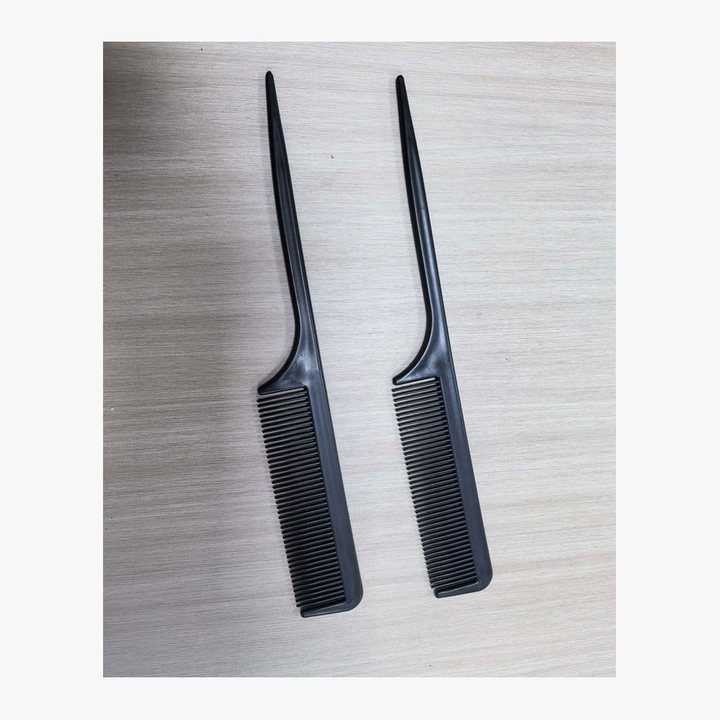
Tooth geometry decides most of the perceived quality. On a tail comb the root runs 0.9–1.6 mm and the tip 0.5–0.9 mm, with a pitch of 1.6–2.0 mm. At those dimensions a single tooth under a 2 N side load deflects roughly 2–4 mm depending on resin, and what happens next is what the customer remembers.
PP deflects furthest and returns cleanly: bend a 1.0 mm PP tooth 30° twenty times and it comes back straight with no visible mark. HIPS shows a white stress line at the root by cycle eight to twelve and snaps by cycle twenty. ABS returns well for the first twenty to thirty cycles, then crazes at the root — the part still works, but a hairlike crack holds dirt and dye.
There is a commercial layer: density is felt as weight, and buyers read weight as quality. A 26 g PP wide-tooth comb and a 28 g ABS comb of the same shape feel different in the hand. For salon distributors handing the product to stylists that 2 g is worth USD 0.05–0.08 per piece; for a supermarket multipack it is not.
Shrinkage and tooth spacing
This is where substitute grades cause the most expensive failures. A 40-tooth row at 1.8 mm pitch spans 72 mm; at 1.5% shrinkage the part comes out 1.08 mm shorter than the cavity. Fine if the tool was cut for that shrinkage, a disaster if the tool was cut for ABS at 0.5% and then run in PP to save cost — the accumulated error pushes the end teeth out of pitch, the row looks uneven and the tips splay.
Shrinkage is directional too. PP shrinks 0.2–0.4 points more across the flow direction than along it, which is why a long thin spine bows into a shallow banana rather than simply shortening. Cooling in the tool runs 8–14 seconds for a 12–30 g comb, and shortening that to hit a cycle target is the most common way a good tool starts producing a bad part. Specify the grade, not the family.
Heat: dryers, hot tools and the 90 °C line
Combs meet heat in four places: hood dryers at 50–60 °C for 20–40 minutes, hot tools at 180–230 °C in brief contact, UV cabinets at 40–50 °C, and the disinfectant bucket that some markets fill with steaming water.
A simple in-house check separates the resins: clamp the comb, hang 500 g from the last tooth, immerse in water at 80 °C for 30 minutes, then measure bow along the spine after cooling. PP typically returns with under 1 mm of permanent bow. ABS at 3 mm spine thickness commonly shows 2–4 mm, because its deflection temperature of 85–95 °C already sits inside the test window. HIPS deforms earlier; glass-filled PP only moves near 140 °C.
Hot-water disinfection means PP or GF-PP; a retail comb that lives in a bathroom cabinet and never sees 80 °C is safe in ABS, which looks better on the shelf.
Chemical resistance: acetone is the test that matters
Salon chemicals are a short list with long consequences: 70–75% alcohol, acetone in nail polish remover, peroxide dye at 6–9%, alkaline perm lotion at pH 8–9.5, and adhesive removers used to lift wig tape residue.
PP and glass-filled PP shrug off all of them. ABS does not survive acetone: a single drop etches a dull ring in 10–20 seconds, and a soaked cloth held against a spine for a minute can craze through the wall. HIPS behaves worse. The failure is undramatic — the comb keeps working but carries a chalky scar, and in a salon that scar is what the stylist shows the distributor when asking for a replacement.
Two ways out: mould in PP and accept the softer feel, or keep ABS and print a care line on the sleeve — avoid acetone and solvent cleaners. For a private label selling into salons, the first is usually cheaper than the returns.
Static, drag and the feel through wet hair
Polyolefins are good insulators, which is exactly the problem. Untreated PP sits at a surface resistivity of roughly 1014–1016 Ω, so a wide-tooth detangling comb run through dry hair in low humidity lifts the hair and leaves it standing. An antistatic masterbatch at 1–3% loading pulls resistivity to about 1010–1011 Ω and adds roughly USD 0.03–0.06 per kilogram — under a cent per comb, the cheapest quality upgrade in the category.
Surface finish changes drag as much as resin does. A cavity polished to SPI A-2 (Ra 0.05–0.1 µm) slides through wet hair; a matte etch at VDI 24–30 grips. Neither is better in the abstract: a teasing comb wants grip at the spine and slip at the tip.
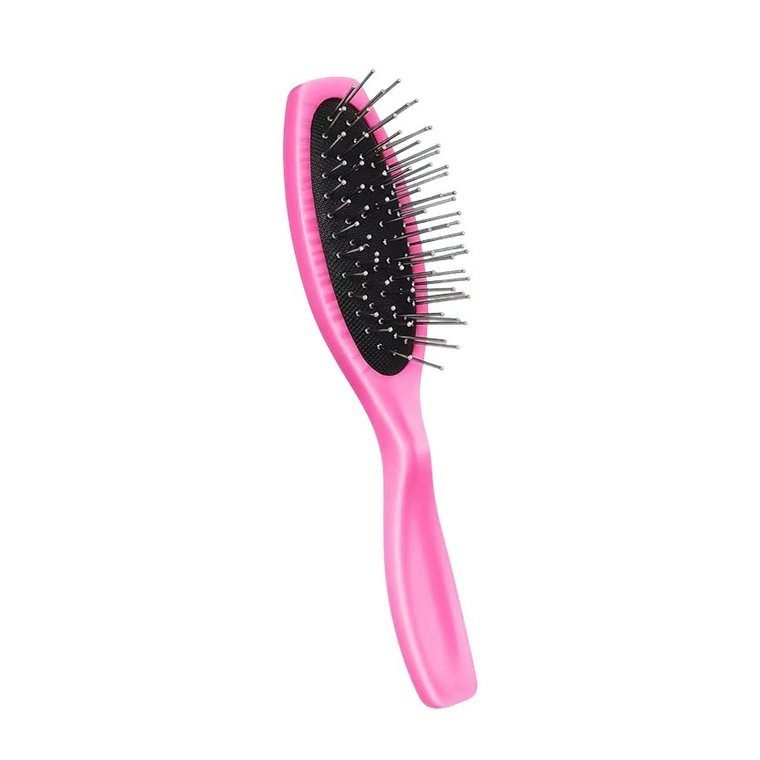
Mixed-material products add a second specification. Metal pins set into a plastic cushion give lower friction and better heat tolerance at the tip, but the metal is now a skin-contact component. Under EU REACH, nickel release from items in prolonged skin contact is limited to 0.5 µg/cm²/week, and that is a test your supplier should document. The wider picture — GPSR responsible person, packaging EPR, REACH declarations — is in our EU import compliance guide.
What the resin delta costs per 1,000 pieces
Resin price is one of three inputs; the others are part weight and moulding cost per piece.
Typical spot ranges for injection grades in China have run roughly USD 1.05–1.30/kg for PP homopolymer, 1.25–1.55 for HIPS, 1.45–1.85 for 20–30% glass-filled PP, and 1.60–2.10 for general-purpose ABS over the past two years; nylon sits higher at 2.60–3.40. These move with oil and feedstock duty, so treat them as an order of magnitude, not a quote.
Moulding cost behaves differently. A machine hour on a 100–180 tonne press costs roughly USD 18–35 including labour and overhead in our region. Four cavities on a 30-second cycle gives 480 pieces an hour, so machine time lands at USD 0.04–0.07 per piece; eight cavities halves it. This is why the gap between two suppliers quoting “PP” is often a tooling gap, not a resin gap — the arithmetic is in our mould cost and tooling ownership guide.
| Comb | Resin | USD/kg | Material/pc (USD) | FOB 1,000 (USD) | What you buy |
|---|---|---|---|---|---|
| Wide-tooth, 26 g | PP homo | 1.15 | 0.030 | 0.26–0.30 | Chemical resistance, low landed cost |
| Wide-tooth, 28 g | ABS | 1.85 | 0.052 | 0.34–0.40 | Gloss, weight, shelf presence |
| Wide-tooth, 28 g | GF-PP 20% | 1.65 | 0.046 | 0.30–0.36 | Stiffness, 140 °C tolerance |
| Tail comb, 12 g | PP homo | 1.15 | 0.014 | 0.18–0.22 | Volume private label |
Read the table as direction, not a price list. PP to ABS on a wide-tooth comb is roughly USD 0.08–0.10 per piece at 1,000 — a 30% FOB increase for a part in the same carton. At 30,000 pieces a year that is USD 2,400–3,000: a marketing decision, or a cost you did not budget.
Surface finish: why glass-filled reads cheaper than it costs
Glass-filled PP is the technically superior material for heat and stiffness, and the hardest to sell at a premium price. Fibres just under the surface scatter light, so a gloss cavity produces a faint hazy, slightly mottled part; polish harder, cut into fibre, and it gets worse.
The workable answer is a deliberate matte: etch the cavity at VDI 24–30 and sell the texture as grip. That is a legitimate design choice, but it cannot be presented as a gloss product. PP has the opposite flexibility — SPI A-2 gloss if the tool is polished, textured matte if you prefer, from the same resin. ABS takes the highest gloss straight off the tool and is the one grade that can be electroplated, which is how chrome-look handles are made.
Colour adds a smaller variable. Glass-filled compounds need roughly 0.2–0.4% more pigment to hit the same Pantone reference because fibres scatter light. Matching a brand colour across a PP body and a GF-PP insert means masterbatch from one lot, approved under D65 rather than office light.
Specifying resin on a purchase order
A specification a factory can act on has six lines. Anything shorter leaves room for substitution, and substitution is rarely malicious — usually a purchasing decision made three weeks before delivery when a grade is out of stock.
Write: resin family and grade with MFI range; virgin-to-regrind ratio, capped at 15–20% regrind and none in skin-contact teeth; colour to a Pantone reference approved under D65; additive package (antistatic 1–3%, UV stabiliser 0.2–0.5%, anti-scratch if gloss); surface finish to an SPI or VDI number per zone; and the two tests you will run on pre-production samples — a 20-cycle tooth bend and 30 minutes at 80 °C under a 500 g load.
Ask for three things with the quotation: the resin datasheet showing shrinkage and MFI, a 300–500 piece run from the production tool rather than a prototype cavity, and five retained samples per lot held for twelve months. That last request costs almost nothing and settles most disputes about whether a defect was in the goods or the handling.
Our tooling, moulding and assembly sit in one plant in Xuchang, Henan, so a grade change is a scheduling decision rather than a supplier negotiation — useful when you want to compare PP against ABS on the same tool before committing to 30,000 pieces. The range is on the product pages, and the custom route — Pantone matching, logo printing, card and blister packaging — is set out under OEM and ODM services. If you are still choosing shapes rather than resins, start with the tail comb versus rat-tail comparison and the tail comb range.
Two things to do before the next order
First, test what you sell today: bend one tooth 30° twenty times and look for a white line at the root, put a drop of acetone on the spine and wipe after 30 seconds, and hold it in 80 °C water under a 500 g load for half an hour. The results tell you which resin you are actually buying, whatever the invoice says.
Second, put the grade on the PO before you compare prices. A quotation that says “PP” and one that says “PP homopolymer, MFI 15–20, max 15% regrind, antistatic” are not the same offer. Send the part you want matched through the contact form with the target market and annual volume, and we will quote the same shape in two resins so the difference fits on one page.
Related reading
- Tail comb vs rat tail comb — tooth profile, taper and finish, and what each type costs to make.
- MOQ, lead times and pricing explained — how minimums are set and what moves the unit price.
- Salon and barber bulk buying guide — what a salon chain should stock, and where the savings actually sit.
Leave a Reply