A photo of a black comb on a white background is not a specification. Buyers send us that photo every week, we quote from it, and four times out of five the sample comes back with the wrong tooth pitch, a spine that flexes too much in the hand, or flash along every tooth edge. It looks identical in the photo, sells badly, and somebody eats the air freight on a re-run.
The cause is that “men’s comb” covers four different products with different dimensions, and the variables that decide whether a comb feels expensive — pitch, tooth taper, root radius, spine thickness, resin shrinkage, edge finishing — are invisible in a picture. What follows are the numbers we work to at our moulding plant in Xuchang, Henan, China, so you can write a spec sheet instead of sending a photo, and cost a men’s comb programme before you commit to tooling.
Four shapes that all get ordered as “a men’s comb”
The first split is not material or colour, it is format. A pocket comb, a barber taper comb, a fork or rake comb and a beard comb are moulded on different tools, packed in different cartons and sold off different shelves. Mixing them up in one purchase order is the most common cause of a sample rejection nobody can explain.
| Format | Length | Weight | Teeth | Where it sells |
|---|---|---|---|---|
| Pocket comb | 100–130 mm | 12–18 g | 18–26 per side | Gift sets, grooming, hotel amenity |
| Barber taper comb | 178–203 mm | 20–28 g | 22–28, two pitches | Salon supply, clipper kits |
| Fork / rake comb | 185–210 mm | 22–32 g | 14–20 wide + 4–6 tines | Barber retail, styling kits |
| Beard comb | 90–110 mm | 10–14 g | 12–18, coarse | Beard oil bundles, subscription boxes |
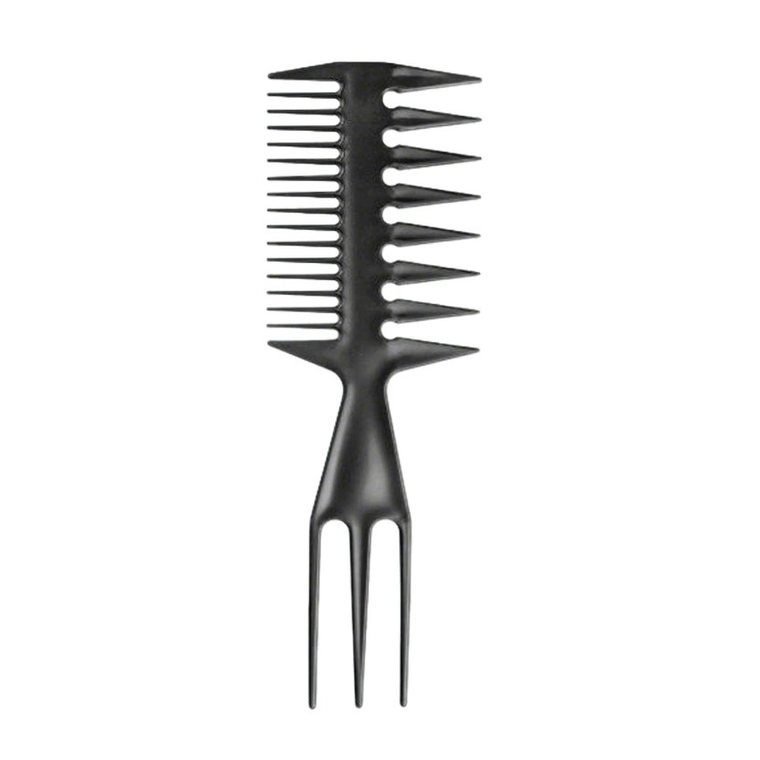
The fork or rake comb is the one that trips buyers up: a wide-tooth face for lifting and separating, a tined face for raking product through, and on some designs a three-prong tail that doubles as a part picker. It is not a scaled-up pocket comb, and it cannot be produced from a pocket-comb mould by swapping an insert.
Tooth pitch: the number that decides how a comb feels
Pitch is the centre-to-centre distance between two teeth. It sits between 1.2 mm and 3.0 mm on men’s combs, roughly 8 to 21 teeth per inch. Below 1.2 mm you have a fine-hair comb, and in PP the teeth deflect permanently after a few months of pocket carry. Above 3.0 mm the comb stops gripping and slides through the hair without doing anything.
Three dimensions move with pitch and are almost never written on a purchase order.
Tooth tip thickness — 0.8 mm to 1.2 mm at the point. A 1.2 mm tip on a 1.6 mm pitch leaves 0.4 mm of gap, which is the difference between a comb that glides and one that drags. Tips under 0.7 mm feel sharp and will fail a hand-feel check in a salon.
Tooth depth — 12 mm to 22 mm from tip to spine on a barber comb, 8 mm to 12 mm on a pocket comb. Deeper teeth flex more. When a buyer says a comb “bends too much”, the fix is usually depth and spine, not a different resin.
Root radius — the fillet where tooth meets spine. Keep it at 0.25 mm minimum. A sharp internal corner is a stress riser: the tooth cracks at the root on the first drop and the crack runs along the spine. It is a tooling detail, cut into the cavity, and it costs nothing to specify.
We hold pitch to ±0.15 mm across cavities on a 12-cavity tool, and we check it with a go/no-go pitch gauge at the machine rather than a caliper on the first part of the shift. Ask for both the tolerance and the method.
Material: PP, ABS, glass-filled PP or acetate
Resin sets shrinkage, and shrinkage sets whether the pitch you drew is the pitch you ship. PP shrinks 1.2–1.8%, ABS 0.4–0.7%, 30% glass-filled PP 0.2–0.5%. On a 1.8 mm pitch, a 1.5% difference across a long spine shows up as a bow, and a bowed comb will not sit flat in a blister.
| Resin | Density | Shrink | Hand feel | FOB band, USD/pc |
|---|---|---|---|---|
| PP homopolymer | 0.90–0.91 | 1.2–1.8% | Light, flexible, matte | 0.14–0.30 |
| ABS | 1.04–1.06 | 0.4–0.7% | Rigid, dense, gloss | 0.20–0.42 |
| 30% glass-filled PP | 1.05–1.15 | 0.2–0.5% | Stiff, dry, heat-stable | 0.45–0.85 |
| Cellulose acetate | 1.28–1.32 | 0.4–0.8% | Warm, heavy, saw-cut teeth | 0.90–2.20 |
Acetate combs are not moulded: the sheet is cast or extruded, the profile cut, the teeth sawed and polished — which is why one acetate comb can cost more than five PP ones. A buyer who sends an acetate reference and asks for 0.35 will be quoted a PP substitute, and the substitution shows in the hand.
Heat deflection sits around 90–105°C for PP, 80–95°C for ABS and 70–80°C for acetate, so an acetate comb left on a dashboard bends and stays bent. On glass-filled PP, budget for an antistatic masterbatch: plain GF-PP at 10^12 ohm surface resistivity still pulls lint in a dry retail environment, and a dusty comb does not sell.
For the flex and drop tests behind those figures, see our comb material comparison.
The fork profile is a mould problem before it is a design problem
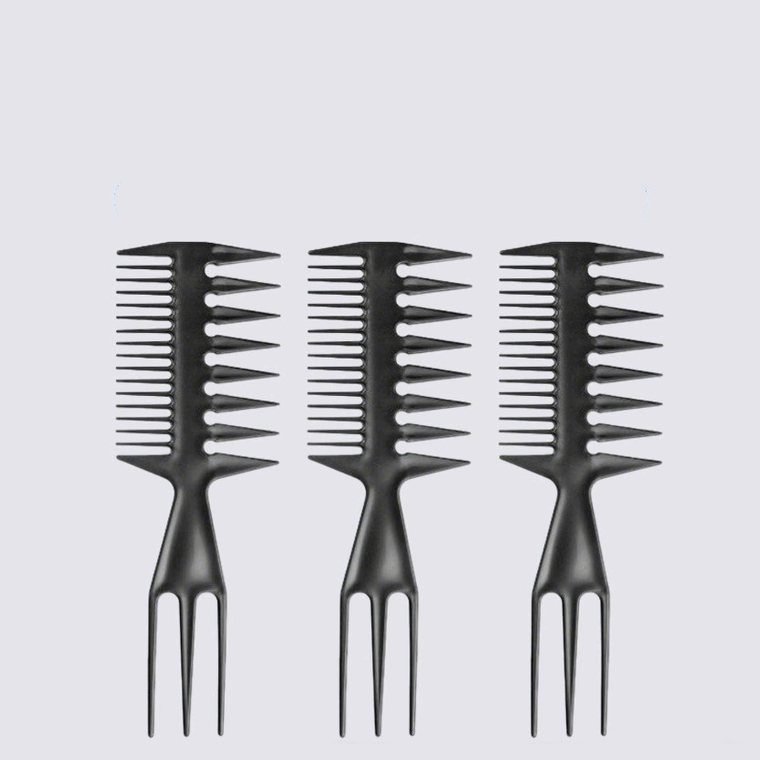
A pocket comb is a two-plate tool. A fork comb is not. The tines stand away from the spine at an angle, and a tine running perpendicular to the parting line needs a slide or a lifter to release, otherwise it drags and scuffs on ejection. The GP-ST05 tool runs two slides, a gate at the tail end, and ejector pins on the spine rather than between teeth.
Gate position matters more than buyers expect. Gating at the tail fills the spine first, then the teeth from the root outward, which keeps the weld line in the thick section where it is invisible. Gate into the middle of the tooth row and the flow front meets itself halfway along the spine, leaving a cold weld that fails in flex.
Typical figures for a men’s comb tool: 8 to 16 cavities, a 25 to 45 second cycle depending on wall thickness and hot-runner setup, 20 to 30 days from drawing release, and USD 3,000–9,000 for a 12-cavity mould with one slide. Tooling is one-time and belongs to whoever paid for it — the mechanics are in our tooling cost article.
Spine, thickness and weight: what a buyer feels in the hand
Spine thickness runs 5–8 mm on a men’s comb. Under 5 mm the comb twists under thumb pressure on the wide-tooth face; over 8 mm it reads as a hotel comb whatever the resin. Web thickness is 2.2–4.0 mm on the tined face and 1.4–2.2 mm on the fine face, and that web is where sink marks appear when the rib behind it is too thin.
Finished weight is a useful honesty check on a sample. A 178 mm barber comb in PP should land at 20–28 g. A sample at 14 g means either the spine is thinner than the drawing or the moulder ran a lower-density grade to save resin — both show up in the breakage rate within three months. We weigh ten parts from the first shot; ±0.5 g across a 12-cavity tool is the target, and a wider band points at a cooling problem on one cavity.
Where the comb will be dropped on a hard floor — barber shops, which is most of the volume — add a 0.3 mm chamfer on the outer edges. Cost: nothing. Effect on breakage: worth measuring over your first 500 pieces.
Edge finishing: the gap between a USD 0.18 comb and a USD 0.28 comb
Two combs can come off the same tool and feel like different products. What happens after ejection decides it, and we run three levels.
Deflash only. A blade or trimming fixture removes the gate stub and any flash at the parting line. Fastest and cheapest, and the tooth edges still carry a micro-burr you can feel with a thumbnail.
Ceramic tumbling. Parts run 20–40 minutes in a vibratory bowl with ceramic media and a light compound. This breaks the burr, softens every tooth tip and gives the matte finish most private-label programmes want. It adds roughly USD 0.01–0.02 per piece at volume and pays for itself in fewer complaints about sharp teeth.
Flame or hot-air polishing. A brief pass melts the surface skin on the tooth edges and spine, producing a gloss PP cannot reach from the mould. It is a manual station, it adds USD 0.03–0.06, and it is the only way to a gloss black pocket comb without moving to ABS or a coating. The trade-off: over-polishing rounds the tips and changes the pitch feel, so it needs a fixed pass speed and a standard sample at the line.
Packaging: four formats and what each adds per unit
On a product with a 0.18–0.30 unit cost, packaging is not a detail; it can double the landed cost. Four formats we run most often, with typical add-on cost per piece at 1,000–5,000 units:
OPP bag, unprinted — USD 0.008–0.015. Right for salon bulk packs and clipper-kit inserts, where the comb is a component rather than a retail item.
Printed backing card with euro slot — USD 0.03–0.06, 300–350 gsm board, four-colour both sides. The default for beauty-supply and pharmacy chains. Card art needs 3 mm bleed, and the slot must be punched on the vertical centre line or the comb hangs crooked on the peg.
Blister on printed card — USD 0.08–0.14 including PVC or PETG forming. Better theft resistance, more freight because the pack is thicker, and the format most likely to fail a drop test when the seal is under-run.
Tin or gift box — USD 0.35–0.60. Only sensible inside a multi-piece grooming set where the box carries the price.
The carton matters as much as the pack. A 500-piece carton of pocket combs runs 0.035–0.05 CBM, so 1,000 pieces is roughly 0.07–0.10 CBM — under a tenth of a pallet, which is why small comb orders ship LCL or consolidated rather than in a container. Use 32 ECT board for sea freight and stack no more than eight cartons high: combs are light, but the cartons crush and the cards inside take a permanent set.

For Amazon the prep rules change the pack again: poly bag with a suffocation warning, no loose pieces in the master carton, and an FNSKU label that does not cover the card art. We keep a separate FBA prep checklist for that route.
Price bands, MOQ and carton maths
FOB China bands for a men’s comb at 1,000–5,000 pieces, one colour, OPP bag: PP pocket 0.14–0.30, ABS pocket or barber 0.20–0.42, glass-filled PP barber 0.45–0.85, acetate 0.90–2.20. Add 0.03–0.06 for a printed card, 0.01–0.02 for tumbling, and 0.10–0.25 where a design needs a two-shot look rather than pad printing.
Our standard MOQ is 1,000 pieces per colour. Below that, buyers normally take from stock rather than a dedicated run, because a 12-cavity tool still has to be set up, purged and colour-changed for 300 pieces. If you are testing a shape before committing, ask what is in stock in black — black covers most of the menswear channel and it is the colour we hold deepest.
Lead time on a repeat colour is 20–30 days from deposit, plus 7–10 days for a pre-production sample when the tool is new or the colour is a Pantone match. Add three weeks for LCL to a US or EU port in the four weeks before Chinese New Year, when every consolidator in Ningbo and Shenzhen is overbooked. Our shipping and export page lists the documents issued with each shipment, and the lead-time calendar explains why a November order is not a June order.
Custom colour is where quotes diverge most. Pantone matching to ΔE ≤ 1.5 is achievable in PP and ABS, but masterbatch has a 25 kg minimum, which is 2,000–5,000 combs depending on part weight. On a 1,000-piece run, expect either a colour surcharge or the closest stock colour. The tolerance side is in our Pantone guide.
A five-point approval sheet before you release the PO
Most men’s comb disputes are settled by five measurements that take under ten minutes on a sample. Put them on the approval sheet and sign a physical golden sample; photographs will not settle an argument about feel.
1. Pitch and tip. Measure ten consecutive teeth with a pitch gauge. Record the average and the spread. Beyond ±0.15 mm goes back to the moulder.
2. Weight. Weigh five pieces from the same bag. A ±0.5 g band is normal; a 2 g spread means mixed cavities or mixed resin.
3. Flex. Hold the comb at both ends and press the middle against a table edge until the spine deflects about 10 mm. It should return flat within a second. A permanent set means the spine is too thin or the resin too soft.
4. Burr. The stocking drag test, both faces, three points along the tooth row.
5. Colour. Compare against the approved masterbatch chip under D65 light, not office lighting. ΔE ≤ 1.5 on a solid colour, and check a second carton from a later production day, because batch drift is what customers notice three months after delivery.
Two actions are worth taking this week. Put pitch tolerance, spine thickness and finish level in your next RFQ instead of a photo — every supplier then quotes the same object, and the cheapest quote stops looking cheapest by accident. And if you are building a grooming range, treat the fork comb and the beard comb as a pair: they share a shelf and a customer, and running both in one colour on one setup splits the changeover cost. What is already tooled sits on our product pages, OEM services covers colour, print and packaging work, and a drawing or reference sample can go through the contact form for a spec review before any tooling decision.
Leave a Reply