Category: Uncategorized

  • Wig Tape and Adhesive Strips: Hold Time, Heat Resistance, Residue and EU Compliance

    Wig Tape and Adhesive Strips: Hold Time, Heat Resistance, Residue and EU Compliance

    Most first orders of wig tape fail for a reason that never shows up on the quotation: the buyer compares price per strip, picks the cheapest, and discovers in week three that the adhesive lifts at 32°C in a salon, or that removal pulls lace fibres and leaves a grey gum line on a customer’s forehead. The second failure is quieter and more expensive. A European importer receives the cartons, then asks for a REACH declaration and a residue report the factory never had, and the shipment sits in a warehouse while the question is answered by email.

    This guide covers the four products sold as “wig tape”, the five variables that decide whether a strip holds one day or seven, the heat and residue numbers worth putting in a purchase order, and the paperwork an EU or US buyer asks for before the second order. It is written from the production side at our factory in Xuchang, Henan, China, where we die-cut adhesive strips alongside our injection moulding lines. Treat every figure as a typical range to confirm on your own samples.

    The Four Products Buyers Call “Wig Tape”

    Quotations get confused because one enquiry word covers four different constructions. Ask which one is being priced before comparing anything.

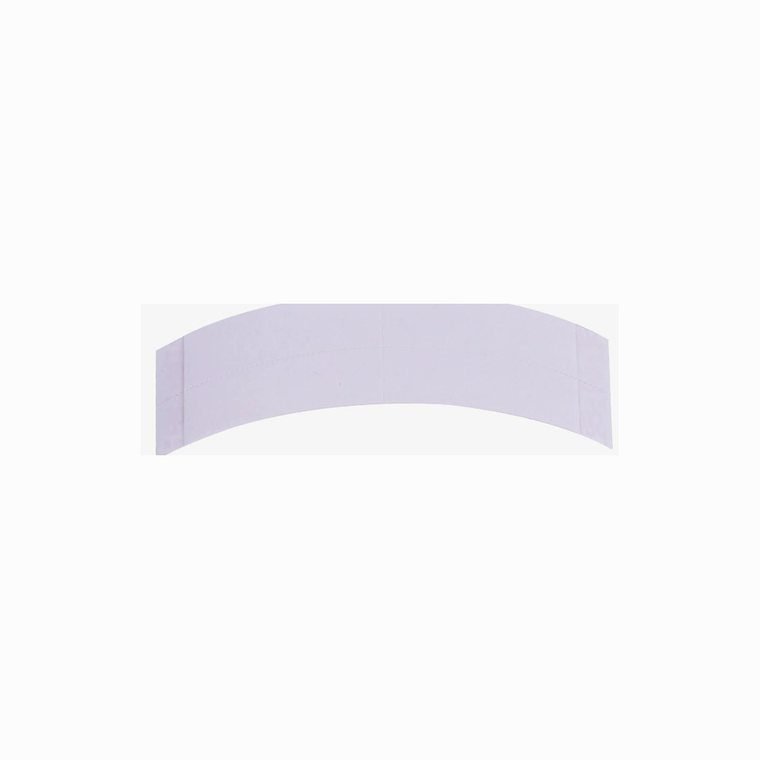
    • Contour-cut double-sided strips. Pre-shaped arcs and bands die-cut from a coated roll, carried on a release liner, packed flat in a card or flow wrap. Typical thickness 0.08–0.15 mm (3–6 mil), strip length 75–200 mm.
    • Tape rolls. The same adhesive in a 3 m to 10 m roll, 12–25 mm wide, cut by the wearer. Cheaper per metre, slower to apply, standard for salon back-bar use.
    • Skin-protective tape (the “white face” product). A thinner, lower-tack tape applied to the scalp first, with the stronger tape stacked on top. It protects sensitive skin and makes removal easier; it does not carry the hold alone.
    • Tabs for closures and edges. Short 25–50 mm pieces for hairline, sideburns and nape, often in a booklet of 12 to 36 pieces.

    Contour-cut double-sided wig tape GP-WT01 on release liner, die-cut strips
    GP-WT01 contour-cut strips on release liner. The die shape, not the adhesive, sets the per-unit cost at this format.

    Hold Time: What Actually Decides 1 Day or 7 Days

    Hold time is not a single property of the adhesive. It is the result of five variables, and a failure in any one caps the result no matter how good the other four are.

    1. Coat weight

    Grams per square metre of dried adhesive. Light coats of 35–45 gsm give clean removal and 1–3 days. Standard salon product sits at 50–70 gsm. Heavy coats of 75–90 gsm give the 5–7 day hold that film work needs, but raise residue risk and cost about 15–25% more per strip than a 55 gsm build.

    2. Surface energy of what you stick to

    Lace mesh, polyurethane skin base, hard front and human skin all behave differently. A tape that performs at 7 days on a poly rim may give 2 days on soft Swiss lace, because the adhesive contacts far less surface per square centimetre and the mesh flexes. Ask which substrate the quoted build was tested on, then test on yours.

    3. Application pressure and cleanliness

    Pressure-sensitive adhesive needs pressure. Two seconds of firm rubbing at roughly 2–3 kg of hand force beats moving up one coat weight band. Oil and sebum are the other half: a scalp wiped with 70% isopropyl alcohol and left 30 seconds to dry holds measurably longer than one wiped with a damp cloth.

    4. Edge design and wearer temperature

    A 0.5–1 mm feathered edge lifts later than a straight cut because there is no step for friction to catch, and it costs nothing per unit once the tool exists. Scalp under a lace front also runs a few degrees above core, which is why the next section matters more than the office sample test.

    Heat and Humidity: Why Summer Orders Fail

    Almost every hold complaint we investigate traces to shear, not peel. Peel is what the buyer tests in an air-conditioned office by pulling a corner. Shear is what happens on a customer’s forehead at 35°C and 70% relative humidity for eight hours with 500 g of hair pulling downward. Quote these ranges in the spec and ask for them in the test report:

    Property Typical range Why it matters
    Peel adhesion, 180°, on stainless steel 3–9 N/25 mm Baseline tack. Above 9 N/25 mm removal usually hurts.
    Peel adhesion on lace mesh 1.5–4 N/25 mm The number that predicts real wear.
    Static shear, 500 g at 38°C 12–72 hours before slip Predicts a full working day in a warm salon.
    Static shear, 500 g at 50°C 2–12 hours Predicts a car dashboard, a shipping container, or a Gulf summer.
    Softening onset 60–80°C for rubber-based, 90–120°C for cross-linked acrylic Container interiors in July reach 60–70°C.

    That last row is the one buyers ignore. A 40ft container on a dock in Jebel Ali or Lagos in August will sit above 60°C for hours, and rubber-based adhesive that performs in a Warsaw salon in March can arrive with the liner welded to the adhesive. If your market includes the Middle East, West Africa or the southern United States, specify cross-linked acrylic and ask for a 50°C shear figure, not a room-temperature peel figure. Our shipping and export notes cover container temperature and loading positions.

    Residue: The Complaint That Ends Accounts

    Residue is a chemistry and coat-weight problem in a customer-service costume. Three things drive it.

    Adhesive type. Rubber-based adhesives are cheap, grab hard and leave the most residue, especially after heat exposure. Standard acrylics are cleaner and good for 3–5 days. Cross-linked acrylics and the better silicone hybrids remove almost cleanly after 7 days and cost 20–40% more. No construction is both the cheapest and the cleanest; anyone who says otherwise is quoting the wrong product.

    Coat weight versus wear time. A 90 gsm strip worn for 10 hours leaves more residue than a 55 gsm strip worn for the same time. Heavy coat is justified only when wear time is genuinely 5–7 days.

    Removal method. Many residue complaints describe a removal technique, not a defect. Removers based on isopropyl myristate or cosmetic-grade solvent, applied along the edge and left 30–60 seconds, lift most acrylic residue without pulling lace. If your customers are salon-trained, print that instruction on the card; it cuts returns more than switching adhesive does.

    What You Are Really Quoted: Adhesive, Carrier, Liner

    Three layers decide the price and the performance, and buyers usually discuss only the first.

    Adhesive. Rubber, standard acrylic, cross-linked acrylic, or silicone. This is 60–75% of the material cost difference between quotations.

    Carrier. Most strips use PET film of 0.05–0.10 mm, which does not stretch and die-cuts cleanly. Non-woven carriers are softer on skin and cheaper, but they tear on removal and cannot hold a feathered edge. For a lace front, PET is the default; for a skin-protective layer, non-woven is often right.

    Liner. Glassine paper at 60–90 gsm is the cheap standard and curls in humid weather. PE-coated paper at 80–120 gsm releases more consistently and stays flat, at roughly USD 0.01–0.03 more per strip. In tropical markets the liner, not the adhesive, is the usual cause of “the strip was stuck to the paper and I could not peel it”.

    Die-cutting and contour shapes

    Contour strips need a steel rule die. Tooling typically costs USD 80–250 and takes 3–7 working days, and it belongs to the buyer who pays for it. Get that sentence in writing, because a die you paid for should move with you if you change supplier. Common shapes are the arc for the hairline, the tapered band for the nape, and a 12 mm x 75 mm rectangle for edges. A new shape at 1,000 pieces is viable because the tool is a one-time cost; at 200 pieces it is not, unless you accept a hand-cut sample run.
    White face tape GP-WT02, wide contour band on release paper for scalp protection
    GP-WT02, the wider white-face band used as a protective layer under a stronger strip.

    EU and US Compliance: REACH, SVHC, EPR and Prop 65

    Get the paperwork before the deposit, not after the arrival notice.

    REACH SVHC. Articles on the EU market must not contain Substances of Very High Concern above 0.1% by weight per article, and the candidate list has passed 240 entries with updates roughly twice a year. Ask for a declaration dated within 12 months that names the list revision it was checked against. A declaration with no date is not a declaration.

    REACH Annex XVII. Restricts specific substances regardless of concentration. For dyed liners and printed cards the relevant ones are azo colourants (entry 43, 30 mg/kg limit on the listed amines) and certain phthalates in ink. If your card is printed in four colours, ask which ink system and get the azo statement.

    Classification. Wig tape is not a CE-marked product category, and a request for a “CE certificate for wig tape” usually comes from a purchasing template rather than a regulation. Resolve it in writing with your importer instead of paying a lab for a certificate that does not exist. Whether a skin-contact adhesive strip is an article or falls under cosmetic rules is a borderline call that belongs to your EU importer or responsible person; get their position in writing and keep it on file.

    Packaging EPR. EU rules require you to register the card, film and carton you place on each national market. Germany (LUCID), France (Triman) and Spain each have their own system, checked at packaging level, so a flow wrap versus a carded blister changes your declared tonnage. Ask for material weights per SKU now; reconstructing them later is painful.

    United States. No pre-market clearance applies to wig tape as a consumer accessory. California Proposition 65 warnings and short-form label rules are the practical issue, along with the accuracy of any “hypoallergenic” or “medical grade” claim. Do not let a supplier print medical claims on your card; they change your regulatory position and no factory declaration can support them.

    For invoice, packing list, certificate of origin and HS classification, see our guide to importing hair accessories from China.

    MOQ, Pricing and Carton Economics

    Tape is light and small, which makes it a natural filler line in a mixed container, and that is the most useful commercial fact about it.

    Format Typical FOB unit price MOQ Carton configuration
    Contour strip, 55 gsm acrylic, plain card USD 0.05–0.12 per strip 1,000 pcs per shape 200 pcs per inner, 20 inners per carton
    Contour strip, 80 gsm cross-linked, printed card USD 0.14–0.30 per strip 1,000 pcs per shape 100 pcs per inner, 24 inners per carton
    Tape roll, 3 m x 12 mm USD 0.60–1.60 per roll 1,000 rolls 144 rolls per carton
    Skin-protective white tape, roll USD 0.80–2.50 per roll 1,000 rolls 120 rolls per carton

    Two structural points drive landed cost more than the unit price.

    Carton cube. A carton of 4,000 strips measures roughly 0.045–0.06 CBM depending on card size, so 1,000 cartons is 45–60 CBM, a 40ft high-cube on its own. Most buyers never ship a full container of tape; they mix 8–15 CBM with wig stands and combs to fill a container that would otherwise be half empty. Our container loading guide has the per-SKU cube table.

    Board grade. Use ECT-32 or equivalent for export cartons, not a lighter domestic board. Tape cartons are dense and stack four to six high, and a crushed carton turns a USD 0.06 strip into a complaint about bent product and a returned pallet.

    Below 1,000 pieces we can offer stock shapes from existing dies instead of opening a tool, which is how a brand tests a market cheaply; the trade-off is that colour, card artwork and coat weight are fixed to what is already running. For the sequence from artwork to first shipment, see our private label walkthrough; for volume tiers and lead times, see MOQ, lead times and pricing.

    Export cartons of finished hair accessories packed for container loading at the factory
    Tape ships dense for its cube. Board grade and stacking height decide whether it arrives flat.

    Incoming Inspection: Five Tests in Your Own Warehouse

    You do not need a lab to catch most bad lots. These five checks take about 90 minutes per SKU.

    1. Liner release. Peel 10 strips at 23°C and again at 30°C after 24 hours in a warm room. Any strip that tears the liner or lifts the adhesive film is a reject. Record the temperature; the number is meaningless without it.
    2. Peel by hand on the real substrate. Stick five strips to lace offcuts and five to poly rim offcuts, press 2 seconds, wait 30 minutes, peel at a slow steady angle. Compare against the sealed approved sample, not against a feeling.
    3. Oven shear. A domestic oven at 50°C, a 500 g weight hung from a strip stuck to a glass tile, and a clock. Anything that slips in under 2 hours will not survive a Gulf summer or a container.
    4. Residue. After the oven test, remove the strip and inspect the tile under a desk lamp. A gum line that needs solvent is a reject for a 5–7 day product.
    5. Count and dimension. Ten strips measured against the drawing. A 1 mm shortfall in width is a 6–8% material shortfall across a carton, and it is the easiest thing to drift.

    Log results per lot number and keep the approved sample sealed and dated; when a dispute appears eight months later, that sample is the only thing that settles it. Our factory page shows the lines these lots come off, and the supplier audit checklist covers what to look for on a video walkthrough.

    Two Actions Before You Place the Next Order

    First, rewrite the specification. Replace “strong hold, easy removal” with four numbers: coat weight in gsm, peel adhesion on lace in N/25 mm, static shear at 50°C with a 500 g load, and a residue rating after 72 hours with the method named. A factory that receives those four lines either confirms them or tells you which one it cannot meet. Either answer beats a sample that feels fine in an office.

    Second, separate tooling from product. Put the die cost, die ownership and shelf life (12–24 months below 25°C and 50% relative humidity) in the same document as the unit price. Tape is a low-value, high-annoyance category: failures are almost never about the USD 0.02 per strip, they are about a liner that will not release and a declaration that arrives three weeks late. Fix those two and the rest of the line scales easily. If you want the four-line specification reviewed against your market, send us the target market and wear time and we will reply with the construction we would run.

    Related reading

  • Wig Stand Sizes and Heights: Cap Fit, Carton Dimensions and Freight

    Wig Stand Sizes and Heights: Cap Fit, Carton Dimensions and Freight

    Most wig stand orders that go wrong do not go wrong on price. They go wrong on height. A buyer collects three quotations, picks the lowest unit cost, and then finds out that a 45 cm stand will not fit the shelf spacing in a beauty supply store, or that the export carton is 5 cm taller than the one the forwarder quoted — which quietly removes 8,000 pieces from a 40HQ container. The stand is still a perfectly good stand. The order just stopped making money somewhere between the quotation and the loading dock.

    This guide works through the numbers that decide a wig stand order: the four heights that cover most wholesale demand, base diameter against cap circumference, wall thickness and part weight, carton geometry and its effect on CBM, board grade for export, and a worked landed-cost comparison between a 30 cm and a 45 cm stand. Every figure below is a typical range taken from our own moulding and packing floor in Xuchang, Henan, China — not laboratory data. Treat them as the starting point for a quotation, then confirm each one against the sample you receive.

    Worth fixing the sequence before the numbers: selling environment first, then height, then shape, then price. A stand is mostly air — 70–80% of the volume it takes up in a container is empty space around a thin moulded shell — so two models that look identical on a product photo can differ by 26% in carton volume and by more than USD 0.10 per piece in ocean freight. Buyers who work price-first usually re-order at a different height within two seasons.

    The four heights that cover most wholesale wig stand orders

    Four heights account for the large majority of volume across the orders that pass through our floor. They are worth knowing because they map onto four retail contexts, and because tooling already exists for all of them — no mould cost, and a 20–30 day production lead time instead of 45–60.

    30 cm (12 in) — countertop and shelf display

    The volume seller. Base diameter typically 12–14 cm, part weight 95–115 g in a one-piece PP moulding, packed 40 pieces per 60 × 40 × 40 cm carton. FOB for 1,000–5,000 pieces usually lands at USD 0.55–0.75 depending on colour and packing. It suits short caps, hairpieces and clip-in sets, and it is the height most Amazon and TikTok Shop sellers start with, because the carton is small enough for FBA prep without dimensional weight penalties.

    35 cm (13.8 in) — the salon worktop compromise

    Slightly taller than the countertop model, still stable on a narrow shelf. Weight 110–130 g, and the extra 5 cm of stem is usually enough to keep a 20-inch cap off the table during styling. If a buyer cannot decide between 30 and 40 cm, 35 cm is the safe middle: it photographs well and still ships at a reasonable CBM.

    40 cm (15.7 in) — desktop display for longer caps

    Common in wig shops and salon retail areas where the stand is meant to be seen rather than stored. Base diameter moves to 15–17 cm to keep the taller centre of gravity stable, weight 125–150 g, and cartons are typically 60 × 45 × 45 cm holding 30 pieces. Expect USD 0.95–1.35 FOB for a foldable version at 1,000–5,000 pieces.

    45 cm (17.7 in) — floor and showroom

    The display height for long straight caps, cosplay pieces and showroom windows. Base diameter 16–20 cm, weight 140–175 g, 24 pieces per 60 × 45 × 45 cm carton. Foldable versions with a locking hinge usually quote at USD 1.45–1.90 FOB. This is the height where freight starts to hurt, and the next two sections explain exactly how much.

    Base diameter and cap circumference: the fit numbers buyers skip

    Classic one-piece wig stand GP-WS01 in white, moulded on Globaplas own tooling
    The classic one-piece stand, GP-WS01 — a single PP moulding with no hinge to break.

    A wig stand is not a head form and does not need to match cap circumference the way a canvas block does. What the base has to do is resist tipping while a wet cap is combed or styled.

    The working rule on our floor: base diameter should be at least 22–26% of the cap circumference the stand will carry. A 58 cm cap (about 22.8 in, near the top of the common 54.6–58.4 cm range) needs a base of roughly 14 cm minimum; a 54 cm cap can sit on 12–13 cm. Below that ratio the stand tips when a wet 24-inch cap is pulled sideways during detangling, and the customer blames the product rather than the sizing decision.

    Height and base have to be chosen together: a 45 cm stem on a 12 cm base is a lever waiting to fall over, while the same stem on an 18 cm base is stable but weighs 15–20% more. The pairing we quote most often is 30 cm / 13 cm, 35 cm / 14 cm, 40 cm / 16 cm and 45 cm / 18 cm. If your market skews to long, dense caps, go one base size up rather than one stem size up.

    Shape selection: five moulds, five different jobs

    Salon foldable wig stand GP-WS06 folded flat beside its open position
    GP-WS06 folds to a 45–60 mm stack, which makes it viable for e-commerce parcels.

    Height gets the order; shape gets the re-order. Each configuration carries a different cost and handling consequence.

    • Classic one-piece (GP-WS01). No hinge, no assembly, lowest unit cost and the most durable, because there is nothing to break. Best for high-volume retail and market stalls. Downside: it occupies full volume in the carton, so you pay for air.
    • Ventilated hollow (GP-WS03). Wall pierced with 8–12 mm openings so air moves through the crown. Drying time for a washed cap is typically 30–40% shorter than on a solid stand, which matters for salons running several washes a day. The core needs slides, so mould cost is higher; unit price at 1,000+ pieces is close to the classic.
    • Draining (GP-WS09). A channel and drip point at the base so water runs off instead of pooling at the crown. Used by salons that wash and dry on the same stand. Usually 10–15 g heavier than the equivalent classic.
    • Foldable (GP-WS06). Hinged legs collapse to a 45–60 mm stack, cutting carton volume by roughly 55–65% against a one-piece stand of the same height — the single biggest freight lever available. Living hinge or pin joint, both moulded in-house.
    • Detachable (GP-WS05). Crown and base separate completely. Similar volume saving to the foldable, and a distributor can ship replacement bases separately. Higher assembly labour, so it prices 5–10% above the foldable.

    For a first order the foldable is usually the right default: it protects margin on freight and survives parcel handling better than a tall rigid stand. Salons tend to prefer the ventilated or draining version once they have tried one, because the drying argument is operational rather than cosmetic.

    Wall thickness and part weight: where cheap stands fail

    Wall thickness on these parts typically runs 1.6–2.2 mm, with 1.8 mm as the working standard for a PP stand that has to survive repeated handling. Below about 1.6 mm, shrinkage at the hinge and at the base-to-stem transition shows up as stress whitening, and a folded stand opened and closed a few hundred times will crack at exactly that point.

    Thickness is not the only way to get stiffness, and rarely the cheapest. Adding a rib costs 0.8–1.2 g of material; adding 0.2 mm of wall across a 40 cm stand costs 8–14 g. Ribs under the base and a 1.2–1.5 mm gusset at the stem transition give most of the rigidity for a fraction of the weight, which is why a well-designed 130 g stand can feel stiffer than a badly designed 160 g one. Ask for the rib layout, not just the wall thickness.

    Material choice matters too. PP is the default: it takes a living hinge, resists salon chemicals and prices 8–15% below ABS at the same part weight. ABS gives a harder surface and takes electroplating, so it suits premium retail and metal-look finishes — but anything with a clip or hinge that flexes should stay PP, because ABS cracks rather than bends.

    Carton geometry: how 5 cm of height moves your freight bill

    Finished wig stands packed into printed export cartons at the Globaplas warehouse
    Export cartons are sized against the pallet first — a 60 × 45 cm base fits a 120 × 100 cm pallet with no overhang.

    Carton dimensions are driven by part height plus 20–30 mm of clearance, and that clearance is where buyers get squeezed.

    Stand height Pcs / carton Carton (cm) CBM / carton CBM / 1,000 pcs
    30 cm 40 60 × 40 × 40 0.096 2.40
    35 cm 36 60 × 42 × 42 0.106 2.94
    40 cm 30 60 × 45 × 45 0.122 4.05
    45 cm 24 60 × 45 × 45 0.122 5.06

    Read the last column. Moving from a 30 cm to a 45 cm stand more than doubles the volume per thousand pieces — 2.40 CBM to 5.06 CBM, an increase of 111%. On a 40HQ with roughly 65 CBM usable after pallets and door clearance, that is the difference between about 27,000 pieces and about 12,800 pieces in the same container.

    Now put a freight rate against it. At a typical USD 2,800 per 40HQ (rates have ranged from 1,800 to 4,500 in the past two years; use your own booking), ocean cost per piece works out at roughly USD 0.10 for the 30 cm stand and USD 0.22 for the 45 cm one. That USD 0.12 gap is larger than the entire moulding margin on some orders, and it is invisible on a quotation that only shows FOB unit price.

    Two levers. First, foldable and detachable versions cut carton volume by 55–65%, pulling the 45 cm stand back toward 30 cm freight economics — usually the single best decision in the whole specification. Second, set carton length and width against the pallet footprint before optimising height: a 60 × 45 cm base fits a standard 120 × 100 cm pallet in a clean four-carton layer with no overhang, while a 65 cm length wastes 5 cm on every layer and adds a pallet per few hundred cartons. Our container loading guide works through the pallet arithmetic in more detail.

    Board grade and inner packing that survive the last mile

    A 45 cm stand in a single-wall carton is a dent waiting to happen. For export we specify ECT-32 board (32 lb/in edge crush) in BC double-wall at 6–7 mm caliper for anything above 35 cm. Single-wall ECT-32 is acceptable for the 30 cm stand if the carton is not palletised more than four high.

    Three inner packing formats:

    • OPP bag only. 0.03 mm bag, one stand per bag, no divider. USD 0.01–0.02 per piece, and adequate for market and wholesale channels where the carton is opened at the point of sale.
    • Blister or clamshell. 0.5–0.8 mm PETG with a 300–350 gsm printed backing card. Adds USD 0.06–0.12 per piece and changes carton count by 10–20% because each unit takes more volume. Right for retail pegboard, wrong for e-commerce.
    • Printed colour box. 300–350 gsm white card, four-colour print, barcode and hang tag. Adds USD 0.05–0.09 per piece and typically 8–12% to carton volume. The usual choice for Amazon and brand retail.

    Drop testing: we run ISTA 1A-style 10-point drops at 76 cm on the packed carton before a first shipment. A carton that shows hinge cracking or base corner deformation after that test will not survive a parcel network, however good the pallet looks. Target breakage in transit is under 1.5%.

    Worked example: 30 cm versus 45 cm, all the way to landed cost

    Take a 10,000-piece order to a US West Coast warehouse, both versions foldable, both in printed colour boxes. Illustrative figures at typical ranges, not a quotation.

    Line item 30 cm foldable 45 cm foldable
    FOB unit price USD 0.68 USD 1.62
    Part weight 108 g 158 g
    CBM for 10,000 pcs 24.0 50.6
    Containers needed (65 CBM usable) 1 × 40HQ, 63% full 1 × 40HQ, full
    Ocean freight per piece at USD 2,800/40HQ USD 0.103 USD 0.216
    Duty at 8% (US, plastic hair accessories) USD 0.054 USD 0.130
    Approx. landed before inland USD 0.84 USD 1.97

    The 45 cm stand costs 2.4× as much landed as the 30 cm one, while retailing at maybe 1.3–1.5× the price. That is not an argument against the 45 cm product — it is an argument for charging for it properly, and for not letting a 45 cm specification slip into a programme that was priced around a 30 cm stand. It also explains why so many importers settle on 35 cm as the volume SKU: most of the visual presence, roughly 60% of the freight. When comparing a USD 1.62 quotation with a USD 1.20 one, check wall thickness, hinge type and board grade before negotiating — the moulding is rarely the difference.

    What to measure on the first article and on every reorder

    Warehouse packing bench where wig stand samples are measured and checked before shipment
    First-article checks happen on the packing bench — height, base diameter and hinge action measured on the part that will ship.

    First-article inspection takes ten minutes and catches almost every problem that would otherwise become a claim. We record the following; ask for the same record with the pre-shipment photos:

    • Overall height against drawing, tolerance ±1.5 mm. Drift of 3–4 mm is common when a mould runs hot, and it is enough to change carton count per layer.
    • Base diameter at two points 90° apart, tolerance ±1.0 mm. Ovality above 1.5 mm means uneven cooling and usually predicts warping in later batches.
    • Wall thickness with a calliper at six points — two on the crown, two at the stem transition, two on the base. Anything under 1.6 mm gets flagged.
    • Hinge cycle: 5,000 open-close cycles is our in-house check for a living hinge. A pin-joint foldable should show no visible play after the same run.
    • Colour against the retained master sample under D65 light, ΔE ≤ 1.5. Pantone matching on PP is achievable to about ΔE 1.0–1.5; promising ΔE 0.5 on a moulded part is a commitment nobody can hold across batches.
    • Carton weight and dimensions, plus a check that the count matches the label. Miscounts of 1–2 pieces per carton are the most common packing error we see, and they cost the buyer a full recount at destination.

    What to write into the purchase order

    Most disputes on this product trace back to a purchase order that said “wig stand, 40 cm, white” and nothing else. One that holds up carries:

    • Height and tolerance (e.g. 400 mm ±1.5 mm), base diameter and tolerance, and the model reference (GP-WS06 or equivalent).
    • Material (PP homopolymer), minimum wall thickness, and part weight with a ±5% band.
    • Colour reference — Pantone number plus “match retained sample, ΔE ≤ 1.5” — and the approved master sample date.
    • Carton dimensions, pieces per carton, board grade (ECT-32 BC double-wall) and a marked carton weight.
    • Inner packing format and material spec (0.03 mm OPP, or 0.6 mm PETG with 350 gsm card).
    • Marking: shipping marks, barcode symbology and placement, country of origin printed as “Made in China”.
    • Inspection terms: AQL 2.5 major / 4.0 minor, pre-shipment photos, and who pays for third-party inspection.
    • Delivery terms with named port: FOB Ningbo or FOB Shanghai, and the allowed shipment window.

    Two actions worth taking this week. First, put your three best-selling heights side by side and calculate CBM per 1,000 pieces for each — if one is above 4 CBM, a foldable version of the same height will probably pay for itself on the first container. Second, ask your supplier for the rib layout drawing alongside the wall thickness figure; it is the fastest way to tell a stand designed for 5,000 handlings from one designed to hit a price.

    If you are still choosing between factories rather than between sizes, our guide to choosing a wig stand manufacturer covers the audit points, and the MOQ, lead time and pricing structure piece explains how volume bands are quoted. For sizes outside the four standard heights, our OEM and ODM service covers new tooling on our own moulds, with mould cost amortised or bought outright depending on the volume you can commit. The full stand range is on the products page, or send your cap sizes and target retail price through the contact form and we will come back with a specification and a carton calculation rather than a single number.

    Related reading

  • Amazon FBA Packaging for Hair Accessories: Prep Checklist

    Amazon FBA Packaging for Hair Accessories: Prep Checklist

    Amazon FBA is the fastest route to the US market for a hair accessories brand, and the fastest way to lose margin if you get prep wrong. Charged prep fees, unsellable inventory flags and removal orders all trace back to a handful of packaging details that are decided at the factory — months before the cartons ever reach a fulfilment centre.

    This checklist covers what Amazon actually inspects for wig stands, tail combs, spray bottles and sectioning clips, how the rules differ between small standard, large standard and oversize tiers, and where factory-direct prep beats a third-party prep centre on cost.

    Hair accessories being packed and cartoned at the Globaplas factory before export
    Prep happens here, not in a fulfilment centre. Everything Amazon inspects is decided at packing stage.

    Why prep is a factory decision, not a warehouse decision

    Every requirement in Amazon’s prep manual can be met two ways: your factory does it before the cartons are sealed, or a prep centre in the destination country unpacks, relabels and repacks them. The second option typically costs USD 0.80 to 2.50 per unit plus inbound freight to the prep centre, and it adds five to eight days. On a 1,000-unit order of wig stands that is real money, and it is avoidable.

    The catch is that your factory has to know the requirements before production, because the poly bag size, the label position and the carton markings are all set at packing stage. Sending the prep spec with the purchase order is the whole trick.

    Poly bag rules that trigger the most rejections

    Bags are the single most common reason a shipment gets flagged. Four rules cover almost every case:

    • Suffocation warning. Any poly bag with an opening of 5 inches (12.7 cm) or larger must carry the warning label, printed on the bag or on a label affixed to it. The wording is fixed — “Warning: To avoid danger of suffocation, keep this plastic bag away from babies and children. Do not use this bag in cribs, beds, carriages, or playpens.” A translated or paraphrased version is treated as missing.
    • Bag thickness. At least 1.5 mil. Thin bags split in the fulfilment centre and the unit is marked unsellable.
    • Barcode visibility. The FNSKU must be readable through the bag without opening it, and must not be covered by the warning label. On a 1,000-unit run, misplaced labels cost more to fix than the labels themselves.
    • No combined bagging. Two units in one bag need to be a declared multipack with its own barcode, otherwise they are treated as unlabelled inventory.

    Ask for the poly bag spec in the sample stage. A factory that already runs FBA accounts will have a standard bag with the warning pre-printed, which removes the labelling step entirely.

    Labelling curved products: the wig stand problem

    Wig stands are the hardest item in this category to label well, because the natural place to put a barcode — the flat base — is also the surface that sits on a shelf and gets scuffed. Two workable patterns:

    • Base label, recessed. A 40 × 25 mm FNSKU label on the underside of the base, inside the recess so it does not contact the shelf. Works on round and tripod bases alike.
    • Hang tag plus base label. A printed hang tag through the neck carries the retail barcode and brand story, while the base carries the FNSKU. Costs roughly USD 0.03 per unit and is what most private-label sellers end up with.

    Do not wrap the label around the neck. Curved labels read badly for scanners and get flagged as unreadable, and on a foldable wig stand the neck joint flexes and peels the label off.

    Carton requirements: weight, strength, markings

    Amazon’s carton rules are stricter than general export cartons, and they are checked on arrival:

    • 50 lb (22.7 kg) maximum per carton for standard-size items, unless the carton contains a single oversize unit. Wig stands packed 20 to a carton usually land between 12 and 16 kg — comfortably inside the limit, which is one reason this category ships well.
    • Edge crush test of at least 32 ECT for cartons under 50 lb. A 5-ply carton is normal for export; a 3-ply carton that passes a domestic test will still crush in a container.
    • No loose fill. Styrofoam peanuts and loose paper are rejected. Air pillows, moulded pulp trays or die-cut corrugated inserts are accepted.
    • Carton label on two adjacent sides, 4 × 6 inches, with the shipment ID and box count. One label per carton is not enough.
    • No mixed SKUs in a single carton unless the shipment is declared as mixed, which slows receiving and increases the chance of a count discrepancy.

    If you are shipping to a fulfilment centre for the first time, ask for the carton marking template before production. Reprinting 200 cartons at the port is not a thing anyone wants to do.

    Salon foldable wig stand GP-WS06 standing on its tripod base
    The neck joint on a foldable stand flexes in transit — a label wrapped around it peels off.

    Product-specific prep: what changes per SKU

    Wig stands and foldable stands

    The main risk is dimensional weight, not damage. A 45 cm stand in a 48 × 20 × 20 cm box moves into a higher size tier, and dimensional weight can exceed actual weight by 60 percent. Two fixes: ship the stand folded or knocked down where the design allows, and negotiate the box dimensions with the carrier’s DIM divisor in hand rather than after the first invoice.

    Also confirm that the base has no exposed screw threads or sharp moulding flash. Amazon’s receiving inspection does not fail a unit for flash, but customers do, and returns on a low-ticket item wipe out the sale.

    Spray bottles

    Anything that holds liquid is treated as a leak risk. Empty bottles are the safe route: ship them dry, with the trigger head removed and bagged separately so it cannot actuate in transit. If you ship bottles pre-filled with water for demonstration, they need leak testing and absorbent packing, and many sellers simply remove the liquid rather than deal with it.

    A continuous spray bottle also needs a rigid insert or a moulded tray, because the trigger is the part that breaks first and a broken trigger makes the whole unit unsellable.

    Fine-tooth tail comb GP-ST02 with a pointed tail that needs capping before FBA shipment
    A 12 g tail comb does not need a poly bag if the insert caps the point.

    Tail combs and sectioning clips

    Small, light and high-count — this is where per-unit prep costs hurt most. A tail comb at 12 g does not need individual poly bagging if it is packed in a printed sleeve or a rigid blister, and skipping the bag removes both a cost and a rejection risk. The pointed tail should be capped or recessed in the insert; exposed points are a safety flag.

    Clips and pins are usually sold as sets, which means a multipack barcode. Declare the pack count on the carton and on the listing — a “50 pack” that arrives as 50 loose units in one bag will be flagged.

    Factory-direct prep vs a prep centre: the arithmetic

    Run the numbers on a 1,000-unit order of foldable wig stands, FOB to a US fulfilment centre:

    • Prep centre route: USD 1.20 per unit labelling and bagging, USD 350 inbound freight to the prep centre, five extra days. Total roughly USD 1,550 before the FBA inbound freight.
    • Factory-direct route: the same labelling and bagging folded into the unit price at USD 0.15 to 0.30 per unit, no extra leg, no extra days. Total roughly USD 300.

    The gap is over USD 1,200 on a single order, which on this category is often more than the entire freight bill. The only reason to use a prep centre is if the factory cannot meet the barcode spec — and that is a reason to change factories, not to pay a middleman.

    Our OEM service runs FBA-ready packing as standard: pre-printed suffocation-warning bags, FNSKU labels applied to your artwork, and cartons marked to the Amazon template. If you are still deciding on packaging format, the private label guide covers artwork, dielines and approval timing.

    Pre-shipment checklist

    Send this to your factory with the purchase order. Every line is something Amazon inspects.

    • Poly bag minimum 1.5 mil, suffocation warning printed, opening under 5 inches or warning present
    • FNSKU on every unit, readable through the bag, on a flat or recessed surface
    • Multipacks declared with their own barcode and pack count
    • Carton under 50 lb, 32 ECT minimum, no loose fill
    • Carton labels on two adjacent sides, 4 × 6 inches
    • No mixed SKUs per carton unless declared
    • Liquids drained, triggers bagged, rigid inserts on breakable parts
    • One sealed carton photographed and sent for approval before the run finishes

    That last line does most of the work. A photo of one finished, labelled, sealed carton catches almost every prep error while there is still time to fix it, and it costs nothing.

    Where this fits in the shipping plan

    FBA prep is one leg of a longer chain. If you are still working out how the cartons travel — sea freight versus air, DDP versus FOB, port to fulfilment centre — the shipping and export page covers the modes and the documents, and the container loading guide gives you the carton maths to price the freight before you commit to a quantity. Get the prep and the loading right at the same time and the landed cost stops being a surprise.

    Related reading

  • Container Loading Guide: Hair Accessories in a 20ft or 40ft Container

    Container Loading Guide: Hair Accessories in a 20ft or 40ft Container

    Freight is usually the second-largest line on a hair accessories order, right after the goods themselves. Yet most first-time importers only discover how much it will cost after the deposit is paid — when the cartons are already built and the forwarder quotes whatever volume the factory happened to produce. Getting the loading numbers right before you confirm quantity is one of the cheapest ways to protect your margin, and it takes about twenty minutes.

    This guide covers how carton loading is calculated for wig stands, tail combs and spray bottles, what a 20ft and 40ft container realistically hold once you allow for pallets and stacking, and the six questions to put to any factory before you book space.

    Hair accessories packed into export cartons ready for container loading
    Cartons sealed and marked before the container is booked.

    Start with four numbers, not a guess

    Container loading is arithmetic once you have four inputs. Ask for all four in writing before you discuss price:

    • Carton dimensions — outside length × width × height in centimetres, measured after packing tape, not the flat cardboard size.
    • Units per carton — the inner pack quantity. This is the number that turns cartons into units, and it is the one most often quoted loosely.
    • Gross weight per carton — goods plus inner packaging plus the carton itself. Net weight is not useful for freight.
    • Carton compression strength — usually given as a burst or edge-crush value. This decides how high you can stack, which decides how much of the container’s height you actually use.

    If a supplier can only give you two of these, the loading estimate you build will be wrong by 15–30%, in the direction that costs you money.

    Typical carton profiles for these product classes

    The table below shows the ranges we see across this product category. Treat it as a planning starting point, not a quotation — carton size moves with wall thickness, assembly state, and how many colourways are packed together.

    Product Typical units / carton Carton size (cm) CBM / carton Gross weight
    Classic wig stand (assembled) 80–120 58–62 × 38–42 × 38–42 0.085–0.105 11–14 kg
    Foldable wig stand 150–250 52–58 × 36–40 × 36–40 0.068–0.090 9–13 kg
    Tail comb (bulk packed) 800–1,200 48–52 × 34–38 × 28–32 0.046–0.062 7–11 kg
    Spray bottle, 300 ml 150–250 54–60 × 36–40 × 40–44 0.078–0.104 12–16 kg

    The pattern to notice: these are all low-density goods. A carton of combs weighs under 10 kg but occupies the same 0.05 CBM as a carton of stands that weighs nearly three times as much. That has a direct consequence covered further down — on these products you will almost always run out of volume before you run out of weight.

    Calculate CBM, then apply a realistic fill factor

    Carton volume in cubic metres is simple:

    CBM per carton = (L × W × H in cm) ÷ 1,000,000

    A 60 × 40 × 40 cm carton is 0.096 CBM. A thousand of them is 96 CBM — which is why the next step matters. Containers are quoted by nominal internal volume, but you never load the nominal figure:

    Container Nominal volume Practical loading volume Typical fill factor
    20ft GP ~33 CBM 26–29 CBM 80–88%
    40ft GP ~67 CBM 54–60 CBM 80–89%
    40ft HQ ~76 CBM 64–70 CBM 84–92%

    Where the missing 10–18% goes: pallets if you ship palletised, dunnage and air bags, the unusable gap at the door end, and — most often — height you cannot reach because the cartons are not strong enough to stack to the roof. A high-cube gains roughly 30 cm of internal height, which only converts into cargo if your cartons can take the extra tiers.

    If you are shipping loose-loaded rather than palletised, you can push toward the top of each range. If your cartons are single-wall and your product is fragile at the corners, plan for the bottom.

    A worked example: mixed order, 40ft HQ

    Suppose you want a first order that spreads across three categories rather than betting everything on one SKU — a sensible structure for a new market. Using the midpoints of the table above:

    • 400 cartons of foldable wig stands × 0.079 CBM = 31.6 CBM
    • 300 cartons of tail combs × 0.054 CBM = 16.2 CBM
    • 200 cartons of spray bottles × 0.091 CBM = 18.2 CBM

    Total: 66.0 CBM, and about 9,600 kg gross. That sits comfortably inside a 40ft HQ at a 68 CBM practical target, and leaves roughly 2 CBM of slack — which is exactly where you want to be, because cartons rarely come out at the exact dimensions on the spec sheet.

    Push the same mix to 1,000 cartons and you are at 79 CBM, past the practical ceiling of a 40 HQ. At that point you either drop a category, switch some SKUs to a denser pack (bulk-packed combs instead of individually bagged), or move to two containers. Working that out before the deposit is the difference between a clean shipment and a renegotiation.

    Which limit binds first: volume or weight?

    Payload ceilings are roughly 28,000 kg for a 20ft GP and 26,000 kg for a 40ft — though the figure that applies to your booking depends on the carrier, the road leg, and the country’s axle limits. On this product class you will hit the volume ceiling long before the weight one: a fully loaded 40 HQ of combs lands around 10–12 tonnes, less than half the payload allowance.

    The exception is spray bottles with liquid-filled samples, or any order where you ship pumps and caps separately at high density. If a mixed order includes a heavy component, check weight per container separately rather than assuming the volume calculation covers you.

    How to load a mixed container without wrecking the goods

    Three practical rules that come out of how these products actually ship:

    • Heaviest and most rigid at the floor and toward the door end. Spray bottle cartons are the stiffest of the three and belong at the base; comb cartons, being light and compressible, go on top.
    • Keep one SKU per stack where possible. Mixed stacks of different carton sizes waste height and make the count at destination harder to verify.
    • Plan the unloading order against your warehouse, not the loading order. Whatever you need first should be nearest the doors.

    If your buyer network spans several countries, the same logic applies at a smaller scale: split the container by destination so each port receives a coherent block rather than a mixed pallet that has to be broken down on arrival.

    Six questions to ask before you book space

    1. What are the exact outside carton dimensions, and are they measured after packing?
    2. How many units per carton, and does that change if I add individual poly bags or colour labels?
    3. What is the gross weight per carton, and what is the carton’s compression rating?
    4. How many tiers can be stacked in a container without crushing the bottom layer?
    5. Can you supply a loading plan showing carton count per container for my exact mix?
    6. What is the carton cost if I need a stronger grade for a longer sea leg?

    A factory that can answer all six from its own records is a factory that packs product every week. One that has to “check and come back to you” on questions 1, 3 and 4 is likely re-selling.

    Where MOQ and container maths meet

    Container loading does not exist in isolation from minimum order quantity. If your MOQ per SKU is 1,000 pieces and a carton holds 100, you are buying ten cartons of that SKU — 0.96 CBM. Spread that across eight categories and you have a 7–8 CBM order, which fills a quarter of a 20ft container and leaves you paying for air. This is why we usually recommend new buyers start with fewer categories at higher volume per SKU, then widen the mix on the second order once the container is paying for itself.

    For the pricing side of the same decision, see our guide to MOQ, lead times and pricing.

    Get the actual loading sheet for your SKUs

    Every product page on this site links to a specification sheet, but carton dimensions are confirmed per order because packing changes with labelling, bagging and assembly state. If you send us your target SKU mix and destination port, we will return a loading plan with carton count per container, CBM, gross weight and a suggested stack order — usually within one working day.

    Start from the full product catalogue, or read more about OEM and ODM programmes if you need custom packaging that changes the carton profile.

    Figures in this guide are typical ranges for this product class and are provided for planning. They are not a quotation. Confirm carton dimensions, units per carton and gross weight against your actual SKU before booking freight.

    Planning a mixed order? Use the carton and container calculator to turn carton dimensions into CBM, gross weight and container fill before you book freight.

    Related reading

  • How to Verify a Hair Accessories Manufacturer in China: Audit Checklist

    How to Verify a Hair Accessories Manufacturer in China: Audit Checklist

    Search any B2B marketplace for a hair accessories manufacturer in China and you will get hundreds of results, most of them describing themselves as a factory. A significant share are trading companies — intermediaries that re-sell goods made by someone else, with no machines of their own. That is not inherently dishonest, but it changes what you are buying: a longer supply chain, less control over quality, less leverage on price, and no direct line to the people who actually mould your parts. A 15-minute verification before you wire a deposit protects months of orders and is the single highest-return step in the sourcing process. This guide is the checklist we recommend buyers run against any prospective hair accessories manufacturer.

    Injection moulding workshop floor at the Globaplas factory in Xuchang, Henan
    A workshop floor with running machines is hard to fake in a video call.

    Manufacturer vs Trading Company — How to Tell

    The distinction matters because it determines who controls production. A real manufacturer owns machines, employs operators, and runs the moulding, assembly, and packing on one site. A trading company sources from one or more factories, marks up the goods, and presents itself as the supplier. Both can deliver product, but a manufacturer gives you direct control over spec, schedule, and quality, and a clearer price structure because there is no reseller margin.

    The signals are consistent across both sides. On a business licence, the scope of business for a manufacturer lists manufacturing or processing; a trading company lists sales, import, and export. A manufacturer can describe its machines by brand and tonnage and will do a live video walkthrough of the shop floor on request; a trading company deflects or offers a staged office tour. Price structure is another tell: a manufacturer quotes based on material, cycle time, and quantity and can explain each line; a trading company quotes a flat number and cannot break it down. None of these signals is conclusive alone, but together they form a clear picture.

    • Business licence scope — manufacturing/processing for a factory; sales/import/export for a trader.
    • Machine knowledge — a manufacturer names brands and tonnage; a trader is vague.
    • Live video walkthrough — a manufacturer shows the shop floor; a trader shows an office.
    • Price structure — a manufacturer breaks down material, cycle time, quantity; a trader quotes a flat number.

    The Document Checklist

    Documents are the cheapest verification you can do, and they eliminate most of the risk before you spend a dollar on samples or travel. Ask for four things and cross-check each one. The business licence confirms the legal entity and its scope of business. The ISO 9001:2015 certificate confirms a quality management system is in place — not a perfect product, but a managed process. Material test reports — MSDS, REACH, and RoHS — confirm the resin and any finishes meet the regulatory thresholds for your market. Cross-check certificate numbers against the issuing body where possible; a credible supplier expects this and will not be offended.

    • Business licence — confirms legal entity and scope of business (manufacturing vs trading).
    • ISO 9001:2015 certificate — confirms a quality management system; check the validity period.
    • MSDS — material safety data sheet for the resin used in your product.
    • REACH — compliance for EU-bound goods; covers chemical substances in the resin and finishes.
    • RoHS — restriction of hazardous substances, relevant for any printed or electronic component.

    At Globaplas our core products carry third-party lab test reports from a CNAS-accredited laboratory (heavy metals, toluene, xylene and TVOC not detected), we work in PP, ABS, and PE with food-grade and BPA-free options available, and the test reports are available on request. A supplier that cannot produce these documents, or that produces them reluctantly, is a signal to slow down.

    Factory Audit Checklist — Physical or Video

    Whether you visit in person or run a live video audit, the same checklist applies. You are looking for evidence of capacity and control — the things that determine whether your order will run on time and to spec. Walk the floor in this order and ask what each area tells you.

    • Injection machines — count and tonnage range. A real hair accessories factory runs a spread of machines (for example, 20 machines from 80T to 280T) so it can mould small combs and large stands on the same site. Ask for brands; established machine brands indicate investment in equipment.
    • In-house tooling workshop — a mould-making and maintenance area on site. This means the factory can adjust a mould quickly instead of waiting for an external toolroom, which is critical for custom work and for fast reorders.
    • Assembly lines — where multi-component products are put together. For foldable wig stands and packaged retail sets, on-site assembly shortens lead time and protects quality.
    • QC station — a dedicated area with inspection records, not a desk in a corner. Ask to see a recent inspection report and the acceptance criteria used.
    • Warehouse and packing area — organised raw-material storage (dried resin, labelled masterbatch) and an export-packing area with cartons and palletising. Chaotic storage signals batch-to-batch inconsistency.

    A factory that runs injection, assembly, packing, and QC on one site — as Globaplas does from our Henan facility — gives you a single point of accountability and a shorter, more controllable supply chain. Each area you can see live is a risk removed.

    Test report cover for a moulded folding comb, report J25M42341704
    Match the report number on the sample to the report number on the PDF.

    Sample Verification — Compare Against Your Spec

    A pre-production sample is your last chance to confirm the product before mass production. Treat it as a verification step, not a formality. Compare the sample against a written spec sheet on five points: material feel (the flex and weight you expect for the resin), colour against a Pantone reference (not a screen approximation), weight in grams (against the spec, because weight reveals wall thickness), logo durability (a rub test with a finger and a mild solvent for printed logos), and packaging print quality (registration, colour, and legibility of any printed sleeve or label).

    Record the results on the spec sheet and approve the sample in writing. Once the sample is approved, the mass production run should match it — and a pre-shipment inspection against the approved sample is your protection at the balance-payment stage. A supplier that resists a written spec sheet or a pre-shipment inspection is a supplier that does not intend to be held to one.

    Communication Red Flags

    Communication patterns reveal a lot about a supplier before any money changes hands. The consistent red flags are: vague answers about machinery (cannot name brands or tonnage), refusal to show production live (a real factory can point a phone at a running machine), quotes far below material cost (the clearest signal of cut corners), and pressure to pay by untraceable methods or to skip the pre-shipment inspection. Any one of these is a reason to pause; two or more is a reason to walk away. A credible manufacturer expects verification and is patient with it — they have nothing to hide on the shop floor.

    Production line running a moulded hair accessory order at the Globaplas factory
    A trial order is a test of the line, not just of the product.

    Trial Order Strategy

    Even after a clean verification, do not commit a full container on the first order. Start with a small mixed order that lets you test the supplier end-to-end: quotation, sampling, production, packing, documentation, and delivery. Run a pre-shipment inspection with a photo report before you pay the balance. When the goods arrive, check them against the approved sample and the spec sheet. If the trial order passes, scale up with confidence; if it does not, you have learned it cheaply. A trial order is insurance, and the cost of it is a fraction of the cost of a bad full-container order.

    Building a Long-Term Relationship

    Verification is not a one-time event — it is the start of a relationship that gets more valuable over time. The practices that sustain it are straightforward: clarify mould ownership in writing before you pay for tooling, so a custom design is yours and not resold to a competitor; keep signed spec sheets on file so reorders match the original; re-audit annually, even informally, because factories change and a quick video check confirms capacity is intact; and treat the relationship as a partnership, because stable factories reward loyal buyers with priority scheduling during peak season. A manufacturer that knows your reorder cycle will hold slot time for you when the factory is busy — and that priority is worth more than a small price discount from an unknown supplier.

    Conclusion

    Verifying a hair accessories manufacturer in China is a 15-minute exercise that protects months of orders. Run the document checklist, walk the floor in person or by video, verify the sample against a written spec, watch for the communication red flags, and start with a trial order before you scale. A real manufacturer — one that owns its machines, runs tooling and assembly and QC on one site, and expects to be audited — is the partner that will deliver consistent product on a predictable schedule. Globaplas has been producing plastic hair and beauty accessories in Henan for years — first as an OEM partner for trading companies, now direct — with 20 injection molding machines, in-house tooling, and third-party lab test reports (CNAS-accredited laboratory) available on request. We welcome verification, and we invite you to a live video factory tour before you place an order.

    A manufacturer that expects to be audited is a manufacturer you can build a reorder cycle around. A manufacturer that resists it is not.

  • Wig Accessories Wholesale: MOQ, Lead Times & Pricing Explained

    Wig Accessories Wholesale: MOQ, Lead Times & Pricing Explained

    When an overseas distributor, salon supplier, or private-label brand first contacts a wig accessories manufacturer, the conversation almost always turns on the same three questions: what is the minimum order quantity, how long will it take, and what will it cost per unit. These are the right questions to ask first, and the answers are usually simpler than most buyers expect — once you understand what drives each number. This guide breaks down MOQ, lead time, and pricing for wholesale wig accessories such as foldable wig stands, tail combs, continuous spray bottles, hair clips, and hair rollers, so you can plan a container order with realistic expectations and no surprises.

    Detachable foldable wig stand GP-WS05 shown assembled
    Detachable foldable stand GP-WS05 — the design that keeps freight per unit down.

    MOQ Explained — Why Factories Set Minimums

    A minimum order quantity is not an arbitrary hurdle. For plastic injection molding, every production run carries fixed setup costs that only make sense above a certain volume. A mould has to be mounted and clamped to the machine, heated to temperature, and trial-run until the parts come out clean. A colour changeover means purging the barrel and running a transition batch until the new masterbatch is consistent. A packaging run means setting up the printing or assembly line for a specific carton size and label. Below the MOQ, those fixed costs dominate the unit price and the run is uneconomical for both sides.

    For commodity plastic hair accessories, typical MOQs sit around 500 pieces per design or colour for a standard product, rising to about 1,000 pieces when custom logo printing is involved. Those are typical numbers for the category; at Globaplas the thresholds are flexible — ready-stock designs carry no rigid MOQ, and laser engraving keeps custom-logo thresholds low. The figure that matters more than the headline MOQ, though, is flexibility: can you mix designs and colours inside a single order to reach the minimum? A manufacturer that lets you combine several colours or SKUs in one run lowers your inventory risk and lets you test the market without committing to a single SKU. Ask explicitly how many SKUs can share a production run and whether mixed-colour orders affect pricing.

    • Standard MOQ — flexible on ready-stock designs; small trial orders welcome.
    • Custom-logo MOQ — kept low by laser engraving, which avoids a heavy printing setup cost.
    • Mixed-SKU orders — combining colours or designs to reach MOQ is often possible; confirm the limit and any price impact.
    • Sample orders — no MOQ; samples are produced to confirm spec before you commit to mass production.

    Lead Time Breakdown — Sampling and Production

    Lead time has two stages and they should be quoted separately. Sampling runs about 3 days for existing moulds. Stock designs ship in about 3 days from order confirmation. A supplier that quotes a single lumped lead time is being vague; a supplier that separates the two is giving you something you can actually plan against.

    Inside the 15–25 day production window, the work moves through several stages. First a tooling check confirms the mould is clean and the part will run to spec. Then moulding produces the raw parts on the injection machines. Assembly follows for any multi-component products (a foldable wig stand, for example, may need the hinge formed and the parts fitted). Printing applies logos or decoration. Packing is last — inner bags, export cartons, and palletising for shipment. Each stage is sequential, and a delay at any one pushes the whole schedule.

    Several things add time on top of the baseline. New tooling for a fully custom part adds days or weeks depending on complexity. A custom colour matched to a Pantone reference needs a masterbatch preparation step. Logo printing adds a setup and proofing step. Peak season — the run-up to major trade shows and the pre-holiday shipping window — stretches lead times across the industry, so place peak-season orders early and expect a few extra days.

    • Sampling — about 3 days for existing moulds; allow longer for a custom Pantone colour.
    • Dispatch — about 3 days for stock designs; bulk runs scheduled per order.
    • Adds time — new tooling, custom colours, logo printing, and peak-season congestion.
    • Plan for — a 30–40 day total window from first contact to goods ready when a custom step is involved.
    Black foldable display wig stand produced factory-direct
    Colour, packing and carton count all move the unit price before moulding even starts.

    Pricing Structure — How a Unit Price Is Built

    A unit price for a plastic hair accessory is built up from a few concrete inputs, not pulled from a price list. The largest component is material weight — the grams of resin in the part multiplied by the resin cost. Cycle time is the second: how long each moulding cycle takes, which sets how many parts an hour a machine produces and therefore the machine cost per part. Packaging is the third — inner bag, printed sleeve, or blister card. Printing is the fourth for branded products. Quantity is the fifth and the one buyers control: higher volumes spread the fixed setup costs across more units, which is why price breaks appear at higher order quantities.

    Price breaks are real and predictable. Moving from 1,000 to 5,000 pieces typically lowers the unit price meaningfully because the setup cost is amortised across more parts. Moving from 5,000 to 20,000 pieces lowers it further, though the curve flattens once material cost dominates. For commodity plastic accessories like foldable wig stands and tail combs, indicative ex-works unit prices usually sit in the low single-digit dollar range at typical wholesale volumes, with spray bottles and more complex parts priced according to their material weight and component count. Treat any number here as indicative — the actual quote depends on your spec, quantity, and packaging — and be suspicious of a quote far below the raw material cost, because that is the clearest signal of cut corners on resin, wall thickness, or QC.

    Payment Terms — How Each Affects Buyer Risk

    Payment terms are a risk allocation, not just a formality. The standard structure for a production order is T/T with a 30 percent deposit on order confirmation and 70 percent balance before shipment, after a pre-shipment inspection and photo report. This splits risk: the factory is protected by the deposit, and the buyer is protected by holding the balance until they have seen the finished goods. A letter of credit at sight is the alternative for larger orders and for buyers whose bank or market requires it; it adds bank fees but gives both sides a documentary guarantee. For samples and very small orders, PayPal or Western Union is practical and fast, and avoids the overhead of a wire transfer for a low-value transaction.

    • T/T 30/70 — 30% deposit on order, 70% balance after pre-shipment inspection; the standard production-order structure.
    • L/C at sight — a documentary guarantee for larger orders; adds bank fees but protects both sides.
    • PayPal / Western Union — practical for samples and small orders only; fast and low overhead.
    Foldable wig stand shown folded next to the same stand assembled
    Folded versus assembled. Same product, roughly a third of the carton volume.

    Freight Cost per Unit — Why Foldable Wins

    The ex-works unit price is only part of the landed cost. Freight, duty, and port handling all add to the per-unit number, and freight is the one most buyers underestimate. This is where product design matters as much as the resin. A foldable wig stand collapses flat, so far more units fit in a carton and therefore in a container. A fixed stand that ships assembled can carry two to four times the freight cost per unit of a foldable equivalent. The same logic applies to lightweight combs and nested spray bottles — anything that packs dense lowers the freight share of landed cost.

    A quick example shows the mechanism. Suppose a 20-foot container holds 8,000 foldable wig stands packed flat versus 2,500 fixed stands shipped assembled. At a given sea freight rate, the foldable design spreads that freight across more than three times as many units, so the freight-per-unit is less than a third. For a low-ticket accessory, that difference often matters more than the ex-works price gap between the two designs. When you are comparing quotes, ask for the carton count and units-per-carton so you can calculate the container quantity and the freight-per-unit yourself.

    Reorder Strategy — Faster, Cheaper, Planned

    The first order with a new manufacturer is always the slowest and the most expensive. The mould has to be checked, the spec confirmed, the colour matched, and the packaging proofed. A reorder of the same SKU is faster and cheaper because the mould is already set, the specs are known, the colour is on file, and the packaging artwork is approved. A well-run factory will turn a reorder noticeably faster than a first order, and the unit price is usually a touch lower because the setup risk is gone.

    The practical implication is to plan stock so you never have to rush an air shipment. Air freight is several times the cost of sea freight per kilogram, and it turns a healthy margin into a thin one fast. Build a reorder cycle based on your sell-through rate, add a buffer for production and sea transit, and place the next order before you are down to the buffer. A reorder placed with six weeks of stock remaining arrives before you run out; a reorder placed at two weeks of stock forces an air shipment that erases the savings of buying factory-direct.

    Conclusion

    Wholesale wig accessories sourcing comes down to three numbers and one habit. The MOQ — typically 500 pieces per design or colour, 1,000 for custom logo — is a function of setup cost and is often flexible if you mix SKUs. The lead time — about 3 days sampling for existing moulds, fast dispatch on stock designs — is plan-able once you separate the two stages and account for custom steps. The price is built from material, cycle time, packaging, printing, and quantity, with real breaks at higher volumes. And the habit is reorder planning: a repeat order is faster and cheaper than a first order, so stock against your sell-through and avoid the air-freight penalty. When you are ready to put numbers against your spec, request a quote with your target quantities and we will give you a landed-cost-aware proposal.

    The cheapest unit price is the one you never have to air-freight. Plan the reorder, not just the first order.

    Related: Globaplas product range — current MOQ and lead time by category.

  • Salon & Barber Bulk Buying Guide: What to Stock and How to Save

    Salon & Barber Bulk Buying Guide: What to Stock and How to Save

    Salons and barbershops burn through consumable accessories faster than most owners expect. Combs go missing, clips walk out in clients’ bags, spray bottles fail, and wig stands crack under daily use. For a single chair that is an annoyance; for a chain of ten or twenty locations it is a margin decision. Buying well — the right products, in the right quantities, from the right supplier — is one of the few levers a salon or barbershop owner has over unit economics that are otherwise fixed by rent, labour and chair utilisation. This guide covers the core consumables, how to estimate reorder quantities, why bulk buying beats ad-hoc buying, what to look for in a wholesale supplier, and how to extend the usable life of plastic tools.

    Men's styling comb GP-ST05 with fine teeth for barber shop use
    Barber combs wear out faster than salon combs — they belong on a shorter reorder cycle.

    The Core Consumables Every Salon Restocks

    The accessories a working salon or barbershop restocks on a predictable cycle are a short, well-defined list:

    • Tail and bone combs — for sectioning, parting, backcombing and colour application; the highest-turnover tool in the building.
    • Sectioning clips — lost and broken constantly; buy in volume.
    • Continuous spray bottles — for dampening, product distribution and colour; mechanisms fail and need replacement.
    • Foldable wig stands — for wig fitting, display and client care; breakage and loss drive reorders.
    • Colouring tools — bowls, brushes and applicators that degrade on contact with chemicals.

    These are not one-time purchases; they are recurring line items, which is exactly why they suit bulk buying from a single manufacturer rather than ad-hoc reordering from a local distributor at retail markup.

    How to Estimate Reorder Quantities

    A simple method works better than a spreadsheet model for most owners. For each consumable, estimate: number of chairs × services per day per chair × breakage or loss rate × days between deliveries. For example, a four-chair salon doing eight services per chair per day, with a comb loss rate of roughly one comb per chair per week and a 30-day delivery cycle, will go through around sixteen combs between orders — so order twenty to hold a buffer. The same logic applies to clips (higher loss rate) and spray bottles (lower loss rate but higher failure rate). The point is to order against actual usage plus a buffer, not against a guess.

    Wide-tooth detangling comb GP-CB01 with rounded teeth
    Wide-tooth detangling comb GP-CB01: the highest-volume comb in most salon baskets.

    Why Bulk Buying Beats Ad-Hoc Buying

    Buying consumables a few units at a time from a local supplier feels easy but costs more in four ways:

    • Unit price — bulk orders from a manufacturer are a fraction of retail or small-quantity distributor pricing.
    • Freight per unit — a consolidated bulk order spreads freight across hundreds of units; ad-hoc orders carry freight on each small shipment.
    • Colour consistency — a single bulk run guarantees matched colour across the batch; ad-hoc buys from different lots come back in slightly different shades.
    • Fewer stockouts — a buffer of bulk stock keeps the salon running instead of sending a stylist to the supply shop mid-shift.

    What to Look for in a Wholesale Supplier

    A wholesale supplier for salon consumables should be evaluated on supply stability and consistency, not just price:

    • Stable supply — the ability to deliver the same SKU on a predictable cycle, so you can plan reorders.
    • Consistent colours between batches — evidence of controlled masterbatch dosing, not batch-to-batch drift.
    • Replacement policy for defects — a clear, written policy for defective units found at inspection or after delivery.
    • Documentation for imported goods — commercial invoice, packing list, certificate of origin and HS code, so customs clearance is not a delay.

    Custom Branding for Salon Chains

    For a multi-location chain, custom branding turns consumables into brand assets. The options that matter are a logo on combs and spray bottles (silk-screen or pad printing), a matched colour palette across the chain so every location looks consistent, and retail-ready packaging for front-of-house resale. A chain that sells its own branded combs and spray bottles at the front desk turns a consumable cost into a revenue line. Custom logo programs typically start at 1,000 pieces per design, which is well within reach for a chain consolidating across locations.

    Massage cushion comb GP-CB04 with soft bristle tips
    Bristle-tipped combs fail at the tip, so check tip bonding on every reorder.

    Maintenance and Lifespan

    Plastic salon tools fail for predictable reasons, and most of them are manageable. Heat is the first — combs and bottles exposed to warm tools or hot water deform; carbon-fiber reinforced combs resist heat up to around 120°C and are the right choice for colour work. Chemicals are the second — bleach and peroxide degrade standard PP over time; ABS and carbon-fiber reinforced materials hold up better. Sterilisation is the third — repeated exposure to barbicide or autoclave cycles shortens life; rinse tools after chemical sterilisation and rotate stock so the same tools are not always in the cycle. Buying slightly better material (ABS or carbon-fiber reinforced instead of basic PP) extends usable life enough to pay for itself within a few months in a busy salon.

    A Simple Stocking Checklist

    Use this as a starting checklist and adjust to your service mix:

    • Combs — tail combs (fine and medium teeth), bone combs; one buffer pack per chair per delivery cycle.
    • Clips — sectioning clips in your brand colour; order at 1.5× the comb quantity to cover loss.
    • Spray bottles — continuous mist bottles in 300ml or 500ml; one working plus one spare per chair.
    • Stands — foldable wig stands for fitting and display; a small buffer plus replacements for breakage.
    • Storage — a labelled, dry storage area away from direct heat and chemical vapour to extend tool life.

    Conclusion

    Salon and barbershop consumables are a recurring cost that rewards a planned approach: know what you burn through, order it in bulk against actual usage, choose a supplier on stability and consistency as well as price, and extend tool life by matching material to the work. For chains, custom branding turns the same consumables into a brand and a revenue line. When you are ready to set up a bulk supply, request a quote and we will help you build a stocking plan and a reorder cycle for your number of chairs.

    A comb is a small cost. A comb that is not there when the client is in the chair is a large one. Bulk buying is really a service-level decision.

  • Private Label Hair Accessories: Step-by-Step Guide for New Brands

    Private Label Hair Accessories: Step-by-Step Guide for New Brands

    More founders are launching hair and beauty accessory brands, and the economics make sense: the category is high-turnover, the unit cost is low, and a branded comb, spray bottle or wig stand carries a far higher retail price than a generic equivalent. The decision that shapes everything else is the production route. OEM means you commission a custom mould to your own design — full control, exclusivity, and higher upfront tooling cost. ODM means you select from a manufacturer’s existing moulds and apply your brand — lower cost, faster to market, but a shared base product unless you negotiate exclusivity. This guide walks through the full launch, step by step, for both routes.

    White foldable plastic wig stand, a common base product for private-label launches
    Start from an existing mould and the first order stays affordable.

    Step 1 — Choose Your Product Line

    Resist the urge to launch with a wide catalogue. A new brand should start with two or three hero SKUs — the products that will define the brand and that you can sell in volume. For most hair accessory brands, a sensible starter line is a tail comb, a continuous spray bottle, and a foldable wig stand, or a set of hair clips in a signature colour. A focused line is easier to brand, easier to photograph, easier to stock, and easier to reorder. You can expand the catalogue once the hero SKUs are selling and you know which ones to scale.

    Pink foldable wig stand produced in a custom masterbatch colour
    Colour is the cheapest branding method: no tooling, no print plate, no minimum artwork run.

    Step 2 — Decide Your Branding Method

    Branding turns a generic product into your product. The common methods, in order of cost and durability, are:

    • Silk-screen printing — economical, works on flat and gently curved surfaces, good for logos and brand names on combs and bottles.
    • Pad printing — handles curved and irregular surfaces where silk screen cannot reach; slightly higher cost, excellent for small logos on spray bottle triggers.
    • Hot stamping — a foil transfer for a metallic or premium finish; higher cost, used for retail-facing premium branding.
    • Embossing — a raised or recessed logo moulded into the part; durable because it is part of the tooling, but only available on OEM or mould-modified ODM projects.
    • Laser engraving — precise, permanent, no ink; used on higher-end tools and on materials that take a clean mark.

    For a first launch, silk-screen or pad printing covers most needs at a sensible cost. Move to hot stamping or embossing when the brand is established and the unit economics justify it.

    Clear flip-top plastic boxes used for retail packaging of hair accessories
    Retail-ready packaging decided at quotation stage, not after the goods are moulded.

    Step 3 — Decide Your Packaging

    Packaging is where new brands overspend. The options, from lowest to highest cost, are:

    • OPP bag — the cheapest option; fine for wholesale and salon supply, weak for retail shelf presence.
    • Blister card — a printed card with a clear blister; retail-ready and tamper-evident, moderate cost.
    • Printed box — a folded carton with full-colour print; strong retail presence, higher cost and longer lead time.
    • Gift box — a premium rigid box; the highest cost, reserved for premium retail or gift sets.

    Match the packaging to the channel. A salon supply distributor does not need a gift box; a retail shelf brand cannot compete in a plain OPP bag. Retailers expect packaging that is barcoded, labelled for the destination market, and sturdy enough to survive shipping and handling.

    Step 4 — Set Your MOQ and First Order

    A 500 to 1,000 piece trial run is the sensible starting point for a new brand. At 500 pieces per design or colour you can test the market without tying up cash in slow-moving inventory; at 1,000 pieces you unlock custom logo programs. The lever that makes a small first order workable is mixed SKUs — combining two or three products or colours to reach the MOQ across the order rather than per line. Ask your manufacturer explicitly how mixed-SKU orders affect pricing and MOQ.

    Step 5 — Approve a Sample

    Never go to production without an approved pre-production sample. On the sample, check:

    • Colour accuracy against the Pantone reference you specified.
    • Logo placement, size and print quality — straight, clean, no smearing.
    • Teeth or seam quality — no flash, no burrs, no sink marks on critical surfaces.
    • Packaging print — barcode readable, text correct, colours matched.

    Sampling typically takes 7–10 days from confirmed specifications. Treat the approved sample as the contract: the production run must match it, and it is the standard for pre-shipment inspection.

    Step 6 — Plan Production and Shipping

    Once the sample is approved, production runs 15–25 days. For a first launch, the air-versus-sea decision is a cash-flow question. Air freight gets the product to market in 5–10 days, which matters when you are launching and need stock for orders you have already taken, but it multiplies the per-unit cost. Sea freight takes 18–32 days but keeps landed cost low enough to price competitively. A common pattern is to air-freight a small first batch for the launch and sea-freight the reorder once demand is confirmed.

    Step 7 — Scale the Winners

    After the first order, you will know which SKUs sell and which do not. Reorder the winners in larger volume to lower the per-unit cost, and drop or reposition the slow movers. This is also the point where mould ownership becomes strategic. If you started on ODM and a SKU is now a proven winner, commissioning your own OEM mould gives you a product no competitor can sell and protects your shelf position. Put the ownership and exclusivity terms in writing — who pays for the mould, who owns it, and whether you can move it to another factory.

    Budget Reality Check

    Where the money actually goes in a private-label launch: product cost is usually the smallest line; branding and packaging often cost more than the product itself; freight can rival the product cost if the order is small or air-shipped; and tooling, if you go OEM, is a one-time upfront that amortizes across reorders. The mistake new brands make is spending on custom tooling too early — before they know the product sells. Start on ODM with strong branding and packaging, validate demand, then invest in OEM tooling on the proven winners. That sequence preserves cash and puts the tooling spend where it earns a return.

    Conclusion

    Launching a private-label hair accessories brand is a sequence: pick two or three hero SKUs, choose a branding method and packaging that match your channel, start with a 500–1,000 piece trial, approve a pre-production sample, plan production and shipping around your launch, and scale the winners — moving to OEM tooling only when the volume justifies it. When you are ready to scope your line, request a quote and a sample and we will help you choose between OEM and ODM for each SKU.

    Spend on branding and packaging before you spend on tooling. Tooling earns its return only on a product you have already proven sells.

    Related: Globaplas product range — every SKU available for private label.

  • How to Import Hair Accessories from China: Documents, Duties & Logistics

    How to Import Hair Accessories from China: Documents, Duties & Logistics

    Importing hair accessories from China is straightforward once you understand the sequence, but it punishes buyers who skip steps. The failures are rarely about the product itself — they are about an undefined spec, an unverified supplier, the wrong Incoterm, or a missing document that stalls the shipment at customs. This guide walks through the full process in seven steps, from defining your product spec to choosing a shipping method, plus the red flags that should stop you before you pay. It is written for both first-time importers and repeat buyers who want to tighten their process.

    Virgin plastic raw material stored at the Globaplas factory before moulding
    Material grade is the first line of a product spec — and the first thing a trading company cannot show you.

    Step 1 — Define Your Product Spec

    Before you request a single quote, write a one-page spec sheet. It should state the product, the material (PP, ABS or PE), the size, the colour (with a Pantone reference if it matters), the logo and branding method, and the packaging. A manufacturer can only quote accurately against a defined spec; without one, you will receive prices that are not comparable and a product that drifts from what you imagined. The spec sheet also becomes the inspection standard later — the document you check the pre-shipment sample against.

    Third-party test report cover for a moulded wig stand, report J25M42341701
    A test report with a number you can look up beats a PDF brochure every time.

    Step 2 — Verify the Supplier

    A quote is not a supplier. Before you commit, verify the business: ask for the business licence, arrange a factory visit or a live video tour of the production floor, confirm ISO 9001:2015 certification, and ask which countries the factory already exports to. A manufacturer with an established export record to your region has already solved the documentation problems that stall first-time exporters. Ask for references from existing buyers if the relationship allows, and confirm the factory runs injection molding, assembly and QC on one site — a trading company that subcontracts production is harder to audit and slower to correct.

    Step 3 — Understand Your Incoterms

    The Incoterm you agree on decides who bears the cost and the risk at each stage of the journey. The four you will encounter most are:

    • EXW (Ex Works) — you take responsibility from the factory door. You arrange and pay for inland transport, export clearance, freight and insurance. Lowest headline price, most work for the buyer.
    • FOB (Free On Board) — the supplier delivers the goods, cleared for export, onto the vessel at the named port. Risk passes to you once the goods are on board. The most common term for sea freight.
    • CIF (Cost, Insurance and Freight) — the supplier pays freight and insurance to the destination port, but risk still passes to you when the goods are loaded on the vessel. You handle import clearance and duty.
    • DDP (Delivered Duty Paid) — the supplier handles everything including import duty and taxes, delivering to your door. Highest price, least work for the buyer, and requires the supplier to have an import entity in your country.

    For most importers, FOB is the workable default for sea freight: you control the freight forwarder and the destination leg, and the supplier’s responsibility ends at a clear, verifiable point.

    Step 4 — Documents You Will Need

    A clean documentation set keeps the shipment moving through customs. The standard set for hair accessories is:

    • Commercial invoice — value, quantity, unit price, currency, Incoterm.
    • Packing list — carton count, pieces per carton, gross and net weight, dimensions.
    • Bill of lading (sea) or air waybill (air) — the transport document and title to the goods.
    • Certificate of origin — often required for duty preference or clearance.
    • HS code — the harmonised classification for your product; many plastic hair accessories fall under plastics headings.
    • MSDS — a material safety data sheet, where the destination or the product requires it.

    Step 5 — Duties and Taxes

    Duty rates depend on the destination country and the HS classification of the product, not on the supplier. Many hair and beauty accessories made of plastic fall under plastics tariff headings, but the exact rate and any applicable anti-dumping or preferential rates vary by country and by trade agreement. The reliable way to confirm your landed duty cost is to ask a licensed customs broker in your destination country for a binding tariff ruling or a written rate based on your HS code and product description. Do not rely on the supplier’s estimate of your local duty — they are not licensed to give it, and an error here directly hits your margin.

    Step 6 — Quality Control Before Shipment

    Quality control is cheaper than returns. A workable QC sequence for a production run is:

    • First article inspection — check the first finished piece against the approved sample and spec sheet before the run continues.
    • In-process checks — periodic inspection during the run for flash, sink marks, colour drift and dimensional accuracy.
    • 100% visual inspection — for critical defects like flash on teeth, cracks, and print errors on branded items.
    • Pre-shipment photo report — the supplier sends photos of the packed goods and a final sample before you pay the balance.

    For larger orders, an independent third-party inspection at the factory before shipment is a small cost relative to the order value and catches defects while they are still the supplier’s problem.

    Finished hair accessories packed into export cartons ready for container loading
    Export cartons marked and sealed before the container is booked, not after.

    Step 7 — Shipping Options Compared

    The three shipping modes each suit a different situation:

    • Sea FCL (full container load) — the lowest per-unit cost for volume; 18–32 days typical from South China to major destinations.
    • Sea LCL (less than container load) — for orders too small to fill a container; slower and slightly higher per unit due to consolidation.
    • Air freight — 5–10 days, used for urgent restocks or high-value, low-weight shipments; multiples the per-unit cost.
    • Express courier (DHL, FedEx, UPS) — 3–7 days, used for samples and very small orders; not economical for production quantity.

    Red Flags

    • Prices below the raw material cost — if the quote is implausibly cheap, the resin, the wall thickness or the QC is being cut.
    • Refusal to share a factory video or allow a visit — a real manufacturer shows the floor.
    • Pressure to pay by untraceable methods outside the agreed terms.
    • No inspection allowed — a supplier who refuses pre-shipment inspection has something to hide.

    Conclusion

    Importing hair accessories from China is a sequence: define the spec, verify the supplier, choose the right Incoterm, assemble the documents, confirm the duty with a broker, inspect before shipment, and pick the shipping mode that fits the order. Run the sequence in order and you will avoid the failures that stall first-time importers. When you are ready to start, request a quote and a sample and we will walk you through the documents and Incoterms for your destination.

    The import is not the product — it is the spec, the documents, and the inspection. Get those three right and the product takes care of itself.

  • OEM vs ODM in Hair Accessories: Which Is Right for Your Brand?

    OEM vs ODM in Hair Accessories: Which Is Right for Your Brand?

    When a brand expands into hair and beauty accessories — wig stands, combs, spray bottles, hair clips, rollers — one of the first decisions is the production model: OEM or ODM. The choice shapes upfront cost, lead time, exclusivity, margin, and risk, and it is often made on incomplete information. This guide explains what each model means in practice, compares them head to head, and gives you a decision framework so you can choose before you ask for a quote.

    Plastic hair accessory production line running at the Globaplas factory in Xuchang
    A running line is the difference between OEM and a catalogue reseller.

    What OEM Means in Practice

    OEM (Original Equipment Manufacturing) means you own the design and the manufacturer produces it to your specification. In hair accessories, that usually means you commission a custom mould — a unique shape, a specific wall thickness, a proprietary fold mechanism — and the factory runs production against your drawings and samples. You control the geometry, the material, the finish, and the branding. The trade-off is upfront tooling cost and a longer time to first shipment, because the mould has to be cut, tested, and sampled before production begins. The upside is a product nobody else can legally sell, which protects your shelf position and your margin.

    What ODM Means in Practice

    ODM (Original Design Manufacturing) means you select from the manufacturer’s existing moulds and apply your brand. The factory already owns the tooling and has likely run the product before, so there is no mould cost to amortize and the lead time is shorter — you are choosing a proven shape, specifying color and branding, and going into production. The trade-off is exclusivity: unless you negotiate an exclusive arrangement, the same base product may be sold to other brands. The upside is lower upfront cost, faster time to market, and lower risk, because the product is already validated.

    Head-to-Head Comparison

    • Upfront tooling cost: OEM requires mould payment; ODM uses existing tooling, so upfront cost is minimal.
    • MOQ: OEM typically starts higher (around 1,000 pieces for a custom program) because the mould run must be justified; ODM can start lower (around 500 pieces) since the tooling already exists.
    • Lead time: OEM is longer because the mould must be cut and sampled; ODM is faster because the product is already tooled.
    • Exclusivity: OEM gives you a product no one else can sell; ODM is shared unless you negotiate exclusivity.
    • Margin ceiling: OEM is higher because the product is differentiated; ODM is lower because the base product is available to competitors.
    • Risk: OEM is higher (you are validating a new mould); ODM is lower (the product is proven).
    • Best fit: OEM for established brands protecting a category; ODM for new brands testing the market or filling a line quickly.
    In-house steel moulds for wig stands and combs at the Globaplas tooling shop
    Who owns the mould decides who controls the product five years from now.

    Mould Ownership: The Question That Decides Everything

    Underneath the OEM-versus-ODM choice is a single question that determines your long-term position: who owns the mould? If you pay for the tooling, the mould is yours — it should be stored at the factory but movable on request, and the arrangement should be documented in writing. If the manufacturer owns the mould, you are buying access to a product they can also sell to others, and your ability to switch factories later is limited because the tooling stays with them. Before you sign anything, get a clear answer on three points: who pays for the mould, who owns it, and whether you can move it to another factory if the relationship changes. A manufacturer that will not answer those questions in writing is not a partner for a private-label program.

    A Practical Decision Framework

    Before you request a quote, answer these four questions:

    • Is this product a strategic, differentiated part of my line, or a volume filler? Strategic points to OEM; filler points to ODM.
    • Do I have the budget and timeline for custom tooling, or do I need to be in market fast? Budget and time point to ODM; control points to OEM.
    • Do I need exclusivity to defend my shelf position or margin? If yes, OEM (or ODM with a negotiated exclusive) is the answer.
    • Am I ready to own a mould — to specify, validate, and potentially move it? If not, start with ODM and move to OEM once the volume justifies it.

    A common and sensible path is to start with ODM to validate demand, then move to OEM with a custom mould once the volume and margin justify the tooling investment. That sequence lets you learn the market on the factory’s tooling before you commit your own.

    Multi-cavity injection moulding machines inside the Globaplas workshop
    Multi-cavity tooling: the reason a 1,000-piece OEM run is viable at all.

    How Globaplas Runs OEM/ODM Projects

    Globaplas has been producing plastic hair and beauty accessories in Henan Province, China for years — first as an OEM partner for trading companies, now direct. We run 20 injection molding machines with in-house tooling, assembly, and quality control, and our core products carry third-party lab test reports from a CNAS-accredited laboratory. For ODM projects, you select from our existing moulds and we apply your color and branding; sampling takes about 3 days for existing moulds and stock designs ship in about 3 days, with no rigid MOQ on ready-stock items. For OEM projects, we cut and own or cut and transfer custom tooling to your specification. Mould ownership terms are documented in the order confirmation, and exclusivity can be arranged by market or globally. We ship via your nominated forwarder, and we prepare export packing and documentation.

    Conclusion

    OEM and ODM are not good-versus-bad — they are two paths with different costs, timelines, and strategic outcomes. OEM gives you a differentiated, exclusive product at the price of upfront tooling and a longer lead time. ODM gives you speed and lower risk at the price of shared product and a lower margin ceiling. The deciding question is mould ownership: who pays, who owns, and whether you can move it. Answer the four framework questions before you quote, and you will choose the right model for your brand’s stage and strategy. When you are ready to scope a project, request a quote and we will walk you through the OEM and ODM options for your specific product.

    Start with ODM to learn the market on someone else’s tooling. Move to OEM when the volume and margin finally justify owning the mould.

Chat with Sales Manager