A US distributor reorders 40 cartons of carded bobby pins, ships them to a chain of beauty supply stores, and six weeks later gets photographs of rust dots at the ball tips. Nothing on the invoice mentioned plating thickness. A salon chain has the opposite problem: the sectioning clips still look new after a year, but the springs have gone soft, and stylists are holding sections with two clips where one used to work. Both buyers paid market price. Both were sold a specification that was never written down.
Clips are the cheapest line item in a hair accessories order and the fastest to damage a brand, because a customer judges them with their fingers in three seconds. This guide covers the four clip families that arrive under one enquiry word, the wire gauge and temper that decide grip, the coating options and the salt spray hours behind them, and the carton and card maths that decide your landed cost. It is written from the production side at our factory in Xuchang, Henan, China, where we mould the plastic-bodied clips, assemble them with spring wire bought to a written spec, and card them in the same building. Every number below is a typical range – confirm it on your own samples before it goes into a purchase order.
Where Clip Specifications Actually Fail
Four failures account for most claims, and none of them is visible in a product photo.
- Red rust at the tip. The ball tip is the thinnest part of the coating and the part that touches scalp oils and water. A 2 µm nickel layer survives a dry warehouse and fails in a humid retail store within eight to twelve weeks.
- Spring collapse. Wire that was formed but not properly tempered loses 30-50% of its opening force after roughly 150-300 open-close cycles. Stylists do that in a month.
- Burrs and snags. A stamping die that is 20,000 strokes past its service interval leaves a feather edge on the inner curve. It cuts hair and scratches scalp. You find out from a one-star review, not from incoming inspection.
- Short count. Pins are sold by weight at the factory gate and by piece at retail. A 3% short count in a 10,000-piece order is invisible on the pallet and worth real money on the shelf.
The commercial point is simple: at USD 0.005-0.015 per pin, material is not where the margin sits. Coating thickness, temper and count control are, and all three cost the factory money to hold. A quotation without them is a quotation for a different product.
The Four Clip Families Sold Under One Enquiry Word
Buyers write “hair clips” and factories quote whatever is on the line that week. Separate the families before you compare a single price.
| Family | Typical sizes | Construction | Typical FOB unit price at 50k-100k pcs |
|---|---|---|---|
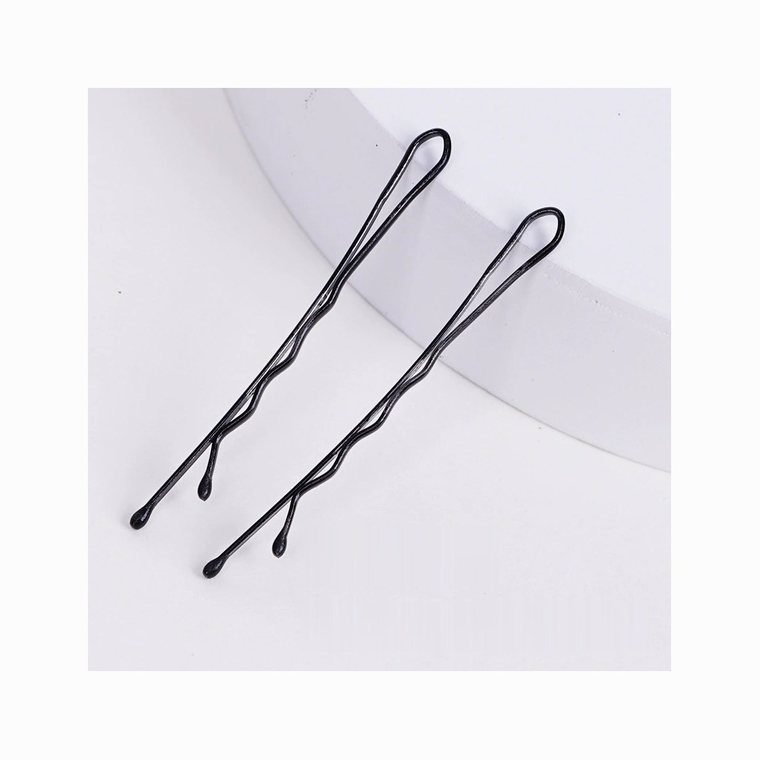
| Bobby pin (kirby grip) | 45, 50, 63, 75 mm | 0.6-0.8 mm spring wire, one piece, coated | USD 0.005-0.015 |
| Alligator sectioning clip | 45, 60, 90 mm | PP or ABS body, 0.7-1.0 mm stainless spring | USD 0.03-0.09 |
| Double-prong clip | 70, 90, 110 mm | PP body, two prongs, one spring | USD 0.04-0.10 |
| Claw clip | 60, 85, 110 mm | ABS body, 1.2 mm spring, often matte finish | USD 0.10-0.35 |
Bobby pins are a metal product. The other three are plastic products with a metal spring, which is why they can carry a Pantone colour and a logo. If your range needs to look like one family on the shelf, that difference decides which items you can brand and which you can only card. Our hair accessories range is built around that split: moulded plastic where colour matters, wire where holding force matters.
Wire Gauge and Temper: What Sets Holding Force
Grip is not a function of how strong the clip looks. It is wire diameter multiplied by temper, applied over the length of the leg.
Diameter
Bobby pins in the trade run 0.6, 0.7 and 0.8 mm. A 0.6 mm pin holds fine hair and disappears in an updo; a 0.8 mm pin holds coarse or dense hair but leaves a visible ridge and costs 15-20% more in wire. Most retail cards sit at 0.65-0.7 mm because that is the compromise the market has already voted for.
Temper
Wire arrives annealed, is formed, then heat treated at roughly 260-320°C for 30-90 minutes depending on diameter, then quenched. Skip or shorten that step and the pin opens wide after a few dozen uses. It is the most common difference between a USD 0.006 pin and a USD 0.011 pin. Ask for the temper condition on the wire certificate, not just the diameter.
Geometry and tips
The crimp near the tip is what keeps the two legs parallel. A pin without a proper crimp twists, and a twisted pin scratches. Ball tips are rolled, not dipped; a dipped tip adds 0.1-0.15 mm and often cracks at the seam, which is exactly where rust begins. For plastic-bodied clips the equivalent detail is the tooth profile: 1.5-2.0 mm teeth at 3-4 mm pitch hold a wet section, while a wider 5 mm pitch releases cleanly and suits dry styling.
Stylists section with a rat-tail comb and pin with the clip, so the two are bought together. If you are building a sectioning kit, match the comb tail diameter to the clip opening: a 6 mm tail with a 45 mm clip is a faster combination in the hand than a 9 mm tail with a 90 mm clip.
Coatings, Salt Spray and What Each One Costs
Coating is where the quotation varies most and where buyers ask the fewest questions. Neutral salt spray hours to first red rust is the only comparable figure; rustproof is not a specification.
| Finish | Typical thickness | Neutral salt spray to red rust | Cost vs plain wire |
|---|---|---|---|
| Bright nickel electroplate | 3-8 µm | 24-48 hours | +8-15% |
| Black nickel or gunmetal | 3-6 µm | 24-36 hours | +12-20% |
| Epoxy powder coat | 40-80 µm | 96-200 hours | +15-25% |
| Electrophoretic (E-coat) | 15-25 µm | 72-120 hours | +12-18% |
| Brass base with clear lacquer | 0.5-1.5 µm lacquer | 48-96 hours | +20-30% |
| Stainless 304, uncoated | none | No red rust; may tea-stain | +40-70% wire cost |
Two practical notes. Powder coat is the right answer for black retail pins sold in humid markets, because 40-80 µm is twenty times the barrier of nickel, and it hides the tooling marks that a bright finish magnifies. Stainless is not automatically better either: it does not rust red, but it tea-stains in chlorine and it is softer than tempered carbon wire at the same diameter, so a 0.7 mm stainless pin feels weaker than a 0.7 mm coated carbon pin. If a buyer asks for stainless so it never rusts, quote 0.8 mm stainless and explain the diameter change.
For plastic bodies the coating question becomes a colour question: masterbatch is stable across a run, painted bodies are not, and the shift shows up where two shipments sit side by side. Where a brand needs an exact match we run to a Pantone reference and keep a retention sample, part of our standard OEM service.
Card Packaging: Board, Euro Slot and Shelf Reality
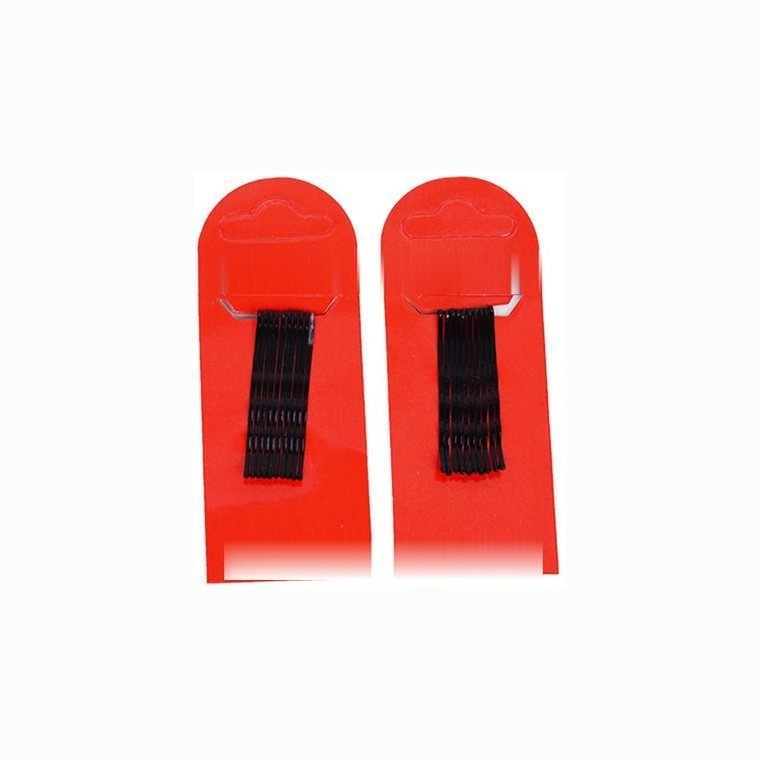
Carded clips are a different product from bulk clips, not a packing option. The card is the only part the shopper reads, and it is the part that fails first in a warehouse.
Board
Use 300-350 gsm coated-one-side board at 0.4-0.5 mm. Below 300 gsm the card curls at the hang hole once humidity passes 65%, and the whole card hangs crooked on the peg. Above 400 gsm is stiffness the pegboard does not need.
Hang feature
A euro slot is 6 x 15 mm punched, or a 12.7 mm round hole with a reinforced patch for heavier cards. Both need 8-10 mm of clear board above the cut; a slot punched 3 mm from the top edge tears on the first pull.
Fixing the product
Three methods, in ascending cost: adhesive dot, staple through the crimp, or a PVC blister welded to the card. Staples are the most common and the most abused – one staple instead of two lets the pin rotate and scratch the print. Specify two staples 15 mm apart and check it on arrival.
Print and data
Four-colour process plus one spot colour covers most retail cards. A plate or digital setup charge of USD 60-120 is normal and one-off; it should not reappear on the second order. Barcodes must be EAN-13 or UPC-A supplied by the buyer with the correct GS1 prefix – a factory that generates a barcode for you is generating someone else’s number. For Amazon sellers the card also needs the FNSKU label position agreed before printing, which is covered in our FBA packaging checklist.
Carton, Weight and Freight per 1,000 Pieces
Clips are light, so freight is a smaller share of landed cost than for wig stands – but the carded version changes the maths enough to matter on a thin-margin item.
A 50 mm bobby pin weighs 0.6-0.65 g. Ten thousand pieces is about 6.3 kg of steel before packaging. Bulk packed 1,000 per poly bag, 10 bags per carton, a 48 x 33 x 26 cm carton runs 0.041 CBM at 8.5 kg gross. That is 244 kg per CBM, so LCL charges on volume rather than weight, and a 40HQ at roughly 62-65 CBM usable takes about 1,500 cartons, or 15 million pins.

Carded goods invert the ratio. A 24-piece card at 250 cards per carton is 6,000 pins: about 3.7 kg of steel, 0.6 kg of board, 0.0269 CBM, roughly 4.5 kg gross. Per 1,000 pieces that is 0.0045 CBM against 0.0041 CBM for bulk, about 10% more volume. The problem is labour: hand-carding runs USD 0.04-0.08 per card, so a 24-piece card carries USD 0.07-0.12 of steel, USD 0.006-0.012 of board and more labour than material. That is why a carded 24-piece pack quotes at USD 0.16-0.28 FOB while 24 loose pins quote at USD 0.12-0.24. You are buying hands, not steel.
At a typical 2026 LCL rate of USD 100-140 per CBM to a US or EU port, freight adds USD 0.41-0.57 per 1,000 bulk pins and USD 0.45-0.63 per 1,000 carded pins. On USD 6-15 of goods value per 1,000 pieces that is 5-10% of FOB, worth modelling but not worth optimising before you have fixed the coating. Carton grade matters more than most buyers expect: ECT-32 board under 10 kg, ECT-44 above, and no more than 12 cartons per pallet layer if the cards are not to crush. The loading arithmetic for a mixed container is set out in our container loading guide.
MOQ, Size Mix and Structuring a First Order
Our MOQ is 1,000 pieces per size and finish, and 1,000 cards for carded items. That is low enough to test a market and high enough to cover a coating run: a plating or powder line does not start for 300 pieces.
The mistake on a first order is spreading 1,000 pieces across eight SKUs. Four sizes at 250 pieces each means four setups, four labels and four near-empty cartons, and the per-piece price rises 10-15% for reasons that have nothing to do with the factory margin. A better first order is three sizes in one finish at 1,000 each, plus one carded SKU to test retail. That gives you a real shelf test and a clean reorder.
Lead time is 20-30 days for bulk and 25-35 days for carded, of which card printing is 7-10 days and cannot be compressed by paying for it. Samples take 5-7 days and ship by courier for USD 35-60. If you need to move before Chinese New Year, order by the end of November: factories in Henan typically stop 10-20 days before the holiday and run at 60-70% capacity for two weeks after. Seasonality around Black Friday and cosplay season is covered in our salon bulk buying guide.
Five Incoming Checks Worth Twenty Minutes
You cannot test temper without a lab, but you can catch the failures that cause claims.
- Count by weight. Weigh 1,000 pieces on a kitchen scale. A 50 mm pin at 0.62 g should come to 620 g plus or minus 3%. A 5% short count shows up immediately.
- Gauge ten pins. Caliper at the straight leg, not at the tip. A 0.7 mm pin reading 0.64 mm is 0.6 mm wire sold as 0.7.
- Cycle test. Open and close ten clips fifty times while filming. Measure the jaw gap before and after. More than 1 mm of permanent set means the temper is weak.
- Snag test. Drag a cotton pad along the inner edge of twenty clips. Any fibre pulled is a burr, and a burr will find a customer’s hair.
- Soak test. Leave five pins in warm salt water for 24 hours, dry them, and look at the tips the next morning. Rust at the ball tip means the coating is under 3 µm whatever the certificate says.
Run these before you approve the balance payment, not after the container lands. Photograph the results with the carton label in frame and send them to the factory: a supplier who sees an organised buyer behaves differently on the second order.
Two Things to Do This Week
First, write the specification into the purchase order: wire diameter and temper condition, coating type and minimum thickness, salt spray hours, count per card, board weight, staple count. A PO with six numbers on it removes most of the argument that follows a bad shipment.
Second, ask the factory who actually cards the product. If the answer is a third-party workshop across town, your quality control ends at the door of a building you have never seen. We mould, assemble, card and pack under one roof in Xuchang – send us your clip specification and we will quote those six numbers back to you. If you want to see the lines before ordering, the factory page shows the moulding floor and the packing area, and shipping and export covers the documents for a first container.
Related reading
- Salon and barber bulk buying guide — what a salon chain should stock, and where the savings actually sit.
- Wholesale guide for African and Middle East markets — container sizes, packaging expectations and payment norms.
- MOQ, lead times and pricing explained — how minimums are set and what moves the unit price.
Leave a Reply