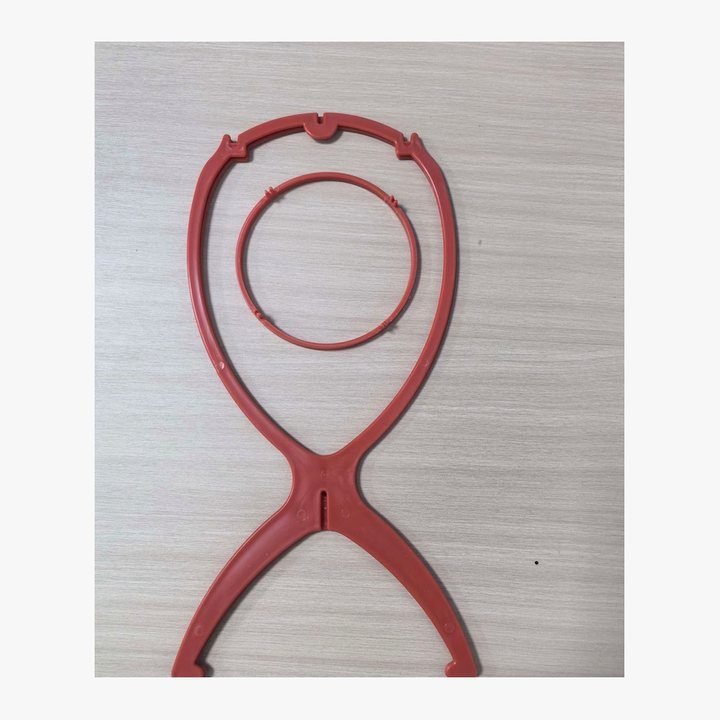
A buyer approves a Pantone chip on a Tuesday, places 3,000 pieces, and six weeks later opens a carton of red foldable wig stands that read like tomato soup next to the chip still taped to their desk drawer. Nothing is broken. Nothing is out of dimension. The parts were moulded on the same tool that produced the sample. And yet the argument that follows lasts three weeks, because the purchase order said “red, as approved” and nothing else — no tolerance, no light source, no measured value.
Colour is the most common reason a first production run gets argued about, and almost every one of those arguments traces back to the same gap: the buyer wrote a colour name, the factory matched a chip, and neither side defined what “match” means in numbers. This article covers what happens between a Pantone number and a moulded part — masterbatch, let-down ratio, resin base — then gives you the clauses, tolerances and approval steps to write into a PO. All figures are typical ranges from commodity injection moulding, not guarantees for a specific part.
Why colour fails before dimensions do
Dimensional faults are self-evident. A stand that will not seat on a table, a comb whose teeth snap at 12 mm — these fail on contact, in front of the buyer, and the factory cannot argue. Colour is structurally fragile in three ways.
It is judged against a reference in a different material. A Pantone chip is ink on coated paper. Your part is pigmented thermoplastic. The two will never be identical, and the gap is physics, not a defect. If the PO treats the chip as an absolute target with zero tolerance, every shipment is technically non-conforming.
It is judged under whatever light happens to be on. The same part that matches under a north-facing window at 10 a.m. can look two ΔE units off under a warm LED in a beauty supply aisle. Buyers and factories routinely measure this and then argue about it without comparing notes on the light source.
It drifts in ways nobody records. Resin lot, masterbatch lot, regrind percentage, melt temperature, mould temperature, cycle time — each shifts the final colour a little. Over 10,000 pieces you get several batches. If nobody keeps a retained sample per batch, you have no evidence either way.
The fix is a written colour specification with a number in it, plus an approval chain that produces physical evidence at three points.
What “Pantone matched” actually means in injection moulding
There is no Pantone mixing vat at the moulding machine. Colour arrives one of three ways, and which one you get determines both accuracy and minimum order.
Pre-compounded resin
The compounder pellets the base resin with pigment already dispersed, and the moulder buys finished colour in bags. Accuracy is the best of the three routes and lot-to-lot consistency is tight, because the compounder controls dispersion. The cost is compounder minimums — commonly 300–500 kg per custom shade. For a foldable wig stand in the 55–70 g range, 300 kg is roughly 4,300–5,400 pieces. That is why a genuinely custom colour often implies a larger quantity than the 1,000-piece MOQ.
Masterbatch at let-down
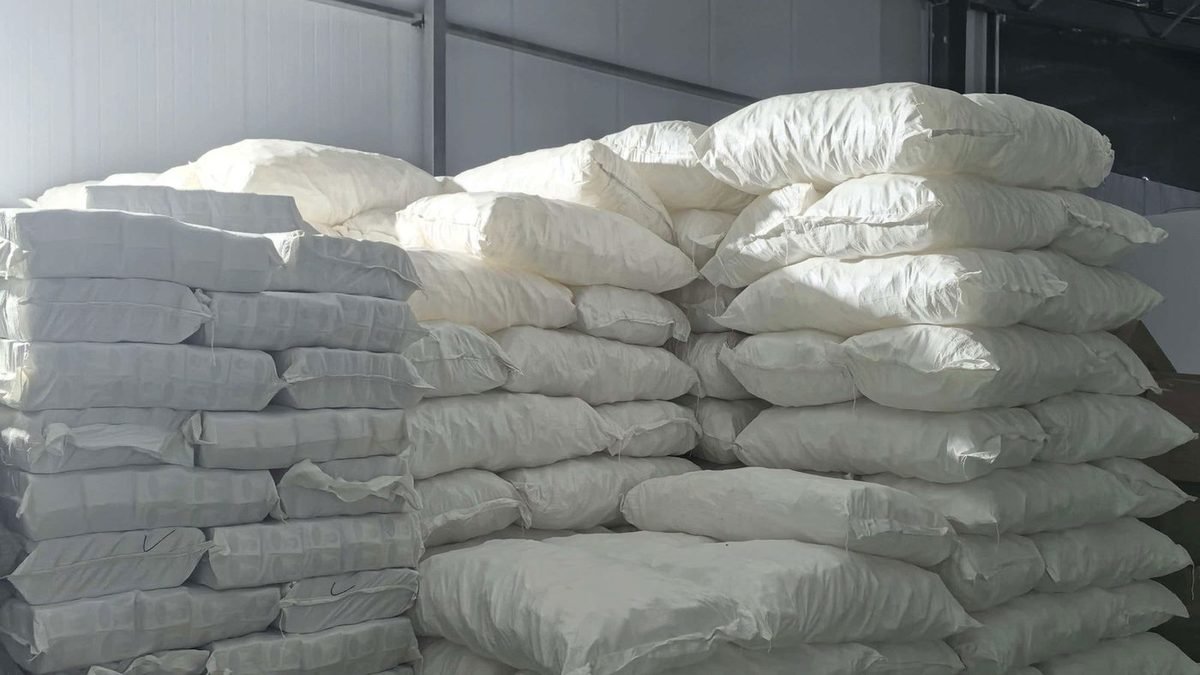
The moulder buys natural resin plus concentrated masterbatch and doses it at the throat, typically 2–4% by weight for solid colours and 1–2% for tints. This is how most hair accessory production runs: one 25 kg sack at 3% let-down covers about 830 kg of resin — enough for well over 10,000 stands — and the same sack serves several products in one colour family.
The trade-off is dosing error. A gravimetric feeder holds dose to roughly ±1%. A volumetric feeder on a short run can wander 5%, and a five percent swing in pigment load shows on light shades long before it shows on black.
Dry colour powder
Pigment powder tumbled with natural pellets. Cheapest and fastest, least consistent — streaking, plate-out on the mould, colour that shifts with tumbling time. Fine for a short promotional run in a dark colour, poor beside a printed colour card on a shelf.
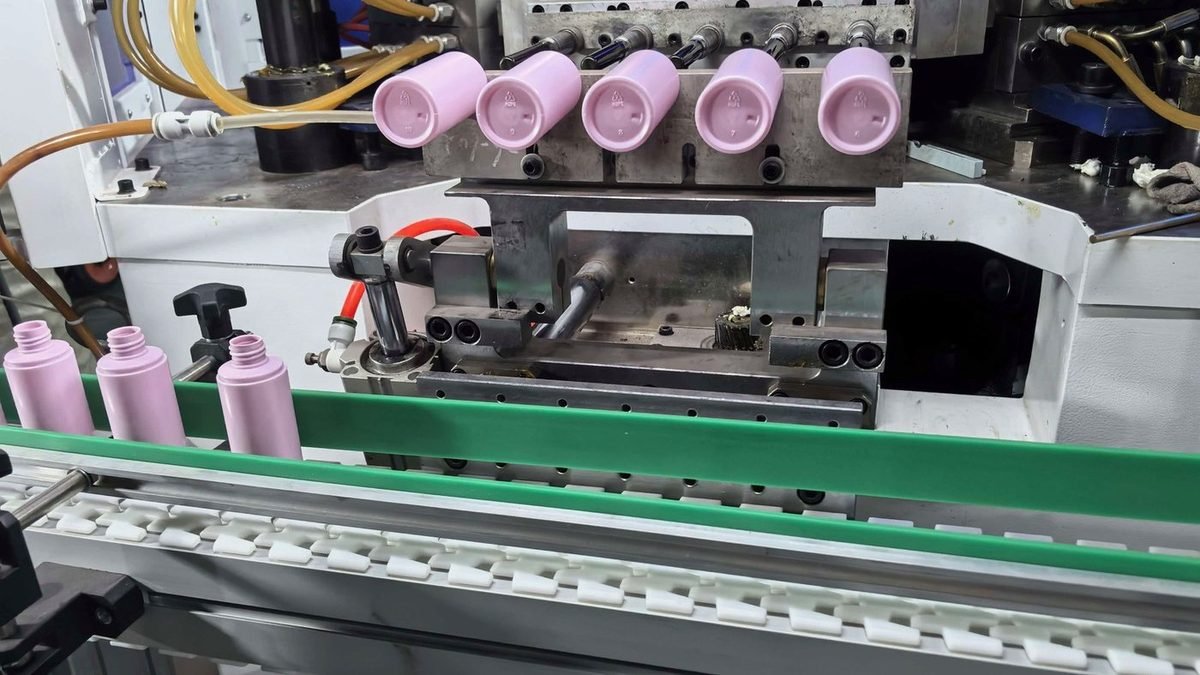
When a supplier says “Pantone matched”, ask which of the three routes they will run. On our own line it depends on volume and shade depth, and it is written into the quotation rather than decided at the machine. Resin choice also shifts colour before pigment is added: natural PP is translucent and slightly yellow, natural ABS is cream, and identical masterbatch dosing produces visibly different results. We cover that in the PP vs ABS vs glass-filled PP comparison.
Write the colour target into the PO: ΔE, light source, geometry
A colour clause that survives a dispute has four parts. Missing any one hands the argument to whoever is louder.
1. The tolerance, as a number. Use ΔE00 (CIEDE2000), not ΔE*ab — the older formula overweights differences in saturated blues and reds and lets a visibly wrong red pass. Typical acceptance bands in consumer plastics:
| ΔE00 target | Where it fits | What it means in practice |
|---|---|---|
| ≤ 1.0 | Tight, brand-critical | Trained eye cannot separate the parts side by side. Expect a matching fee and a pre-production plaque. |
| 1.0 – 2.0 | Normal retail standard | Slight shift, visible only with parts held together. Sensible default for hair accessories. |
| 2.0 – 3.0 | Utility, bulk, giveaway | Same colour family, clearly not the same shade. Acceptable only if written into the order. |
2. The light source. Specify CIE D65 (6500 K daylight) as primary and add a second source for a metamerism check — CIE A (2856 K incandescent) or F11 (triphosphor fluorescent, close to retail lighting). Metamerism is where two samples match under D65 and split under shop light. It is common when one side is a paper chip and the other pigmented plastic, and it cannot be fixed after moulding.
3. The instrument geometry. A 45/0 or integrating-sphere d/8 spectrophotometer, and — the clause most buyers omit — whether the reading includes specular reflection (SCI) or excludes it (SCE). The two modes differ by several ΔE units on a glossy part. Pick one and require the same mode from both sides.
4. The physical standard. A moulded plaque in the actual resin at the actual texture, signed and dated by both parties, cut into three: one for the factory, one to the buyer, one sealed in the file. Not a paper chip. A paper chip is a starting point; the plaque is the contract.
Where batch-to-batch variation actually comes from
Resin lot
Natural PP from different lots carries slightly different haze and yellowness index. On a white or pastel part this shows as a half-unit ΔE drift with no process change at all. Factories that run light colours seriously hold one resin lot for the whole order rather than topping up mid-run.
Masterbatch lot and dose
Masterbatch itself varies by lot, typically less than resin but not zero. Dose error compounds it: at 3% nominal, a feeder running 2.85% shifts a mid-tone by roughly one ΔE. Gravimetric dosing matters more on pastels than on black.
Regrind
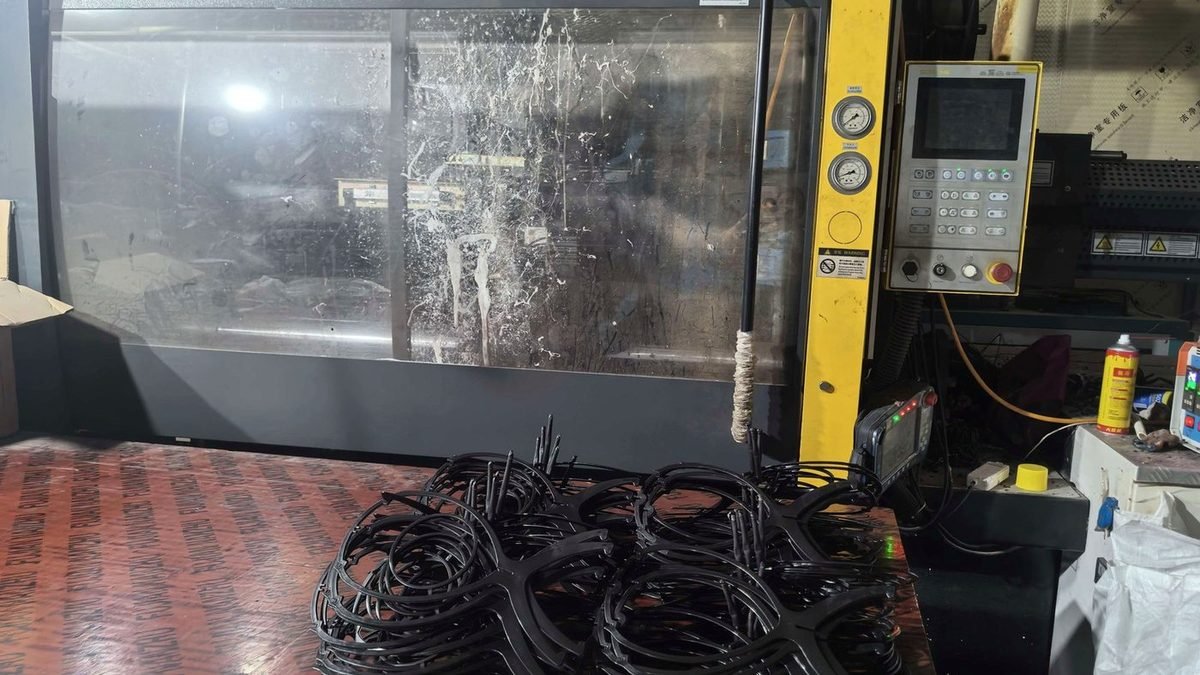
Runners and rejects get ground and fed back. Regrind carries heat history, so it darkens and dulls, and the effect is non-linear — the first 10% costs almost nothing visually, 30% is obvious. Cap regrind at 15–20%, same colour and same resin; mixed-colour regrind muddies a clean pastel fastest.
Melt temperature, mould temperature, cycle
Higher melt temperature improves dispersion and can deepen a shade. Mould temperature changes surface gloss on PP, and a gloss change reads as a colour change to the eye even when the spectrophotometer disagrees. A 10 °C drift on a textured part is enough to make two batches look different in a photo. Quicker cycles also leave PP less crystalline and slightly more translucent, which is a real effect on thin-walled parts like comb spines.
None of these can be eliminated. All of them can be bounded and documented per batch, which is what turns a complaint into a measured conversation.
The approval workflow that prevents disputes
Three physical checkpoints, each producing something you keep. Skip one and you are relying on memory.
Stage 1 — colour plaque, before the tool runs
The factory moulds flat plaques, typically 75 × 100 mm at 2 mm nominal wall, in the specified resin and masterbatch. Three to five pieces. You approve against D65 and sign. Cost is usually absorbed or charged as a matching fee in the USD 80–150 range; timing is 5–10 working days including masterbatch delivery. Do this before mass production — a plaque that fails costs a fee, a production run that fails costs a run.
Stage 2 — first-off samples from the production tool
Plaques and moulded parts are not the same surface. Tool texture, draft and wall thickness all change how light leaves the part. First-off samples — 5–10 pieces pulled from the first hour, before packing — are the real approval point. Measure them, photograph them beside the signed plaque under the same lamp, and keep both.
Stage 3 — per-batch retention
For any order spanning more than one production batch, retain two pieces per batch, labelled with date, machine, resin lot and masterbatch lot, held for at least 24 months. This is the cheapest insurance in the whole process. When a buyer reorders in month 14 and says “this is not the same red”, the retained samples answer in ten minutes instead of ten emails.
Ask for the batch record alongside the inspection report. If a supplier cannot say which resin lot went into which carton, they cannot control colour — they can only hope.
Gloss, texture and the light the product will live under
Two parts can measure identically and look different, because gloss and texture change how much light returns to the eye. A high-gloss red reads deeper and more saturated; the same colour at SPI B-2 or a matte texture reads lighter and flatter. If your plaque is glossy and your production part is textured, you approved the wrong reference.
This matters for hair accessories because the product ships into three contexts at once: a printed colour card, a marketplace photograph, and a shelf under store lighting. A shade that matches the card under D65 but shifts under F11 looks wrong on the shelf while passing every measurement. Approve the plaque at production texture, under both lamps — five minutes, no cost.
What custom colour costs, and the real minimum
Colour is rarely a large line item, but the cost is front-loaded and it is not where buyers expect it. Typical structure for a 1,000–5,000 piece run:
| Cost item | Typical range | Notes |
|---|---|---|
| Colour matching fee | USD 80–150 one-off | Often waived on a repeat order; ask rather than assume |
| Masterbatch, 25 kg sack | USD 6–15 per kg | Driven by pigment chemistry, not by part size |
| Per-piece colour premium | USD 0.01–0.04 | At 1,000–5,000 pcs; falls sharply above 10,000 |
| Machine purge between colours | 30–60 min, 5–15 kg resin | Why four colours in one run costs more than sequential runs |
| White specifically | +USD 0.01–0.03 vs mid-tones | Opacity needs 4–8% TiO₂ and hides nothing — the hardest shade to hold |
The 1,000-piece MOQ applies to the part, not the colour. A custom shade on 1,000 pieces is workable when the masterbatch minimum can be spread across future orders or shared with another product in the same colour family — a red stand, a red storage box and a red sectioning clip can draw from one sack. If a shade is single-use and low volume, the honest answer is either raise the quantity or pick from a running colour range. On standard colours we hold stock, which is what makes sub-1,000 trial orders realistic; on a bespoke shade the trade-off is 7–12 extra days for masterbatch.
Colour continuity across repeat orders
Second orders are where colour quietly breaks. The masterbatch sack is finished, the compounder’s lot has changed, a different machine runs the job, and nobody compares the new parts to the old ones because both look red.
Three cheap habits prevent it. Keep the signed plaque as a permanent standard, not a one-off approval — pull it out at the start of every repeat run. Record the masterbatch supplier, code and let-down ratio on the batch card, so a repeat order reorders the same input instead of rematching. And when retained sample and new batch disagree, measure before concluding: a ΔE reading separates a supplier problem from a lighting problem.
Where a shade is tied to brand identity — a salon chain’s signature colour, a private label line sold beside printed packaging — fix the masterbatch code in writing on the specification sheet. That one line converts colour from a verbal understanding into a controlled input. The wider sequence, including how colour sits alongside card, blister and barcode decisions, is in our private label walkthrough.
What to send us, and what to check before you sign
Sourcing custom colour on wig stands, combs, spray bottles or clips comes down to a Pantone number plus four facts: resin (PP or ABS), surface finish (gloss, matte, textured), the light source you will judge under, and quantity per colour. Send those and the colour question is answerable in a day. Our OEM and ODM service runs Pantone matching, masterbatch sourcing and plaque approval as a standard step, not an extra, and the factory page shows the moulding and tooling setup the colour runs on.
Before you sign the PO, check five lines are present:
- A ΔE00 tolerance with a number in it, plus the instrument mode (SCI or SCE).
- A named light source for approval, and a second source for a metamerism check.
- A physical plaque standard in the production resin at the production texture, signed and dated.
- A regrind cap, stated as a percentage.
- A per-batch retention requirement, with the retention period in months.
Five lines, roughly forty words. They will not make colour perfect — nothing does — but they turn the conversation from “this looks wrong” into “this measures 2.4, the limit was 2.0, here are the retained samples”. That is a conversation with an ending. Start with the foldable wig stand range to see how colourways are quoted in practice, or browse the full product catalogue for the parts most often ordered in custom shades.
Related reading
- OEM vs ODM: which is right for your brand — who owns the tool, who carries the design risk, and what changes at MOQ.
- Private label, step by step — artwork, approvals and carton marks, and what holds a launch up.
- Tail comb vs rat tail comb — tooth profile, taper and finish, and what each type costs to make.
Leave a Reply