Most wig stand orders that go wrong do not go wrong on price. They go wrong on height. A buyer collects three quotations, picks the lowest unit cost, and then finds out that a 45 cm stand will not fit the shelf spacing in a beauty supply store, or that the export carton is 5 cm taller than the one the forwarder quoted — which quietly removes 8,000 pieces from a 40HQ container. The stand is still a perfectly good stand. The order just stopped making money somewhere between the quotation and the loading dock.
This guide works through the numbers that decide a wig stand order: the four heights that cover most wholesale demand, base diameter against cap circumference, wall thickness and part weight, carton geometry and its effect on CBM, board grade for export, and a worked landed-cost comparison between a 30 cm and a 45 cm stand. Every figure below is a typical range taken from our own moulding and packing floor in Xuchang, Henan, China — not laboratory data. Treat them as the starting point for a quotation, then confirm each one against the sample you receive.
Worth fixing the sequence before the numbers: selling environment first, then height, then shape, then price. A stand is mostly air — 70–80% of the volume it takes up in a container is empty space around a thin moulded shell — so two models that look identical on a product photo can differ by 26% in carton volume and by more than USD 0.10 per piece in ocean freight. Buyers who work price-first usually re-order at a different height within two seasons.
The four heights that cover most wholesale wig stand orders
Four heights account for the large majority of volume across the orders that pass through our floor. They are worth knowing because they map onto four retail contexts, and because tooling already exists for all of them — no mould cost, and a 20–30 day production lead time instead of 45–60.
30 cm (12 in) — countertop and shelf display
The volume seller. Base diameter typically 12–14 cm, part weight 95–115 g in a one-piece PP moulding, packed 40 pieces per 60 × 40 × 40 cm carton. FOB for 1,000–5,000 pieces usually lands at USD 0.55–0.75 depending on colour and packing. It suits short caps, hairpieces and clip-in sets, and it is the height most Amazon and TikTok Shop sellers start with, because the carton is small enough for FBA prep without dimensional weight penalties.
35 cm (13.8 in) — the salon worktop compromise
Slightly taller than the countertop model, still stable on a narrow shelf. Weight 110–130 g, and the extra 5 cm of stem is usually enough to keep a 20-inch cap off the table during styling. If a buyer cannot decide between 30 and 40 cm, 35 cm is the safe middle: it photographs well and still ships at a reasonable CBM.
40 cm (15.7 in) — desktop display for longer caps
Common in wig shops and salon retail areas where the stand is meant to be seen rather than stored. Base diameter moves to 15–17 cm to keep the taller centre of gravity stable, weight 125–150 g, and cartons are typically 60 × 45 × 45 cm holding 30 pieces. Expect USD 0.95–1.35 FOB for a foldable version at 1,000–5,000 pieces.
45 cm (17.7 in) — floor and showroom
The display height for long straight caps, cosplay pieces and showroom windows. Base diameter 16–20 cm, weight 140–175 g, 24 pieces per 60 × 45 × 45 cm carton. Foldable versions with a locking hinge usually quote at USD 1.45–1.90 FOB. This is the height where freight starts to hurt, and the next two sections explain exactly how much.
Base diameter and cap circumference: the fit numbers buyers skip

A wig stand is not a head form and does not need to match cap circumference the way a canvas block does. What the base has to do is resist tipping while a wet cap is combed or styled.
The working rule on our floor: base diameter should be at least 22–26% of the cap circumference the stand will carry. A 58 cm cap (about 22.8 in, near the top of the common 54.6–58.4 cm range) needs a base of roughly 14 cm minimum; a 54 cm cap can sit on 12–13 cm. Below that ratio the stand tips when a wet 24-inch cap is pulled sideways during detangling, and the customer blames the product rather than the sizing decision.
Height and base have to be chosen together: a 45 cm stem on a 12 cm base is a lever waiting to fall over, while the same stem on an 18 cm base is stable but weighs 15–20% more. The pairing we quote most often is 30 cm / 13 cm, 35 cm / 14 cm, 40 cm / 16 cm and 45 cm / 18 cm. If your market skews to long, dense caps, go one base size up rather than one stem size up.
Shape selection: five moulds, five different jobs
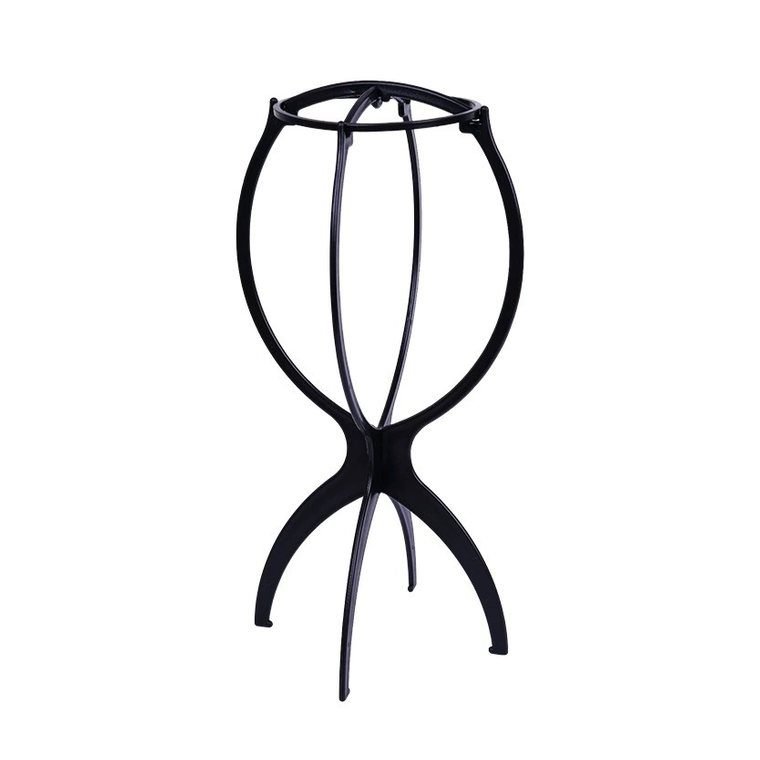
Height gets the order; shape gets the re-order. Each configuration carries a different cost and handling consequence.
- Classic one-piece (GP-WS01). No hinge, no assembly, lowest unit cost and the most durable, because there is nothing to break. Best for high-volume retail and market stalls. Downside: it occupies full volume in the carton, so you pay for air.
- Ventilated hollow (GP-WS03). Wall pierced with 8–12 mm openings so air moves through the crown. Drying time for a washed cap is typically 30–40% shorter than on a solid stand, which matters for salons running several washes a day. The core needs slides, so mould cost is higher; unit price at 1,000+ pieces is close to the classic.
- Draining (GP-WS09). A channel and drip point at the base so water runs off instead of pooling at the crown. Used by salons that wash and dry on the same stand. Usually 10–15 g heavier than the equivalent classic.
- Foldable (GP-WS06). Hinged legs collapse to a 45–60 mm stack, cutting carton volume by roughly 55–65% against a one-piece stand of the same height — the single biggest freight lever available. Living hinge or pin joint, both moulded in-house.
- Detachable (GP-WS05). Crown and base separate completely. Similar volume saving to the foldable, and a distributor can ship replacement bases separately. Higher assembly labour, so it prices 5–10% above the foldable.
For a first order the foldable is usually the right default: it protects margin on freight and survives parcel handling better than a tall rigid stand. Salons tend to prefer the ventilated or draining version once they have tried one, because the drying argument is operational rather than cosmetic.
Wall thickness and part weight: where cheap stands fail
Wall thickness on these parts typically runs 1.6–2.2 mm, with 1.8 mm as the working standard for a PP stand that has to survive repeated handling. Below about 1.6 mm, shrinkage at the hinge and at the base-to-stem transition shows up as stress whitening, and a folded stand opened and closed a few hundred times will crack at exactly that point.
Thickness is not the only way to get stiffness, and rarely the cheapest. Adding a rib costs 0.8–1.2 g of material; adding 0.2 mm of wall across a 40 cm stand costs 8–14 g. Ribs under the base and a 1.2–1.5 mm gusset at the stem transition give most of the rigidity for a fraction of the weight, which is why a well-designed 130 g stand can feel stiffer than a badly designed 160 g one. Ask for the rib layout, not just the wall thickness.
Material choice matters too. PP is the default: it takes a living hinge, resists salon chemicals and prices 8–15% below ABS at the same part weight. ABS gives a harder surface and takes electroplating, so it suits premium retail and metal-look finishes — but anything with a clip or hinge that flexes should stay PP, because ABS cracks rather than bends.
Carton geometry: how 5 cm of height moves your freight bill
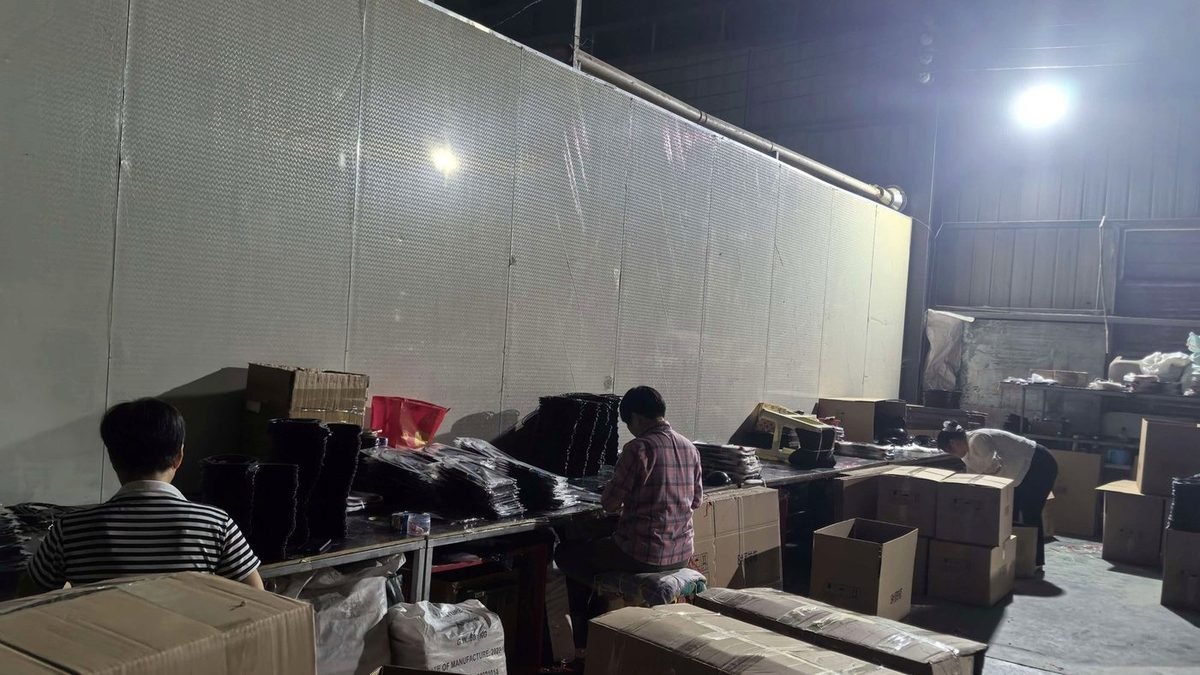
Carton dimensions are driven by part height plus 20–30 mm of clearance, and that clearance is where buyers get squeezed.
| Stand height | Pcs / carton | Carton (cm) | CBM / carton | CBM / 1,000 pcs |
|---|---|---|---|---|
| 30 cm | 40 | 60 × 40 × 40 | 0.096 | 2.40 |
| 35 cm | 36 | 60 × 42 × 42 | 0.106 | 2.94 |
| 40 cm | 30 | 60 × 45 × 45 | 0.122 | 4.05 |
| 45 cm | 24 | 60 × 45 × 45 | 0.122 | 5.06 |
Read the last column. Moving from a 30 cm to a 45 cm stand more than doubles the volume per thousand pieces — 2.40 CBM to 5.06 CBM, an increase of 111%. On a 40HQ with roughly 65 CBM usable after pallets and door clearance, that is the difference between about 27,000 pieces and about 12,800 pieces in the same container.
Now put a freight rate against it. At a typical USD 2,800 per 40HQ (rates have ranged from 1,800 to 4,500 in the past two years; use your own booking), ocean cost per piece works out at roughly USD 0.10 for the 30 cm stand and USD 0.22 for the 45 cm one. That USD 0.12 gap is larger than the entire moulding margin on some orders, and it is invisible on a quotation that only shows FOB unit price.
Two levers. First, foldable and detachable versions cut carton volume by 55–65%, pulling the 45 cm stand back toward 30 cm freight economics — usually the single best decision in the whole specification. Second, set carton length and width against the pallet footprint before optimising height: a 60 × 45 cm base fits a standard 120 × 100 cm pallet in a clean four-carton layer with no overhang, while a 65 cm length wastes 5 cm on every layer and adds a pallet per few hundred cartons. Our container loading guide works through the pallet arithmetic in more detail.
Board grade and inner packing that survive the last mile
A 45 cm stand in a single-wall carton is a dent waiting to happen. For export we specify ECT-32 board (32 lb/in edge crush) in BC double-wall at 6–7 mm caliper for anything above 35 cm. Single-wall ECT-32 is acceptable for the 30 cm stand if the carton is not palletised more than four high.
Three inner packing formats:
- OPP bag only. 0.03 mm bag, one stand per bag, no divider. USD 0.01–0.02 per piece, and adequate for market and wholesale channels where the carton is opened at the point of sale.
- Blister or clamshell. 0.5–0.8 mm PETG with a 300–350 gsm printed backing card. Adds USD 0.06–0.12 per piece and changes carton count by 10–20% because each unit takes more volume. Right for retail pegboard, wrong for e-commerce.
- Printed colour box. 300–350 gsm white card, four-colour print, barcode and hang tag. Adds USD 0.05–0.09 per piece and typically 8–12% to carton volume. The usual choice for Amazon and brand retail.
Drop testing: we run ISTA 1A-style 10-point drops at 76 cm on the packed carton before a first shipment. A carton that shows hinge cracking or base corner deformation after that test will not survive a parcel network, however good the pallet looks. Target breakage in transit is under 1.5%.
Worked example: 30 cm versus 45 cm, all the way to landed cost
Take a 10,000-piece order to a US West Coast warehouse, both versions foldable, both in printed colour boxes. Illustrative figures at typical ranges, not a quotation.
| Line item | 30 cm foldable | 45 cm foldable |
|---|---|---|
| FOB unit price | USD 0.68 | USD 1.62 |
| Part weight | 108 g | 158 g |
| CBM for 10,000 pcs | 24.0 | 50.6 |
| Containers needed (65 CBM usable) | 1 × 40HQ, 63% full | 1 × 40HQ, full |
| Ocean freight per piece at USD 2,800/40HQ | USD 0.103 | USD 0.216 |
| Duty at 8% (US, plastic hair accessories) | USD 0.054 | USD 0.130 |
| Approx. landed before inland | USD 0.84 | USD 1.97 |
The 45 cm stand costs 2.4× as much landed as the 30 cm one, while retailing at maybe 1.3–1.5× the price. That is not an argument against the 45 cm product — it is an argument for charging for it properly, and for not letting a 45 cm specification slip into a programme that was priced around a 30 cm stand. It also explains why so many importers settle on 35 cm as the volume SKU: most of the visual presence, roughly 60% of the freight. When comparing a USD 1.62 quotation with a USD 1.20 one, check wall thickness, hinge type and board grade before negotiating — the moulding is rarely the difference.
What to measure on the first article and on every reorder
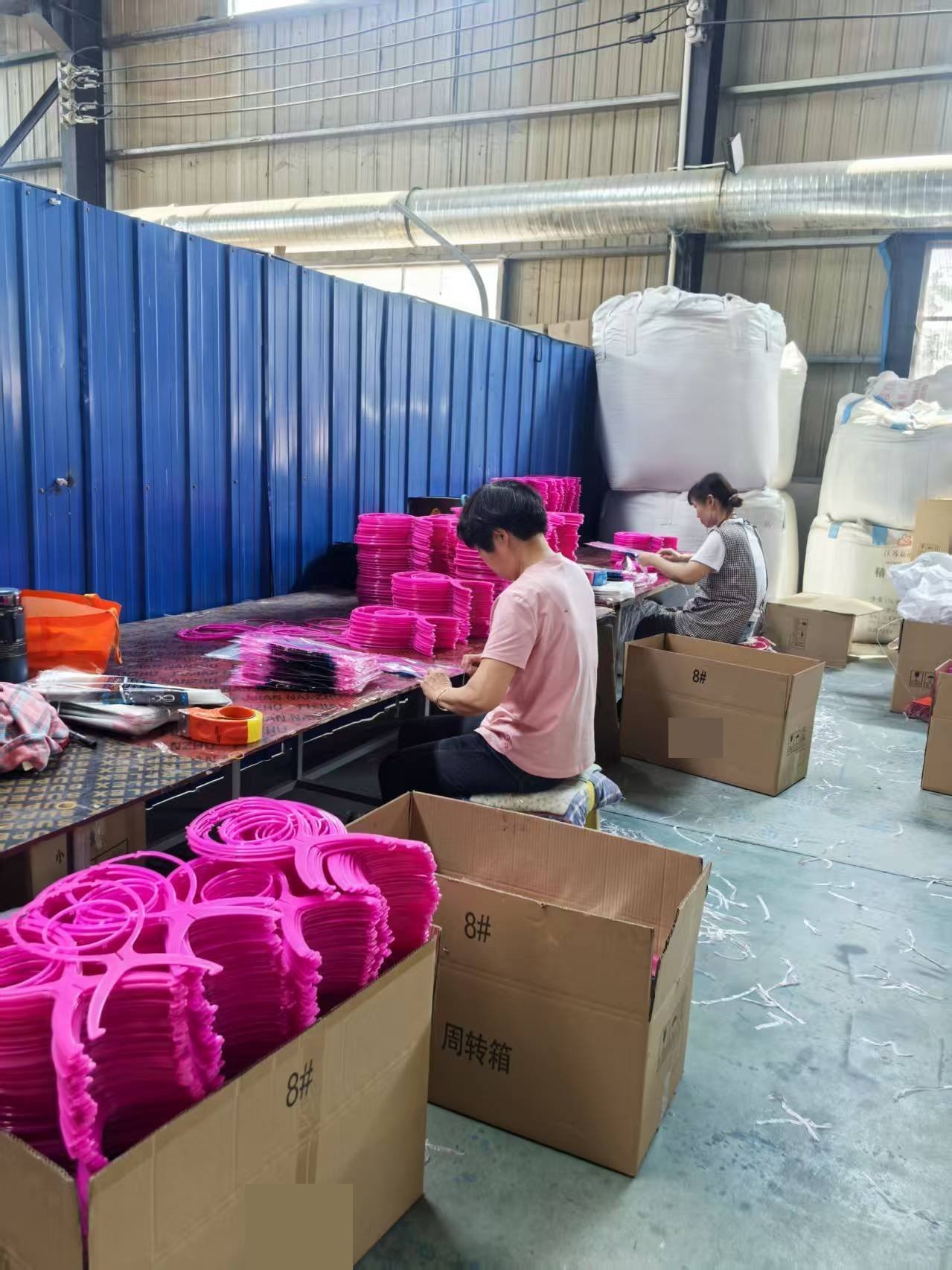
First-article inspection takes ten minutes and catches almost every problem that would otherwise become a claim. We record the following; ask for the same record with the pre-shipment photos:
- Overall height against drawing, tolerance ±1.5 mm. Drift of 3–4 mm is common when a mould runs hot, and it is enough to change carton count per layer.
- Base diameter at two points 90° apart, tolerance ±1.0 mm. Ovality above 1.5 mm means uneven cooling and usually predicts warping in later batches.
- Wall thickness with a calliper at six points — two on the crown, two at the stem transition, two on the base. Anything under 1.6 mm gets flagged.
- Hinge cycle: 5,000 open-close cycles is our in-house check for a living hinge. A pin-joint foldable should show no visible play after the same run.
- Colour against the retained master sample under D65 light, ΔE ≤ 1.5. Pantone matching on PP is achievable to about ΔE 1.0–1.5; promising ΔE 0.5 on a moulded part is a commitment nobody can hold across batches.
- Carton weight and dimensions, plus a check that the count matches the label. Miscounts of 1–2 pieces per carton are the most common packing error we see, and they cost the buyer a full recount at destination.
What to write into the purchase order
Most disputes on this product trace back to a purchase order that said “wig stand, 40 cm, white” and nothing else. One that holds up carries:
- Height and tolerance (e.g. 400 mm ±1.5 mm), base diameter and tolerance, and the model reference (GP-WS06 or equivalent).
- Material (PP homopolymer), minimum wall thickness, and part weight with a ±5% band.
- Colour reference — Pantone number plus “match retained sample, ΔE ≤ 1.5” — and the approved master sample date.
- Carton dimensions, pieces per carton, board grade (ECT-32 BC double-wall) and a marked carton weight.
- Inner packing format and material spec (0.03 mm OPP, or 0.6 mm PETG with 350 gsm card).
- Marking: shipping marks, barcode symbology and placement, country of origin printed as “Made in China”.
- Inspection terms: AQL 2.5 major / 4.0 minor, pre-shipment photos, and who pays for third-party inspection.
- Delivery terms with named port: FOB Ningbo or FOB Shanghai, and the allowed shipment window.
Two actions worth taking this week. First, put your three best-selling heights side by side and calculate CBM per 1,000 pieces for each — if one is above 4 CBM, a foldable version of the same height will probably pay for itself on the first container. Second, ask your supplier for the rib layout drawing alongside the wall thickness figure; it is the fastest way to tell a stand designed for 5,000 handlings from one designed to hit a price.
If you are still choosing between factories rather than between sizes, our guide to choosing a wig stand manufacturer covers the audit points, and the MOQ, lead time and pricing structure piece explains how volume bands are quoted. For sizes outside the four standard heights, our OEM and ODM service covers new tooling on our own moulds, with mould cost amortised or bought outright depending on the volume you can commit. The full stand range is on the products page, or send your cap sizes and target retail price through the contact form and we will come back with a specification and a carton calculation rather than a single number.
Related reading
- How to choose a wig stand manufacturer — the seven checks B2B buyers run before a first order.
- How to import hair accessories from China — documents, duty and the clearance sequence for a first shipment.
- MOQ, lead times and pricing explained — how minimums are set and what moves the unit price.
Leave a Reply