
Amazon FBA is the fastest route to the US market for a hair accessories brand, and the fastest way to lose margin if you get prep wrong. Charged prep fees, unsellable inventory flags and removal orders all trace back to a handful of packaging details that are decided at the factory — months before the cartons ever reach a fulfilment centre.
This checklist covers what Amazon actually inspects for wig stands, tail combs, spray bottles and sectioning clips, how the rules differ between small standard, large standard and oversize tiers, and where factory-direct prep beats a third-party prep centre on cost.
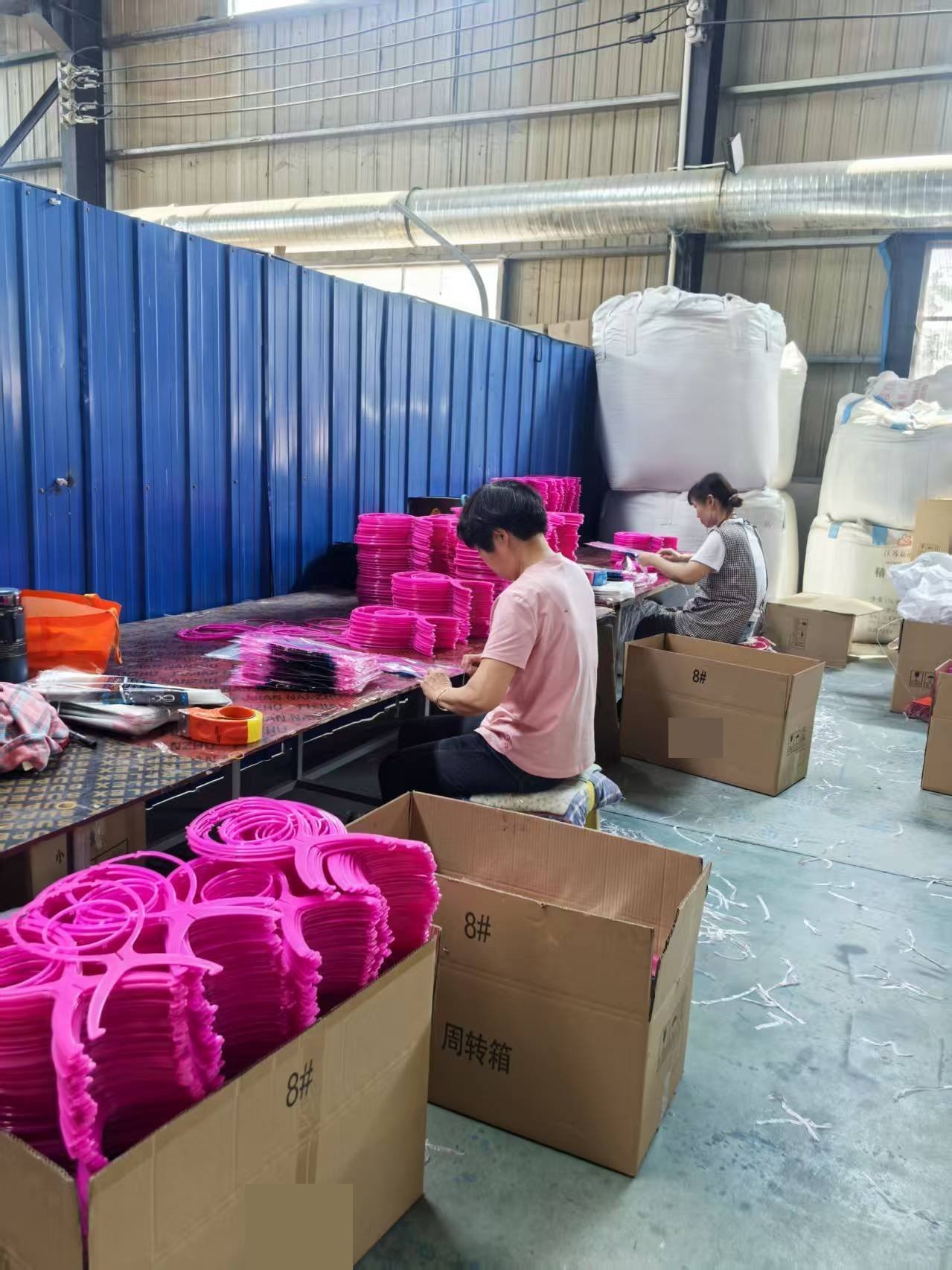
Why prep is a factory decision, not a warehouse decision
Every requirement in Amazon’s prep manual can be met two ways: your factory does it before the cartons are sealed, or a prep centre in the destination country unpacks, relabels and repacks them. The second option typically costs USD 0.80 to 2.50 per unit plus inbound freight to the prep centre, and it adds five to eight days. On a 1,000-unit order of wig stands that is real money, and it is avoidable.
The catch is that your factory has to know the requirements before production, because the poly bag size, the label position and the carton markings are all set at packing stage. Sending the prep spec with the purchase order is the whole trick.
Poly bag rules that trigger the most rejections
Bags are the single most common reason a shipment gets flagged. Four rules cover almost every case:
- Suffocation warning. Any poly bag with an opening of 5 inches (12.7 cm) or larger must carry the warning label, printed on the bag or on a label affixed to it. The wording is fixed — “Warning: To avoid danger of suffocation, keep this plastic bag away from babies and children. Do not use this bag in cribs, beds, carriages, or playpens.” A translated or paraphrased version is treated as missing.
- Bag thickness. At least 1.5 mil. Thin bags split in the fulfilment centre and the unit is marked unsellable.
- Barcode visibility. The FNSKU must be readable through the bag without opening it, and must not be covered by the warning label. On a 1,000-unit run, misplaced labels cost more to fix than the labels themselves.
- No combined bagging. Two units in one bag need to be a declared multipack with its own barcode, otherwise they are treated as unlabelled inventory.
Ask for the poly bag spec in the sample stage. A factory that already runs FBA accounts will have a standard bag with the warning pre-printed, which removes the labelling step entirely.
Labelling curved products: the wig stand problem
Wig stands are the hardest item in this category to label well, because the natural place to put a barcode — the flat base — is also the surface that sits on a shelf and gets scuffed. Two workable patterns:
- Base label, recessed. A 40 × 25 mm FNSKU label on the underside of the base, inside the recess so it does not contact the shelf. Works on round and tripod bases alike.
- Hang tag plus base label. A printed hang tag through the neck carries the retail barcode and brand story, while the base carries the FNSKU. Costs roughly USD 0.03 per unit and is what most private-label sellers end up with.
Do not wrap the label around the neck. Curved labels read badly for scanners and get flagged as unreadable, and on a foldable wig stand the neck joint flexes and peels the label off.
Carton requirements: weight, strength, markings
Amazon’s carton rules are stricter than general export cartons, and they are checked on arrival:
- 50 lb (22.7 kg) maximum per carton for standard-size items, unless the carton contains a single oversize unit. Wig stands packed 20 to a carton usually land between 12 and 16 kg — comfortably inside the limit, which is one reason this category ships well.
- Edge crush test of at least 32 ECT for cartons under 50 lb. A 5-ply carton is normal for export; a 3-ply carton that passes a domestic test will still crush in a container.
- No loose fill. Styrofoam peanuts and loose paper are rejected. Air pillows, moulded pulp trays or die-cut corrugated inserts are accepted.
- Carton label on two adjacent sides, 4 × 6 inches, with the shipment ID and box count. One label per carton is not enough.
- No mixed SKUs in a single carton unless the shipment is declared as mixed, which slows receiving and increases the chance of a count discrepancy.
If you are shipping to a fulfilment centre for the first time, ask for the carton marking template before production. Reprinting 200 cartons at the port is not a thing anyone wants to do.

Product-specific prep: what changes per SKU
Wig stands and foldable stands
The main risk is dimensional weight, not damage. A 45 cm stand in a 48 × 20 × 20 cm box moves into a higher size tier, and dimensional weight can exceed actual weight by 60 percent. Two fixes: ship the stand folded or knocked down where the design allows, and negotiate the box dimensions with the carrier’s DIM divisor in hand rather than after the first invoice.
Also confirm that the base has no exposed screw threads or sharp moulding flash. Amazon’s receiving inspection does not fail a unit for flash, but customers do, and returns on a low-ticket item wipe out the sale.
Spray bottles
Anything that holds liquid is treated as a leak risk. Empty bottles are the safe route: ship them dry, with the trigger head removed and bagged separately so it cannot actuate in transit. If you ship bottles pre-filled with water for demonstration, they need leak testing and absorbent packing, and many sellers simply remove the liquid rather than deal with it.
A continuous spray bottle also needs a rigid insert or a moulded tray, because the trigger is the part that breaks first and a broken trigger makes the whole unit unsellable.

Tail combs and sectioning clips
Small, light and high-count — this is where per-unit prep costs hurt most. A tail comb at 12 g does not need individual poly bagging if it is packed in a printed sleeve or a rigid blister, and skipping the bag removes both a cost and a rejection risk. The pointed tail should be capped or recessed in the insert; exposed points are a safety flag.
Clips and pins are usually sold as sets, which means a multipack barcode. Declare the pack count on the carton and on the listing — a “50 pack” that arrives as 50 loose units in one bag will be flagged.
Factory-direct prep vs a prep centre: the arithmetic
Run the numbers on a 1,000-unit order of foldable wig stands, FOB to a US fulfilment centre:
- Prep centre route: USD 1.20 per unit labelling and bagging, USD 350 inbound freight to the prep centre, five extra days. Total roughly USD 1,550 before the FBA inbound freight.
- Factory-direct route: the same labelling and bagging folded into the unit price at USD 0.15 to 0.30 per unit, no extra leg, no extra days. Total roughly USD 300.
The gap is over USD 1,200 on a single order, which on this category is often more than the entire freight bill. The only reason to use a prep centre is if the factory cannot meet the barcode spec — and that is a reason to change factories, not to pay a middleman.
Our OEM service runs FBA-ready packing as standard: pre-printed suffocation-warning bags, FNSKU labels applied to your artwork, and cartons marked to the Amazon template. If you are still deciding on packaging format, the private label guide covers artwork, dielines and approval timing.
Pre-shipment checklist
Send this to your factory with the purchase order. Every line is something Amazon inspects.
- Poly bag minimum 1.5 mil, suffocation warning printed, opening under 5 inches or warning present
- FNSKU on every unit, readable through the bag, on a flat or recessed surface
- Multipacks declared with their own barcode and pack count
- Carton under 50 lb, 32 ECT minimum, no loose fill
- Carton labels on two adjacent sides, 4 × 6 inches
- No mixed SKUs per carton unless declared
- Liquids drained, triggers bagged, rigid inserts on breakable parts
- One sealed carton photographed and sent for approval before the run finishes
That last line does most of the work. A photo of one finished, labelled, sealed carton catches almost every prep error while there is still time to fix it, and it costs nothing.
Where this fits in the shipping plan
FBA prep is one leg of a longer chain. If you are still working out how the cartons travel — sea freight versus air, DDP versus FOB, port to fulfilment centre — the shipping and export page covers the modes and the documents, and the container loading guide gives you the carton maths to price the freight before you commit to a quantity. Get the prep and the loading right at the same time and the landed cost stops being a surprise.
Related reading
- Salon and barber bulk buying guide — what a salon chain should stock, and where the savings actually sit.
- MOQ, lead times and pricing explained — how minimums are set and what moves the unit price.
- Private label, step by step — artwork, approvals and carton marks, and what holds a launch up.
Leave a Reply